Antwerp No. 3 / Amberes / Antwerpen / Anvers
Assumed PD
Results: 4 records
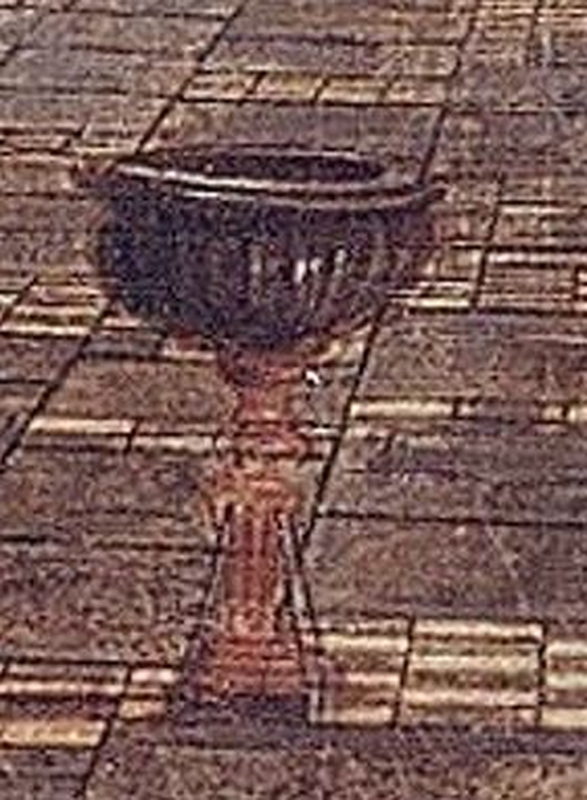
view of font
Scene Description: "font shown by the Antwerp architectural painter Antoon Gunther Gheringh in his painting of the interior view of St Walburgis Church, in 1661" [cf. FontNotes]
Image Source: digital image of a detail in a 1661 painting by Antoon Gunther Gheringh
Copyright Instructions: Assumed PD
view of font and cover
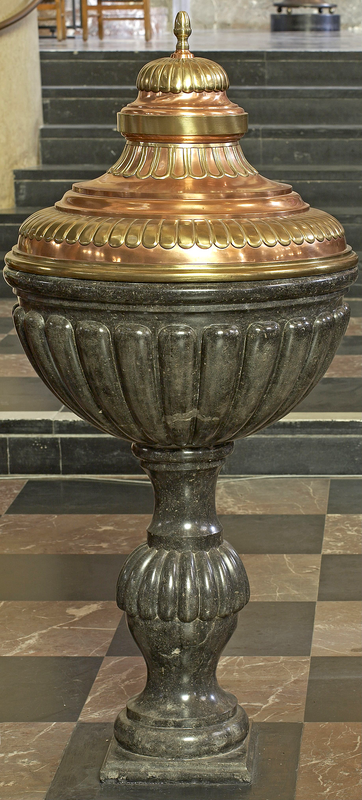
Scene Description: the 19thC font
Copyright Statement: Image copyright © KIK-IRPA, Brussels (Belgium), 2026
Image Source: digital photograph 2009 [cliché X028705] by Arijs, Hilke, KIK
Copyright Instructions: CC-BY-4.0
view of church exterior
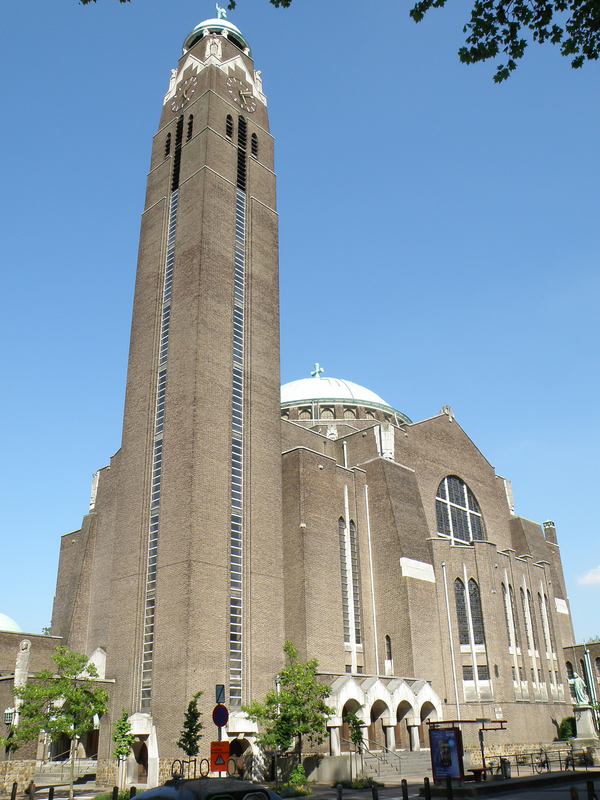
Scene Description: "Anvers, Belgique. Église Saint-Laurent, sise à l’angle des rues Van Schoonbekestraat / Markgravelei, de style Art déco et néo-byzantin. Architecte : Jef Huygh, date d’achèvement 1934 (clocher : 1941) / Antwerpen, hoek Markgravelei / Van Schoonbekestraat. Sint-Laurentiuskerk, in Art Deco en neo-Byzantijnse stijl. Ontwerp van Jef Huygh, inwijding 1934 (toren 1941)"
Copyright Statement: Image copyright © Torsade de Pointes, 2010
Image Source: digital photograph June 2010 by Torsade des Pointes
Copyright Instructions: PD
view of church interior - looking east
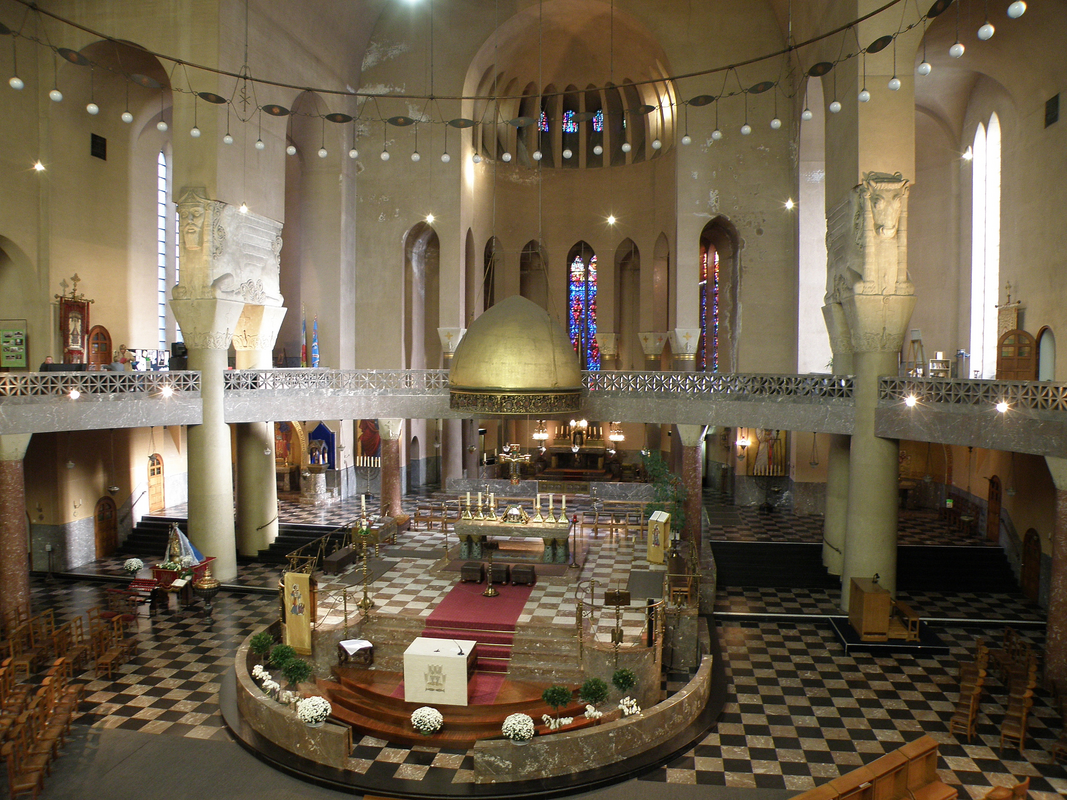
Scene Description: "Anvers, Belgique. Église Saint-Laurent, sise à l’angle des rues Van Schoonbekestraat / Markgravelei, de style Art déco et néo-byzantin. Architecte : Jef Huygh, date d’achèvement 1934 (clocher : 1941) / Antwerpen, hoek Markgravelei / Van Schoonbekestraat. Sint-Laurentiuskerk, in Art Deco en neo-Byzantijnse stijl. Ontwerp van Jef Huygh, inwijding 1934 (toren 1941)" -- showing the present, 19thC baptismal font and cover on the left, outside the chancel area.
Copyright Statement: Image copyright © Torsade de Pointes, 2010
Image Source: digital photograph June 2010 by Torsade des Pointes
Copyright Instructions: PD
INFORMATION
Font ID: 26191MJK
Object Type: Baptismal Font1?
Font Century and Period/Style: 17th century (?)
Church / Chapel Name: Sint-Laurentiuskerk / Eglise Saint-Laurent
Font Location in Church: disappeared?
Church Wikidata: https://en.wikipedia.org/wiki/St._Lawrence's_Church,_Antwerp
Church Patron Saint(s): St. Lawrence
Church Notes: church founded 1659
Church Address: Van Schoonbekestraat 155, 2018 Antwerpen, Belgium -- Tel.: +32 3 237 40 53
Site Location: Antwerp, Wallonie / Wallonne, Belgium, Europe
Directions to Site: This church is located in the Markgrave area of Antwerp, on the corner of Markgravelei and Van Schoonbekestraat
Additional Comments: disappeared font? [cf. FontNotes]
Font Notes:
Click to view
The present baptismal font in this church is modern, 19th-century; listed and illustrated in BALaT KIK-IRPA [https://balat.kikirpa.be/object/157466] [accessed 5 March 2026]: "doopvont [...] Date: 1801 (onzeker) - 1900 (onzeker)".
A communication to BSI from Pol Herman (e-mail of 10 November 2025) informs: "Antwerpen, Sint-Laurentiuskerk. The Leikwartier, a suburb south of Antwerp's Spanish city walls, was designed in the 16th century by the ambitious building contractor Gilbert Van Schoonbeke (1519-1556). The Leikwartier grew into a country estate district with pleasure gardens for Antwerp's wealthy bourgeoisie. Until the mid-17th century, the district fell under the jurisdiction of the St. George parish, which was located within the city walls. In 1659, the Bishop of Antwerp, Ambrosius Capello, signed the charter of foundation for the new, independent St. Lawrence parish. It was the oldest, fully-fledged parish established in Antwerp outside the Spanish city walls. The church, built in 1660-61, stood on what is now Fransenplaats. In 1746-47 (occupation of Antwerp by French king Louis XV), it was severely damaged and consequently demolished. A new church was built in 1770-77. Under French rule, the church and its contents were sold at public auction. In 1814, it was demolished for military reasons. From 1824 to 1826, a new church was built on the site of the current church: the corner of Van Schoonbekestraat and Markgravelei. In 1833, St. Laurentius became a parish church. From 1892 to 1894, it was enlarged. Barely 40 years later, it too was demolished. From 1932 to 1934, this church was replaced by a new neo-byzantine building. https://balat.kikirpa.be/object/157466 KIK-IRPA dates the font 19th c. Because the church was rebuilt many times, and because the furnishings were sold during the time of the French revolution, it is improbable that the font of the 1660’s would have survived. On the other hand, the design is baroque. It is either a good copy or the original or originating from another old church in Antwerp. The latter could be possible if one compares the Laurentius’ font with the font shown by the Antwerp architectural painter Antoon Gunther Gheringh in his painting of the interior view of St Walburgis Church, in 1661."
A communication to BSI from Pol Herman (e-mail of 10 November 2025) informs: "Antwerpen, Sint-Laurentiuskerk. The Leikwartier, a suburb south of Antwerp's Spanish city walls, was designed in the 16th century by the ambitious building contractor Gilbert Van Schoonbeke (1519-1556). The Leikwartier grew into a country estate district with pleasure gardens for Antwerp's wealthy bourgeoisie. Until the mid-17th century, the district fell under the jurisdiction of the St. George parish, which was located within the city walls. In 1659, the Bishop of Antwerp, Ambrosius Capello, signed the charter of foundation for the new, independent St. Lawrence parish. It was the oldest, fully-fledged parish established in Antwerp outside the Spanish city walls. The church, built in 1660-61, stood on what is now Fransenplaats. In 1746-47 (occupation of Antwerp by French king Louis XV), it was severely damaged and consequently demolished. A new church was built in 1770-77. Under French rule, the church and its contents were sold at public auction. In 1814, it was demolished for military reasons. From 1824 to 1826, a new church was built on the site of the current church: the corner of Van Schoonbekestraat and Markgravelei. In 1833, St. Laurentius became a parish church. From 1892 to 1894, it was enlarged. Barely 40 years later, it too was demolished. From 1932 to 1934, this church was replaced by a new neo-byzantine building. https://balat.kikirpa.be/object/157466 KIK-IRPA dates the font 19th c. Because the church was rebuilt many times, and because the furnishings were sold during the time of the French revolution, it is improbable that the font of the 1660’s would have survived. On the other hand, the design is baroque. It is either a good copy or the original or originating from another old church in Antwerp. The latter could be possible if one compares the Laurentius’ font with the font shown by the Antwerp architectural painter Antoon Gunther Gheringh in his painting of the interior view of St Walburgis Church, in 1661."
Credit and Acknowledgements: We are grateful to Pol Herman for bringing this font to our attention and for his help documenting it
COORDINATES
UTM: 31U 598047 5672848
Latitude & Longitude (Decimal): 51.198617, 4.403319
Latitude & Longitude (DMS): 51° 11′ 55.02″ N, 4° 24′ 11.95″ E
REFERENCES
- KIK-IRPA, BALaT KIK-IRPA, 2024. URL: https://balat.kikirpa.be/.