Landelies / Landelies in Montigny-le-Tilleul / Landilla / Landeilhies / Landilhy / Landliye
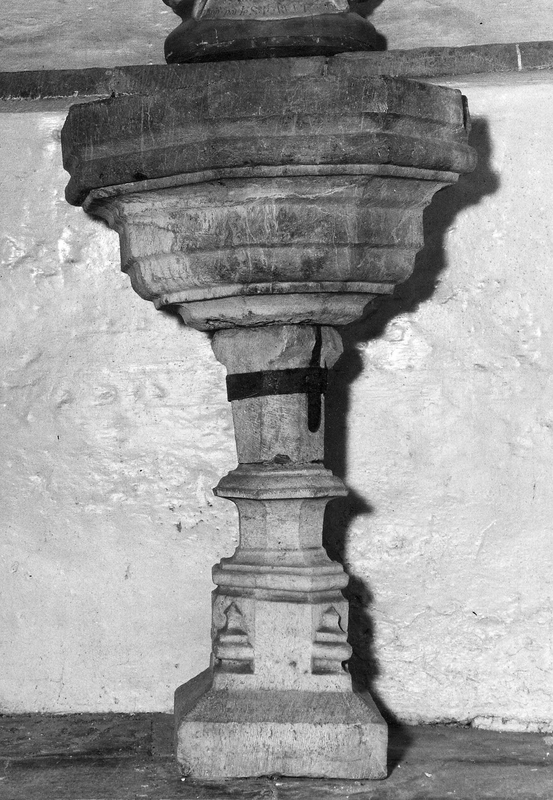
Image copyright © KIK-IRPA, Brussels (Belgium), 2026
CC-BY-4.0
Results: 2 records
view of font
Copyright Statement: Image copyright © KIK-IRPA, Brussels (Belgium), 2026
Image Source: digital image of a 1968 B&W photograph [cliché M030994] by IRPA
Copyright Instructions: CC-BY-4.0
view of church exterior - southwest end
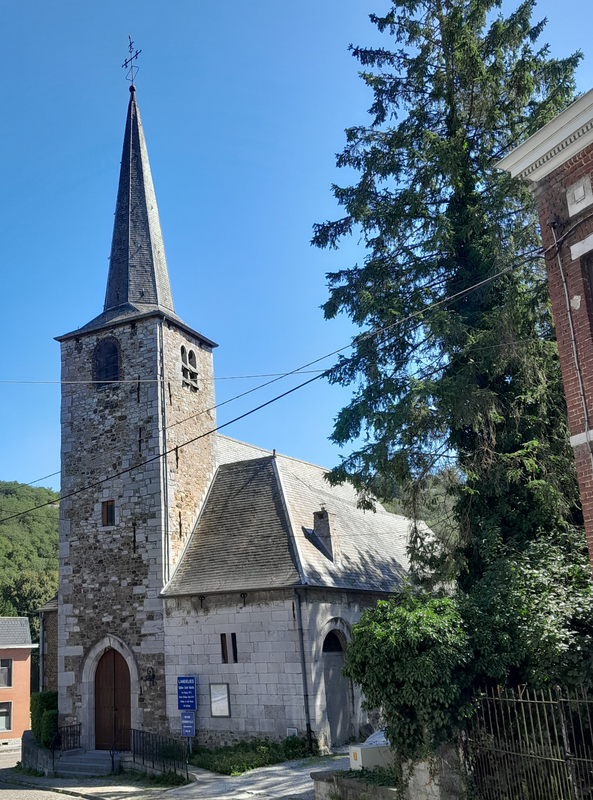
Scene Description: "Eglise Saint-Martin de Landelies"
Copyright Statement: Image copyright © Pulcherus, 2023
Image Source: digital photograph 20 August 2023 by Pulcherus
Copyright Instructions: CC-BY-SA-4.0
INFORMATION
Font ID: 26163OGH
Object Type: Baptismal Font1
Font Century and Period/Style: 16th century (?), Renaissance [altered font]
Cognate Fonts: [cf. FontNotes]
Church / Chapel Name: Eglise [ancienne] Saint-Martin de Landelies
Font Location in Church: Inside
Church Patron Saint(s): St. Martin
Church Notes: church here documented 1223 but the tower is said to date from the 9thC; much modified since; present church chiefly 16thC
Church Address: T580 1-19, 6111, Rue du Déversoir 21, 6111 Montigny-le-Tilleul, Belgium -- Tel.: +32 71 51 60 82
Site Location: Hainaut / Henegouwen, Wallonie / Wallonne, Belgium, Europe
Directions to Site: Located off the N579, in the municipality and 4-5 km W of Montigny-le-Tilleul, on the left bank of the river Sambre, WSW of Charleroi
Ecclesiastic Region: Diocèse de Tournai / Bisdom Doornik
Additional Comments: altered font (stem of later date) [cf. FontNotes] / disappeared font? (the one from the medieval church here)
Font Notes:
Click to view
A baptismal font possibly of the 16th century here is listed and illustrated in BALaT KIK-IRPA [https://balat.kikirpa.be/object/10049069] [accessed 26 February 2026]: "fonts baptismaux [...] pierre calcaire [...] gothique [...] hauteur: 102 cm [... ] Date: 1501 - 1551 [...] fût postérieur".
A communication to BSI from Pol Herman (e-mail of 2 February 2026] informs: "Landelies, église Saint-Martin. 1311 Landilhy, 1470 Landeilhies.
According to legend, in 653, the village was the residence of Saint Landelin, a monk of Frankish origin, founder of the abbeys of Aulne and Lobbes, as well as Crespin abbey. The history of Landelies is linked to that of Aulne abbey, which was founded around 657. The first record of the village is said to date back to the 9th century. The lordship of Landelies was under the jurisdiction of the Prince-Bishopric of Liège. The church incorporates an 11th-century Romanesque defensive tower, built to withstand the fury of men. 1233: A charter from the dean of Thuin states that Aulne, Gozée, and Landelies formed a single parish. Saint-Martin de Landelies was the ecclesia integra, and therefore the mother parish. A Romanesque oratory thus existed in the 13th century. In the 14th century, a chapel was erected on the site of the present church, served by a monk from Aulne Abbey.
Between 1507 and 1516, the chapel was partially rebuilt, and in 1515, the buildings were raised. In 1518, a Gothic chancel and nave were constructed. The current church therefore dates primarily from the 16th century. In 1803, the imposing château de Landelies was sold in several lots and demolished by the buyers, who reused the materials to build houses in the village. The church was damaged by fire in 1783. First baptismal records date from 1610. Octagonal, limestone, renaissance baptismal font that combines a Mosan-type base with an Hainaut-type column and basin. This combination is not an exception, there must have been a workshop that preferred this style. Except for its dimensions, the base of Landelies is almost identical to the base of Lieferinge. 16th century, could be the font from appr. 1518? https://balat.kikirpa.be/object/10049069".
A communication to BSI from Pol Herman (e-mail of 2 February 2026] informs: "Landelies, église Saint-Martin. 1311 Landilhy, 1470 Landeilhies.
According to legend, in 653, the village was the residence of Saint Landelin, a monk of Frankish origin, founder of the abbeys of Aulne and Lobbes, as well as Crespin abbey. The history of Landelies is linked to that of Aulne abbey, which was founded around 657. The first record of the village is said to date back to the 9th century. The lordship of Landelies was under the jurisdiction of the Prince-Bishopric of Liège. The church incorporates an 11th-century Romanesque defensive tower, built to withstand the fury of men. 1233: A charter from the dean of Thuin states that Aulne, Gozée, and Landelies formed a single parish. Saint-Martin de Landelies was the ecclesia integra, and therefore the mother parish. A Romanesque oratory thus existed in the 13th century. In the 14th century, a chapel was erected on the site of the present church, served by a monk from Aulne Abbey.
Between 1507 and 1516, the chapel was partially rebuilt, and in 1515, the buildings were raised. In 1518, a Gothic chancel and nave were constructed. The current church therefore dates primarily from the 16th century. In 1803, the imposing château de Landelies was sold in several lots and demolished by the buyers, who reused the materials to build houses in the village. The church was damaged by fire in 1783. First baptismal records date from 1610. Octagonal, limestone, renaissance baptismal font that combines a Mosan-type base with an Hainaut-type column and basin. This combination is not an exception, there must have been a workshop that preferred this style. Except for its dimensions, the base of Landelies is almost identical to the base of Lieferinge. 16th century, could be the font from appr. 1518? https://balat.kikirpa.be/object/10049069".
Credit and Acknowledgements: We are grateful to Pol Herman for bringing this font to our attention and for his help documenting it
COORDINATES
UTM: 31U 596351 5581642
Latitude & Longitude (Decimal): 50.37894, 4.35513
Latitude & Longitude (DMS): 50° 22′ 44.18″ N, 4° 21′ 18.47″ E
MEDIUM AND MEASUREMENTS
Material: stone, limestone
Font Shape: octagonal (mounted)
Basin Interior Shape: round
Basin Exterior Shape: octagonal
Font Height (less Plinth): 102 cm*
Notes on Measurements: * cf. FontNotes]
REFERENCES
- KIK-IRPA, BALaT KIK-IRPA, 2024. URL: https://balat.kikirpa.be/.