Bassilly / Bachili / Bas-Sylly / Basseli / Bassely / Bassilchi / Bassilge / Inferiori Sileca / Nederzilleke / Silgi Inferiori / Zullik
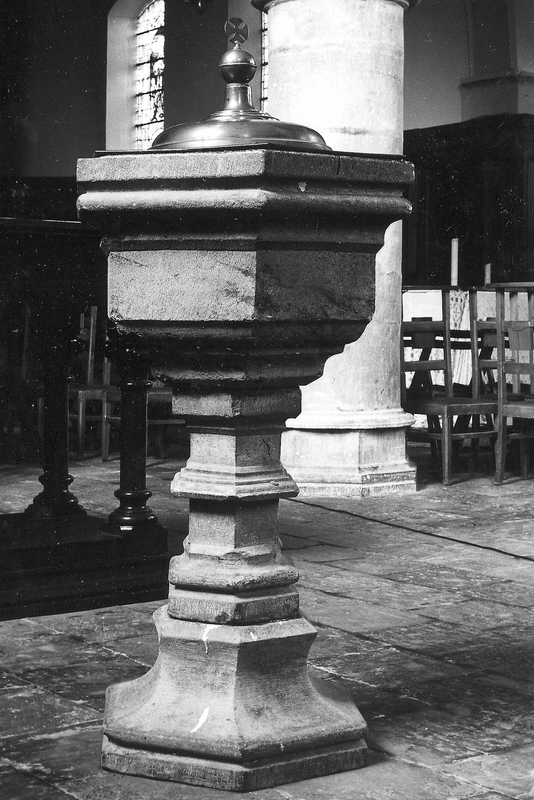
Image copyright © KIK-IRPA, Brussels (Belgium), 2026
CC-BY-4.0
Results: 1 records
view of font and cover
Copyright Statement: Image copyright © KIK-IRPA, Brussels (Belgium), 2026
Image Source: digital image of a 1973 B&W photograph [cliché M093223] by Sluse, Jean-Pierre
Copyright Instructions: CC-BY-4.0
INFORMATION
Font ID: 26149WDX
Object Type: Baptismal Font1
Font Century and Period/Style: 16th century (?), composite?
Workshop/Group/Artisan: Hainaut type font
Church / Chapel Name: Eglise Sainte-Vierge à Bassilly
Church Patron Saint(s): St. Mary the Virgin
Church Notes: church documented 1138;
Church Address: Place de Bassilly, 7830 Silly, Belgium
Site Location: Hainaut / Henegouwen, Wallonie / Wallonne, Belgium, Europe
Directions to Site: Located off the N7-N263 crossroads, 5 km W of Enghien, in the municipality of Silly, WSW of Brussels
Town/City Wikipedia: https://fr.wikipedia.org/wiki/Bassilly
Font Notes:
Click to view
Baptismal font of the 16th century listed and illustrated in BALaT KIK-IRPA [https://balat.kikirpa.be/object/10013250] [accessed 22 February 2026]: "fonts baptismaux [...] pierre calcaire [...] hauteur: 108 cm [...] Date: 1501 - 1600".
A communication to BSI from Pol Herman (e-mail of 26 January 2026) informs: "Flemish name : Zullik, Nederzilleke. 1040 : Bassilchi, 1048 : Basilg, 1147 : Bassilgi, Bas-Sylly, Bassely, Basseli, Inferiori Sileca , Silgi Inferiori. Until its appearance in a document from 1048, nothing is known about the village's history. In 1048, the abbey of Ename purchased a significant agricultural estate in the village. The church was given in 1138 by Nicolas, Bishop of Cambrai, to the Abbey of Ename. The church of Bassilly preserves Romanesque remains of an 11th-century chapel (on the west entrance façade) and Gothic fragments from the 12th and 13th centuries (at the base of the tower). The original chapel (with a separate bell tower) underwent numerous alterations and expansions over the centuries, resulting in the heterogeneous religious building of today, which is at once original, atypical, and fortified. The tower served as a fortification, as evidenced by the presence of arrow slits. It is striking for its dimensions (a 6-meter square), the thickness of its walls, and its location. The tower is located outside the church itself and is accessible only from the outside. The current Gothic oratory was largely built in the 15th and 16th centuries and enlarged around 1660. The chancel dates from 1768. Baptismal records: 1659.
The hexagonal limestone font in Hainaut-style is probably composite. The base looks younger than the basin. KIK-IRPA dates 16th century. The style of the basin would suggest very early 16th c then. https://balat.kikirpa.be/object/10013250"
A communication to BSI from Pol Herman (e-mail of 26 January 2026) informs: "Flemish name : Zullik, Nederzilleke. 1040 : Bassilchi, 1048 : Basilg, 1147 : Bassilgi, Bas-Sylly, Bassely, Basseli, Inferiori Sileca , Silgi Inferiori. Until its appearance in a document from 1048, nothing is known about the village's history. In 1048, the abbey of Ename purchased a significant agricultural estate in the village. The church was given in 1138 by Nicolas, Bishop of Cambrai, to the Abbey of Ename. The church of Bassilly preserves Romanesque remains of an 11th-century chapel (on the west entrance façade) and Gothic fragments from the 12th and 13th centuries (at the base of the tower). The original chapel (with a separate bell tower) underwent numerous alterations and expansions over the centuries, resulting in the heterogeneous religious building of today, which is at once original, atypical, and fortified. The tower served as a fortification, as evidenced by the presence of arrow slits. It is striking for its dimensions (a 6-meter square), the thickness of its walls, and its location. The tower is located outside the church itself and is accessible only from the outside. The current Gothic oratory was largely built in the 15th and 16th centuries and enlarged around 1660. The chancel dates from 1768. Baptismal records: 1659.
The hexagonal limestone font in Hainaut-style is probably composite. The base looks younger than the basin. KIK-IRPA dates 16th century. The style of the basin would suggest very early 16th c then. https://balat.kikirpa.be/object/10013250"
Credit and Acknowledgements: We are grateful to Pol Herman for bringing this font to our attention and for his help documenting it
COORDINATES
Latitude & Longitude (Decimal): 50.67, 3.933
Latitude & Longitude (DMS): 50° 40′ 12″ N, 3° 55′ 58.8″ E
MEDIUM AND MEASUREMENTS
Material: stone, limestone
Font Shape: hexagonal (mounted)
Basin Interior Shape: round
Basin Exterior Shape: hexagonal
Font Height (less Plinth): 108 cm*
Notes on Measurements: * [cf. FontNotes]
LID INFORMATION
Notes: low dome with orb-and-cross finial
REFERENCES
- KIK-IRPA, BALaT KIK-IRPA, 2024. URL: https://balat.kikirpa.be/.