Belsele / Belcele / Belzeele / Belzele / Bulsele
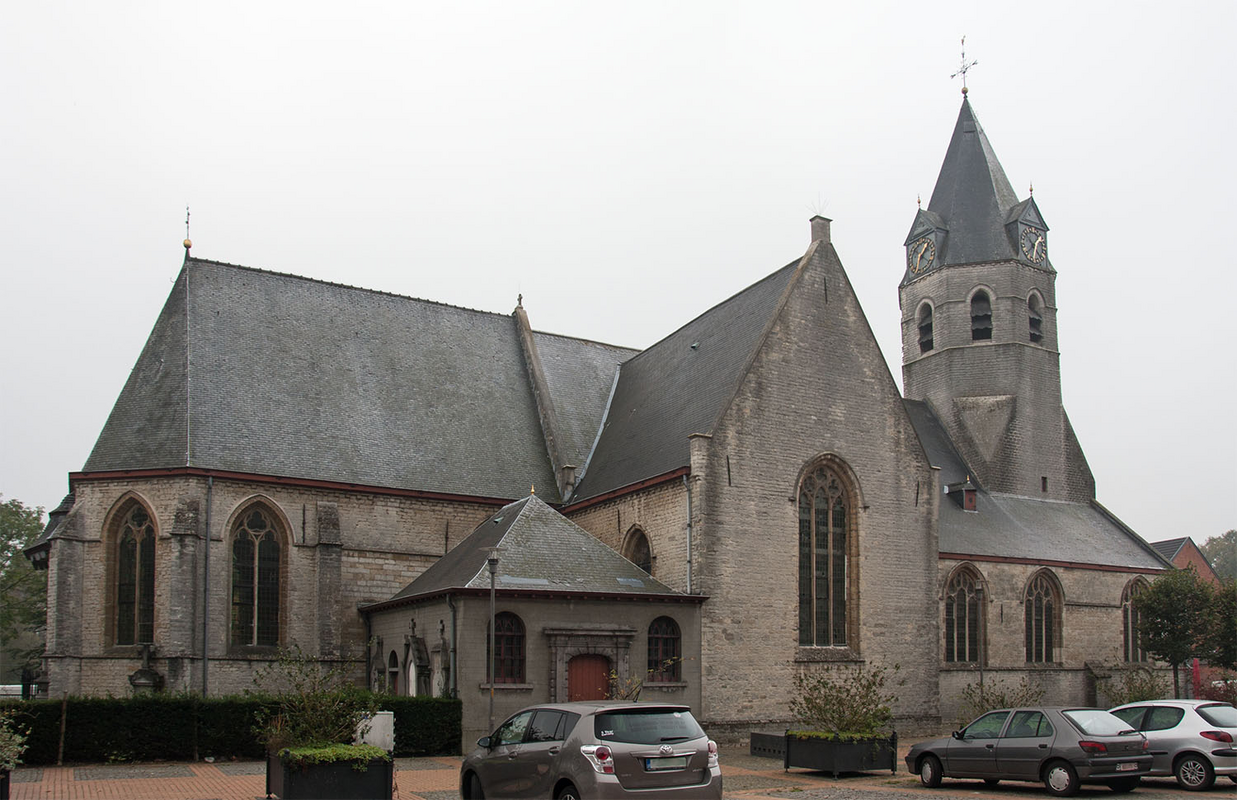
Image copyright © KrisMaes, 2014
CC-BY-SA-3.0
Results: 2 records
view of church exterior - northeast view
Scene Description: "parochiekerk Sint Adreas Belsele"
Copyright Statement: Image copyright © KrisMaes, 2014
Image Source: digital photograph 20 September 2014 by KrisMaes
Copyright Instructions: CC-BY-SA-3.0
view of church interior - looking east
![partially showing the font and cover at the far [east] end of the left bank of benches](/static-50478a99ec6f36a15d6234548c59f63da52304e5/others/permission_not_available.jpg)
Scene Description: partially showing the font and cover at the far [east] end of the left bank of benches
Image Source: image source not available
Copyright Instructions: PERMISSION NOT AVAILABLE – IMAGE NOT FOR PUBLIC USE
INFORMATION
Font ID: 26137AWA
Object Type: Baptismal Font1
Font Century and Period/Style: 15th - 16th century (?)
Workshop/Group/Artisan: Hainaut type font
Church / Chapel Name: Sint-Andreas- en Ghislenuskerk
Font Location in Church: Inside, in the nave, E end
Church Wikidata: https://nl.wikipedia.org/wiki/Sint-Andreas-_en_Ghislenuskerk
Church Patron Saint(s): St. Andrew
Church Address: Belseledorp, 9111 Sint-Niklaas, Belgium -- Tel.: +32 3 219 87 45
Site Location: Oost-Vlaanderen / Flandre Est, Vlaanderen / Flandres, Belgium, Europe
Directions to Site: Located off (N) the N70, in the municipality and 5 km W of Sint-Niklas
Ecclesiastic Region: Diocèse de Ghand / Bistum Ghent
Additional Comments: disappeared font? (the one from the original medieval church here)
Town/City Wikipedia: https://nl.wikipedia.org/wiki/Belsele
Font Notes:
Click to view
The entry for this church in the Belgian Wikipedia [https://nl.wikipedia.org/wiki/Sint-Andreas-_en_Ghislenuskerk] [accessed 19 February 2026] reports a 15th-century baptismal font made of bluestone: "Het 15e eeuws doopvont is in hardsteen uitgevoerd".
A communication to BSI from Pol Herman (e-mail of 20 January 2026) informs: "Detailed historical information : https://plannen.onroerenderfgoed.be/plannen/1598. 870, 950, 964: Bulsele. Belcele, Belzele, Belzeele. Numerous Roman and Gallo-Roman finds. The name Belsele already appears in the Annales Abbatiae Sancti Petri Blandiniensis from the ninth century. 964: Lother, King of France, confirms that the domain was owned by the Abbey of St. Peter in Ghent. The first place of worship was probably a wooden chapel. The first stone church in Belsele was built in the late tenth or eleventh century. It was a small, Romanesque, three-aisled church. The material used for the foundations consisted of pieces of Gallo-Roman bricks, Tournai limestone, and lumps of iron ore. It is very likely that these came from the ruins of the Roman villa at the site known as Steenwerk. In archival documents from 1141 and 1154, Belsele is mentioned in connection as a possession of the Abbey of Drongen. In 1217, Belsele became an autonomous parish, separated from the mother parish of Waasmunster. Tithes belonged to the Boudelo Abbey. In the first quarter of the 13th century, the walls were raised and fitted with early Gothic windows. Later in the 13th century, a west tower was built. Traces of holes can still be seen around the entrance gate. When the tower was built, it served a military purpose. When marauding armies threatened the village, everyone fled with their belongings (including livestock) to the church, where the right of asylum applied. Heavy oak beams could be slid into these holes to block the gate. The inhabitants of Belsele once stayed here for three long weeks, while their livestock remained in the churchyard. 1432: Choir and transept added. The church was plundered by the protestant rebels around 1570. In 1578, the church was severely damaged during the religious conflict. According to church accounts, repairs were carried out shortly afterward. Since then, numerous modifications and renovations have taken place. Baptismal registers from 1585 onwards. Baptismal font is not in KIK-IRPA. The octagonal, limestone, baptismal font in Hainaut-style is said to be from the 15th c. I cannot recognize the typical features of such early fonts."
A communication to BSI from Pol Herman (e-mail of 20 January 2026) informs: "Detailed historical information : https://plannen.onroerenderfgoed.be/plannen/1598. 870, 950, 964: Bulsele. Belcele, Belzele, Belzeele. Numerous Roman and Gallo-Roman finds. The name Belsele already appears in the Annales Abbatiae Sancti Petri Blandiniensis from the ninth century. 964: Lother, King of France, confirms that the domain was owned by the Abbey of St. Peter in Ghent. The first place of worship was probably a wooden chapel. The first stone church in Belsele was built in the late tenth or eleventh century. It was a small, Romanesque, three-aisled church. The material used for the foundations consisted of pieces of Gallo-Roman bricks, Tournai limestone, and lumps of iron ore. It is very likely that these came from the ruins of the Roman villa at the site known as Steenwerk. In archival documents from 1141 and 1154, Belsele is mentioned in connection as a possession of the Abbey of Drongen. In 1217, Belsele became an autonomous parish, separated from the mother parish of Waasmunster. Tithes belonged to the Boudelo Abbey. In the first quarter of the 13th century, the walls were raised and fitted with early Gothic windows. Later in the 13th century, a west tower was built. Traces of holes can still be seen around the entrance gate. When the tower was built, it served a military purpose. When marauding armies threatened the village, everyone fled with their belongings (including livestock) to the church, where the right of asylum applied. Heavy oak beams could be slid into these holes to block the gate. The inhabitants of Belsele once stayed here for three long weeks, while their livestock remained in the churchyard. 1432: Choir and transept added. The church was plundered by the protestant rebels around 1570. In 1578, the church was severely damaged during the religious conflict. According to church accounts, repairs were carried out shortly afterward. Since then, numerous modifications and renovations have taken place. Baptismal registers from 1585 onwards. Baptismal font is not in KIK-IRPA. The octagonal, limestone, baptismal font in Hainaut-style is said to be from the 15th c. I cannot recognize the typical features of such early fonts."
Credit and Acknowledgements: We are grateful to Pol Herman for bringing this font to our attention and for his help in documenting it
COORDINATES
UTM: 31U 576147 5666626
Latitude & Longitude (Decimal): 51.146017, 4.088617
Latitude & Longitude (DMS): 51° 8′ 45.66″ N, 4° 5′ 19.02″ E
MEDIUM AND MEASUREMENTS
Material: stone, limestone (blue)
Font Shape: octagonal (mounted)
Basin Interior Shape: round
Basin Exterior Shape: octagonal
LID INFORMATION
Material: metal, brass?
Notes: bell-shaped dome with finial