Beauwelz / Beau Welz / Beawe / Beawé / Biauwes
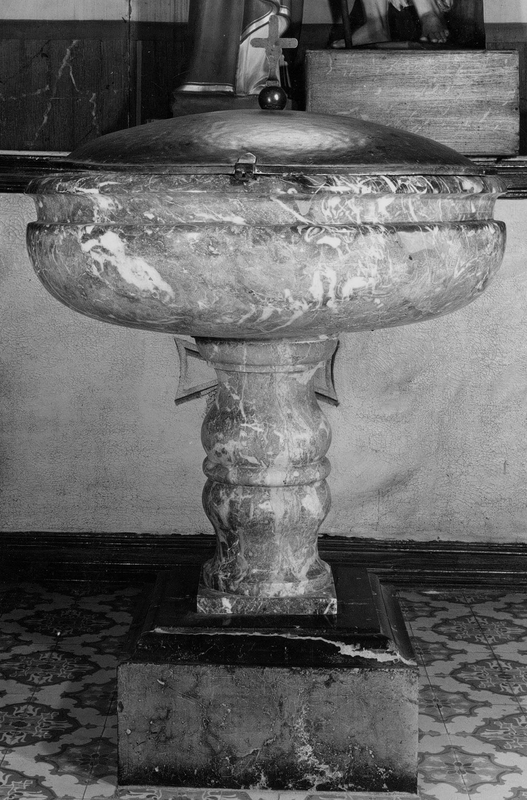
Image copyright © KIK-IRPA, Brussels (Belgium), 2026
CC-BY-4.0
Results: 2 records
view of font and cover
Scene Description: "Date: 1641 (incertain) - 1660 (incertain)"
Copyright Statement: Image copyright © KIK-IRPA, Brussels (Belgium), 2026
Image Source: digital image of a 1972 B&W photograph [cliché M092308]
Copyright Instructions: CC-BY-4.0
view of church exterior - southwest view
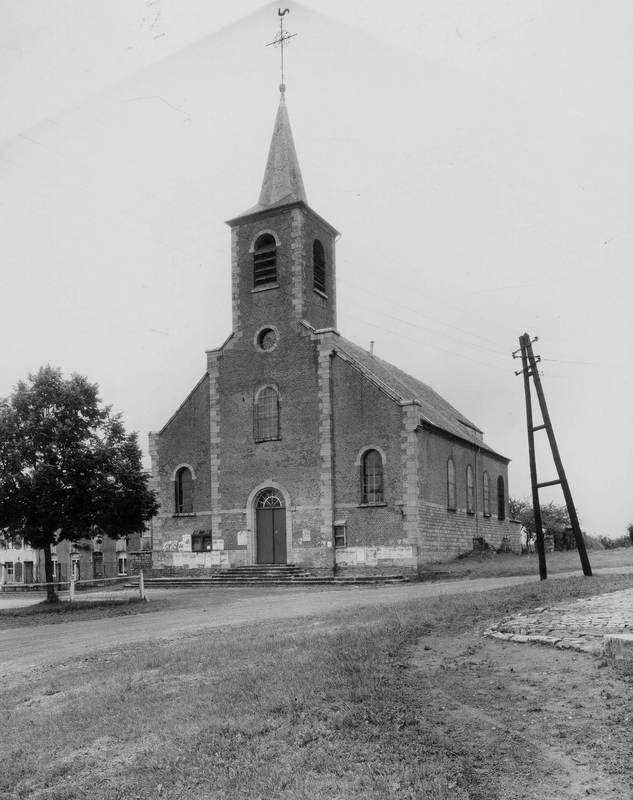
Scene Description: "vue gén. S.-O. 1948"
Copyright Statement: Image copyright © KIK-IRPA, Brussels (Belgium), 2026
Image Source: digital image of a 1948 B&W photograph [cliché B110786]
Copyright Instructions: CC-BY-4.0
INFORMATION
Font ID: 26131EZC
Object Type: Baptismal Font1
Cognate Fonts: [cf. FontNotes]
Church / Chapel Name: Eglise Saint-Quentin de Beauwelz
Font Location in Church: Inside
Church Patron Saint(s): St. Quentin
Church Address: Rue des Liégeois 14, 6594 Momignies, Belgium
Site Location: Hainaut / Henegouwen, Wallonie / Wallonne, Belgium, Europe
Directions to Site: Located off the N591, in the municipality and 2-3 km SW of Momignies, by the border with France, 60+/- km SSW of Charleroi
Ecclesiastic Region: Diocèse de Tournai / Bisdom Doornik
Town/City Wikipedia: https://fr.wikipedia.org/wiki/Beauwelz
Font Notes:
Click to view
Baptismal font probably of the mid-17th century listed and illustrated in BALaT KIK-IRPA [https://balat.kikirpa.be/object/10063348] [accessed 18 February 2026]: "fonts baptismaux [...] marbrier [...] hauteur: 99 cm [...] Date: 1641 (incertain) - 1660 (incertain)".
A communication to BSI from Pol Herman (e-mail of 19 January 2026) informs: "1310 : Beau Welz, 1412 : Biauwes. The first mention of the village's name dates back to 1336, when it was one of the nine towns of the domain “Sart de Chimay”. In 1445, the village consisted of only 13 inhabited houses. In the 15th and 16th centuries, the village became famous for its glassworks. The number of households increased. A first chapel was built in 1631. François Vanderburch, Bishop of Cambrai, granted permission for Mass to be celebrated there. The chapel was served by the vicar of Momignies. He could not administer baptism in Beauwelz without the express permission of the parish priest of Momignies. The rights belonged to the Abbey of Liessies. In 1757, Charles de Saint Albin, Bishop of Cambrai, established Beauwelz as a parish, under the patronage of Saint Augustine. The abbeys of Roeulx and Saint-Feuillien opposed his decision, and in 1763 the civil court of Hainaut suspended it. Only in 1786 was an amicable agreement reached to resolve the matter. In 1803, following the Concordat, the parish regained its autonomy. In 1840, the current church, dedicated to Saint Quentin, was built. It was consecrated in 1850. First baptismal records preserved : 1781. Marble baptismal font, KIK-IRPA: 1641-1660. This style of the baluster column can be found on century fonts from the 1670’s. Other examples : Baaigem, Sint-Ulriks-Kapelle, Bretteville, Moerbeke. https://balat.kikirpa.be/object/10063348".
A communication to BSI from Pol Herman (e-mail of 19 January 2026) informs: "1310 : Beau Welz, 1412 : Biauwes. The first mention of the village's name dates back to 1336, when it was one of the nine towns of the domain “Sart de Chimay”. In 1445, the village consisted of only 13 inhabited houses. In the 15th and 16th centuries, the village became famous for its glassworks. The number of households increased. A first chapel was built in 1631. François Vanderburch, Bishop of Cambrai, granted permission for Mass to be celebrated there. The chapel was served by the vicar of Momignies. He could not administer baptism in Beauwelz without the express permission of the parish priest of Momignies. The rights belonged to the Abbey of Liessies. In 1757, Charles de Saint Albin, Bishop of Cambrai, established Beauwelz as a parish, under the patronage of Saint Augustine. The abbeys of Roeulx and Saint-Feuillien opposed his decision, and in 1763 the civil court of Hainaut suspended it. Only in 1786 was an amicable agreement reached to resolve the matter. In 1803, following the Concordat, the parish regained its autonomy. In 1840, the current church, dedicated to Saint Quentin, was built. It was consecrated in 1850. First baptismal records preserved : 1781. Marble baptismal font, KIK-IRPA: 1641-1660. This style of the baluster column can be found on century fonts from the 1670’s. Other examples : Baaigem, Sint-Ulriks-Kapelle, Bretteville, Moerbeke. https://balat.kikirpa.be/object/10063348".
MEDIUM AND MEASUREMENTS
Material: stone, marble
Font Shape: hemispheric (mounted)
Basin Exterior Shape: round
Font Height (less Plinth): 99 cm*
Notes on Measurements: * [cf. FontNotes]
LID INFORMATION
Notes: low-dome with cross finial
REFERENCES
- KIK-IRPA, BALaT KIK-IRPA, 2024. URL: https://balat.kikirpa.be/.