Wadelincourt / Guandelencurt / Wandaleni curtis / Wandalinkust / Wandelincour / Wandelincourt / Warlêcou / Warlincoue
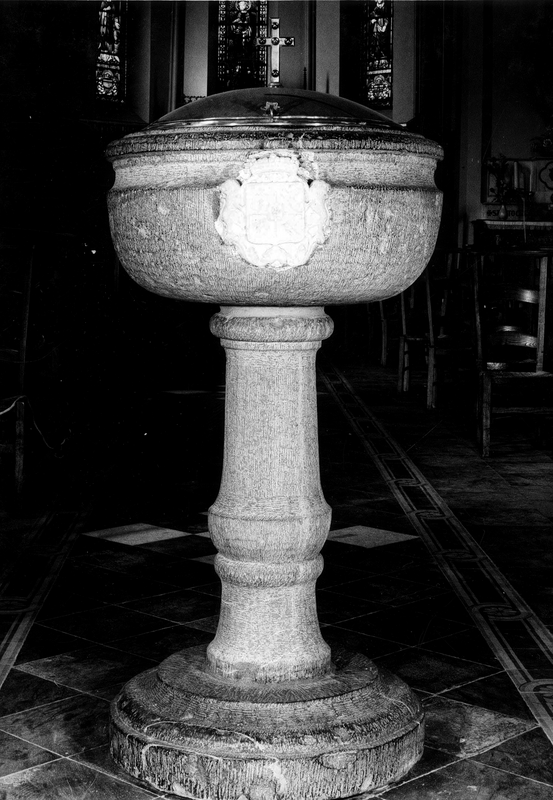
Image copyright © KIK-IRPA, Brussels (Belgium), 2026
CC-BY-4.0
Results: 2 records
view of font and cover
Scene Description: the modern, late-18thC font
Copyright Statement: Image copyright © KIK-IRPA, Brussels (Belgium), 2026
Image Source: digital image of a 1973 B&W photograph by Ugeux, Brigitte, IRPA [cliché M092813]
Copyright Instructions: CC-BY-4.0
view of church exterior
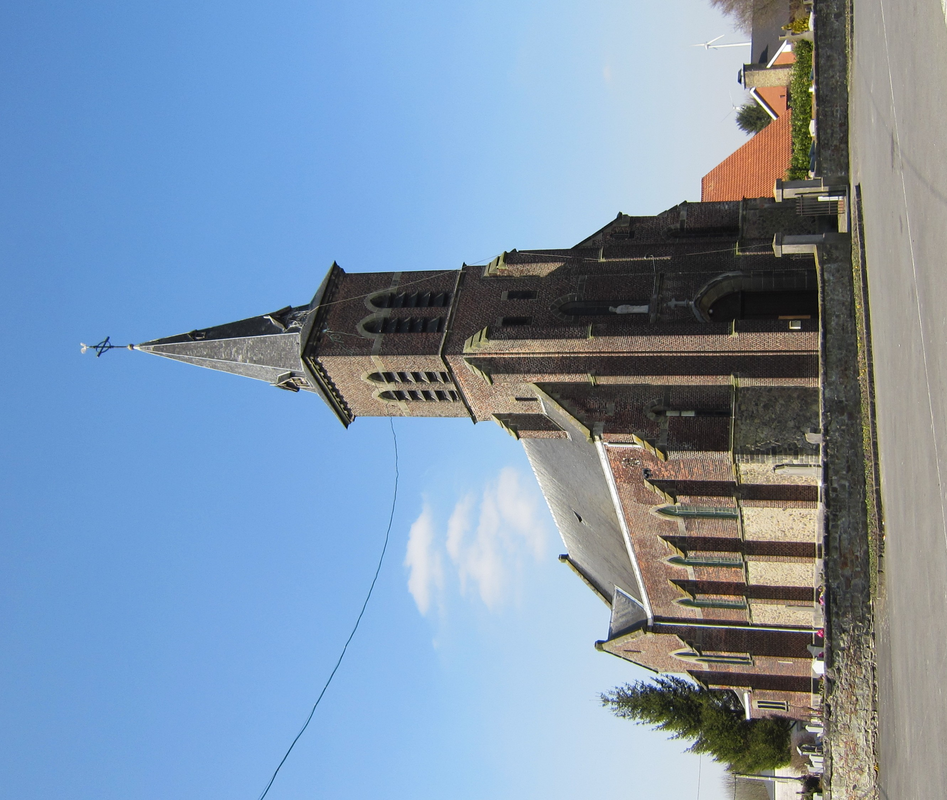
Scene Description: present church replaced the medieval building
Copyright Statement: Image copyright © Herpoel, 2013
Image Source: digital photograph 2 April 2013 by Herpoel
Copyright Instructions: CC-BY-SA-4.0
INFORMATION
Font ID: 26111WUJ
Object Type: Baptismal Font1?
Font Century and Period/Style: 12th century (?), Romanesque?
Church / Chapel Name: Eglise Saint-Vendrégésile
Font Location in Church: disappeared font
Church Patron Saint(s): St. Vendrégésile
Other Dedications: St. Charalampe
Church Notes: church here documented in 1110; present church built 1870 -- [NB: 2025 local note: "l'église Saint-Vandregésile de Wadelincourt n'est plus accessible au public pour des raisons de sécurité depuis 2018."]
Church Address: Rue de l'Eglise 26, 7971 Beloeil, Belgium
Site Location: Hainaut / Henegouwen, Wallonie / Wallonne, Belgium, Europe
Directions to Site: Located off the N50, N of Hwy E42, in the municipality of Beloeil, 20 km SE of Tournai, about 6 km from the border with France
Ecclesiastic Region: Diocèse de Tournai / Bisdom Doornik
Additional Comments: disappeared font? (the one from the medieval church here)
Town/City Wikipedia: https://fr.wikipedia.org/wiki/Wadelincourt_(Belgique)
Font Notes:
Click to view
The present font in this church is modern (late-18th century); it is listed and illustrated in BALaT KIK-IRPA [https://balat.kikirpa.be/object/10053039] [accessed 10 February 2026]: "fonts baptismaux [...] datation, gravé, : daté 1787". [NB: we have no information on the font of the medieval church here].
A communication to BSI from Pol Herman (e-mail of 5 February 2026) informs: "988 : Wandaleni curtis, 1019 : Wandalinkust, 1042 : Wandalinhurt, 1110 : Wandelancurt, 1119 : Guandelencurt, 1186 : Wandelincourt, Wadelencour. 988: emperor Otto, at the request of counts Godfrey and Arnulf of Hainaut, confirmed on behalf of the holy confessors whose bodies rested there (Wandregisili, Gudwali, Ansberti, Amalbirguae), that the village had been given by a certain Eilbodo to the Abbey of Saint Peter in Ghent. 1096: The altar dedicated to Saint Wandregisil, a subsidiary of the parish of Basècles, belonged to the Abbey of Saint Ghislain, as confirmed by Pope Urban II. 1110 : Altar (tithes, church maintenance, appointment of clergy) belongs to the Abbey of Saint Ghislain in as confirmed by Odo, Bishop of Cambrai. 1119 : Confirmation of above by Bishop Burchard of Cambrai.
Several church buildings, about which nothing is known, must have followed one another. A small church dating from the 17th c. was demolished in 1870. It had probably been built by the lord of Milomez, whose castle-farm was adjacent to the church. Church built in 1871 on the site of the former church. It contains a relic of Saint Charalampe, a priest during the reign of Emperor Severus, around the year 202. https://en.wikipedia.org/wiki/Charalambos. He is invoked against the plague and contagious diseases of domestic animals. Since 1687, when Pope Innocent XI established a confraternity in honour of the saint, pilgrims have come in large numbers to the church to venerate the saint's relics. Baptismal records : oldest 1550, register from 1780 onwards. Limestone, Hainaut-type, baptismal font, dated 1787, with white marble coat of arms of the parents of Léger Charles Maximilien Robert de Robersart (1714-1787), lord of Walincourt (Wadelincourt) and his wife Marie Angélique Françoise de Saint Genois ( ?-1764)
https://balat.kikirpa.be/object/10053039"
A communication to BSI from Pol Herman (e-mail of 5 February 2026) informs: "988 : Wandaleni curtis, 1019 : Wandalinkust, 1042 : Wandalinhurt, 1110 : Wandelancurt, 1119 : Guandelencurt, 1186 : Wandelincourt, Wadelencour. 988: emperor Otto, at the request of counts Godfrey and Arnulf of Hainaut, confirmed on behalf of the holy confessors whose bodies rested there (Wandregisili, Gudwali, Ansberti, Amalbirguae), that the village had been given by a certain Eilbodo to the Abbey of Saint Peter in Ghent. 1096: The altar dedicated to Saint Wandregisil, a subsidiary of the parish of Basècles, belonged to the Abbey of Saint Ghislain, as confirmed by Pope Urban II. 1110 : Altar (tithes, church maintenance, appointment of clergy) belongs to the Abbey of Saint Ghislain in as confirmed by Odo, Bishop of Cambrai. 1119 : Confirmation of above by Bishop Burchard of Cambrai.
Several church buildings, about which nothing is known, must have followed one another. A small church dating from the 17th c. was demolished in 1870. It had probably been built by the lord of Milomez, whose castle-farm was adjacent to the church. Church built in 1871 on the site of the former church. It contains a relic of Saint Charalampe, a priest during the reign of Emperor Severus, around the year 202. https://en.wikipedia.org/wiki/Charalambos. He is invoked against the plague and contagious diseases of domestic animals. Since 1687, when Pope Innocent XI established a confraternity in honour of the saint, pilgrims have come in large numbers to the church to venerate the saint's relics. Baptismal records : oldest 1550, register from 1780 onwards. Limestone, Hainaut-type, baptismal font, dated 1787, with white marble coat of arms of the parents of Léger Charles Maximilien Robert de Robersart (1714-1787), lord of Walincourt (Wadelincourt) and his wife Marie Angélique Françoise de Saint Genois ( ?-1764)
https://balat.kikirpa.be/object/10053039"
Credit and Acknowledgements: We are grateful to Pol Herman for bringing this font to our attention and for his help documenting the site
COORDINATES
UTM: 31U 544862 5598086
Latitude & Longitude (Decimal): 50.533, 3.633
Latitude & Longitude (DMS): 50° 31′ 58.8″ N, 3° 37′ 58.8″ E
REFERENCES
- KIK-IRPA, BALaT KIK-IRPA, 2024. URL: https://balat.kikirpa.be/.