Beernem / Berneham
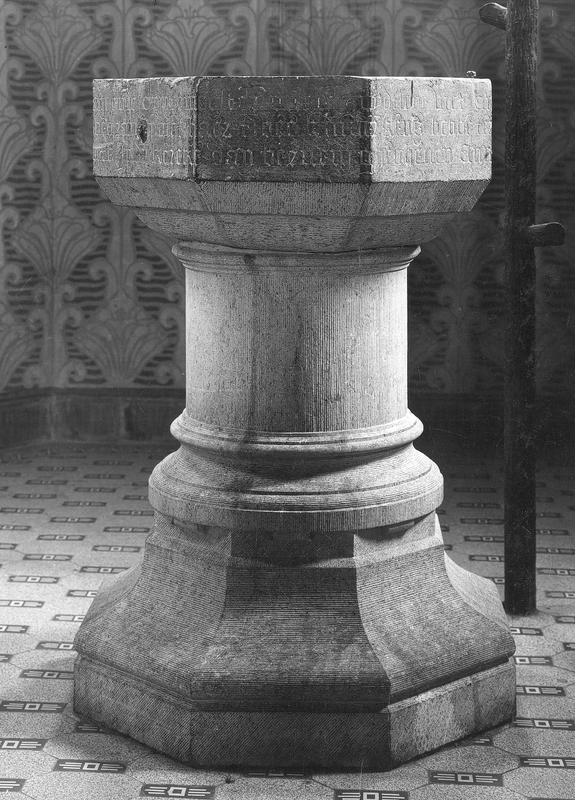
Image copyright © KIK-IRPA, Brussels (Belgium), 2026
CC-BY-4.0
Results: 5 records
view of font
Scene Description: the composite font [cf. FontNotes]
Copyright Statement: Image copyright © KIK-IRPA, Brussels (Belgium), 2026
Image Source: digital image of a 1953 B&W photograph [cliché B141994] https://balat.kikirpa.be/object/90381
Copyright Instructions: CC-BY-4.0
inscription - partial

Scene Description: " Doopvont in de Sint-Amanduskerk - Bloemendalestraat - Beernem - West-Vlaanderen - België.
Achtkantige doopvont van blauwe hardsteen met inscriptie: "ICK ISRAËLL JANSENS INGHELSMAN ENDE OPPERMEESTER VANDE ZUYDTLEYE, MET ANNA PRETTE MIJN WETTICK HUYSVROUV LIGGHENDE HIER BEGRAVEN MET HEUR TWEE KINDEKENS, HEBBEN TER EERE GODTS ENDE MARIA VERHEEVEN DESE VONTE INDE KERCKE VAN BEERNEM GHEGHEVEN ANNO 1619". Kuip van 1619 zie inscriptie geplaatst op een voet van 1900-1902, neogotisch deksel opgehangen aan smeedijzeren Boom des Levens."
Copyright Statement: Image copyright © Spotter2, 2020
Image Source: digital photograph 5 November 2020 by Spotter2
Copyright Instructions: CC-BY-SA-4.0
view of church exterior - northeasd view
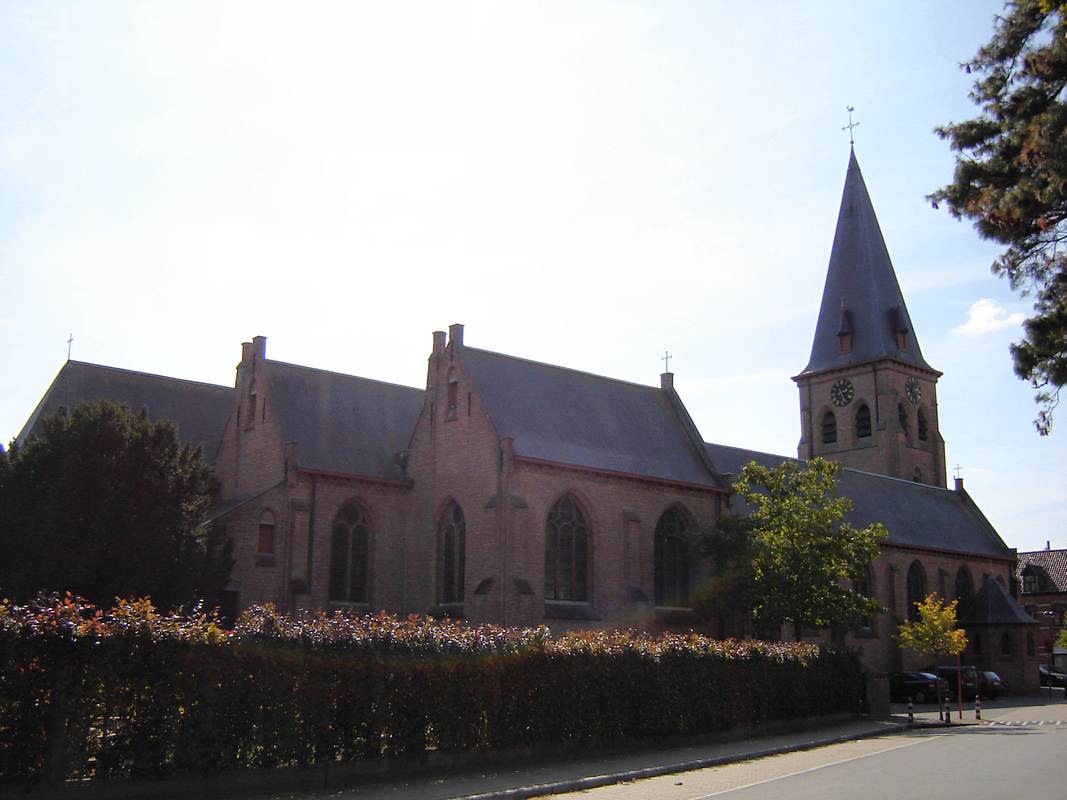
Scene Description: "Sint-Amanduskerk in Beernem"
Copyright Statement: Image copyright © LimoWreck, 2008
Image Source: digital photograph 21 September 2008 by LimoWreck
Copyright Instructions: CC-BY-SA-3.0
view of font and cover
Scene Description: "Doopvont in de Sint-Amanduskerk - Bloemendalestraat - Beernem - West-Vlaanderen - België.
Achtkantige doopvont van blauwe hardsteen met inscriptie: "ICK ISRAËLL JANSENS INGHELSMAN ENDE OPPERMEESTER VANDE ZUYDTLEYE, MET ANNA PRETTE MIJN WETTICK HUYSVROUV LIGGHENDE HIER BEGRAVEN MET HEUR TWEE KINDEKENS, HEBBEN TER EERE GODTS ENDE MARIA VERHEEVEN DESE VONTE INDE KERCKE VAN BEERNEM GHEGHEVEN ANNO 1619". Kuip van 1619 zie inscriptie geplaatst op een voet van 1900-1902, neogotisch deksel opgehangen aan smeedijzeren Boom des Levens." -- showing the composite font: 17thC basin on a modern replacement base; the 'cover' is also modern
Copyright Statement: Image copyright © Spotter2, 2020
Image Source: digital photograph 5 November 2020 by Spotter2
Copyright Instructions: CC-BY-SA-4.0
view of church interior - looking west
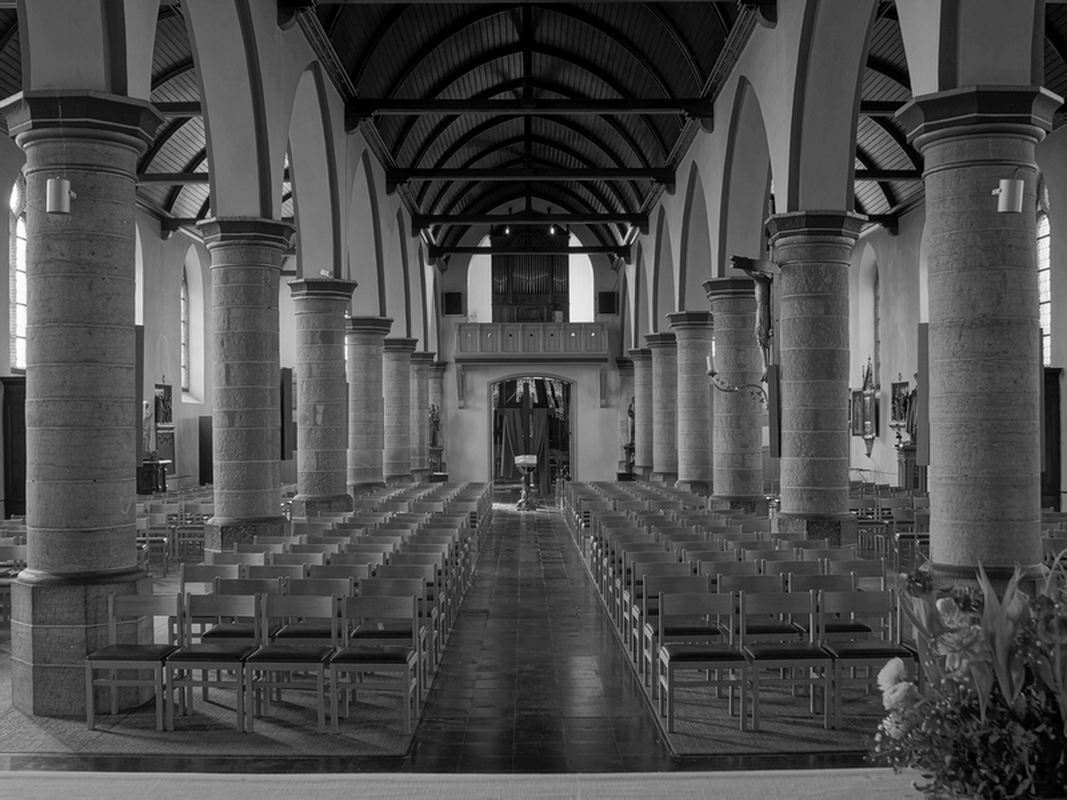
Scene Description: "Middenbeuk (achteraanzicht)" -- showing the font in the centre aisle, at the far end
Copyright Statement: Image copyright © IDD5000, 2015
Image Source: digital photograph 17 March 2015 by IDD5000
Copyright Instructions: CC-BY-SA-4.0
INFORMATION
Font ID: 26085WNN
Object Type: Baptismal Font1
Font Date: 1619
Font Century and Period/Style: 17th century (early) [basin only], [composite font]
Church / Chapel Name: Sint-Amanduskerk te Beernem
Font Location in Church: Inside, centre aisle, W end
Church Wikidata: https://nl.wikipedia.org/wiki/Sint-Amanduskerk_(Beernem)
Church Patron Saint(s): St. Amandus
Church Notes: 9thC original church? first stone church probably mid-12thC [cf. FontNotes]
Church Address: Bloemendalestraat 1, 8730 Beernem, Belgium
Site Location: West-Vlaanderen / Flandre Occidentale, Vlaanderen / Flandres, Belgium, Europe
Directions to Site: Located off the N370, about 15 km SE of Bruges
Ecclesiastic Region: Diocèse de Ghand / Bistum Ghent
Additional Comments: composite font (the whole base is a modern replacement) [cf. FontNotes]
Town/City Wikipedia: https://nl.wikipedia.org/wiki/Beernem
Font Notes:
Click to view
Baptismal font of 1619 listed and illustrated in BALaT KIK-IRPA [https://balat.kikirpa.be/object/90381] [accessed 28 January 2026]: "doopvont [...] arduin [...] datering, gebeiteld, bovenaan: gedat. opschrift Date: 1619 - 1619 [...] hoogte: 92 cm; diameter: 61 cm".
A communication to BSI from Pol Herman (e-mail of 16 January 2026) informs: "As early as 847, the French king Charles the Bald (Charles II le Chauve) decreed that the altar rights of “Berneham” were granted to the Abbey of Saint-Amand-les-Eaux. The oldest mention of a place of worship therefore dates from the 9th century. It is unknown which authority built the place of worship (presumably made of clay and wood) at that time. The parish originated in the 10th century. During the demolition of the existing church in 1899-1900, traces of a Romanesque church were discovered. This first stone building probably dated from around 1150. During his visit the bishop of Tournai, Walter de Marvis defined the boundaries of the parish in 1242. After 1580, during the reign of king Philip II of Spain, the church was destroyed following religious unrest. In 1608, a limited restoration was carried out. In 1644, the church was restored in the Gothic style. In 1802, after being closed for eight years by the French revolution, the church reopened its doors. During the 19th century, there was a significant population growth. In 1837, the building was enlarged. The church was demolished in 1901 and replaced by the current Neo-Gothic temple. Four old Romanesque limestone pillars from the previous church were preserved. Baptismal font: In 1613, work began on the digging of a canal between Ghent and Bruges, known as the Zuid-Lieve. This work would last until 1621. Many foreigners were recruited for the work, including a large team of Englishmen led by Israel Jansens. The church preserves a limestone baptismal font from 1619, donated by Israel Jansens in memory of his wife and children. It bears the following inscription in Gothic calligraphy and Middle Dutch: “Ick Istraëll Jansens Inghelsman ende Oppermeester vande Zuydtleye, met Anna Prette myn wettick huysvrouv ligghende hier begraven met heur twee kindekes, hebben ter eere Godts ende Maria verheeven dese vonte inde kercke van Beernem ghegheven anno XVI C XIX”. (I, Istraëll Jansens, Englishman and Chief Master of the Zuydtleye, and Anna Prette my lawful wife buried here with her two children, have raised this font in the church of Beernem in the year 1619 to the honor of God and Mary). Only the basin is original. The base and column were replaced in 1901. Probably because of the place needed for the long text, the design of the basin is atypical for Hainaut-type fonts of that time. https://balat.kikirpa.be/object/90381"
A communication to BSI from Pol Herman (e-mail of 16 January 2026) informs: "As early as 847, the French king Charles the Bald (Charles II le Chauve) decreed that the altar rights of “Berneham” were granted to the Abbey of Saint-Amand-les-Eaux. The oldest mention of a place of worship therefore dates from the 9th century. It is unknown which authority built the place of worship (presumably made of clay and wood) at that time. The parish originated in the 10th century. During the demolition of the existing church in 1899-1900, traces of a Romanesque church were discovered. This first stone building probably dated from around 1150. During his visit the bishop of Tournai, Walter de Marvis defined the boundaries of the parish in 1242. After 1580, during the reign of king Philip II of Spain, the church was destroyed following religious unrest. In 1608, a limited restoration was carried out. In 1644, the church was restored in the Gothic style. In 1802, after being closed for eight years by the French revolution, the church reopened its doors. During the 19th century, there was a significant population growth. In 1837, the building was enlarged. The church was demolished in 1901 and replaced by the current Neo-Gothic temple. Four old Romanesque limestone pillars from the previous church were preserved. Baptismal font: In 1613, work began on the digging of a canal between Ghent and Bruges, known as the Zuid-Lieve. This work would last until 1621. Many foreigners were recruited for the work, including a large team of Englishmen led by Israel Jansens. The church preserves a limestone baptismal font from 1619, donated by Israel Jansens in memory of his wife and children. It bears the following inscription in Gothic calligraphy and Middle Dutch: “Ick Istraëll Jansens Inghelsman ende Oppermeester vande Zuydtleye, met Anna Prette myn wettick huysvrouv ligghende hier begraven met heur twee kindekes, hebben ter eere Godts ende Maria verheeven dese vonte inde kercke van Beernem ghegheven anno XVI C XIX”. (I, Istraëll Jansens, Englishman and Chief Master of the Zuydtleye, and Anna Prette my lawful wife buried here with her two children, have raised this font in the church of Beernem in the year 1619 to the honor of God and Mary). Only the basin is original. The base and column were replaced in 1901. Probably because of the place needed for the long text, the design of the basin is atypical for Hainaut-type fonts of that time. https://balat.kikirpa.be/object/90381"
Credit and Acknowledgements: We are grateful to Pol Herman for bringing this font to our attention and for his help in documenting it
COORDINATES
UTM: 31U 523882 5665748
Latitude & Longitude (Decimal): 51.142692, 3.341397
Latitude & Longitude (DMS): 51° 8′ 33.69″ N, 3° 20′ 29.03″ E
MEDIUM AND MEASUREMENTS
Material: stone, limestone
Font Shape: octagonal (mounted)
Basin Interior Shape: round
Basin Exterior Shape: octagonal
Font Height (less Plinth): 92 cm*
Trapezoidal Basin: 61 cm*
Notes on Measurements: * [cf. FontNotes]
INSCRIPTION
Inscription Language: Dutch - Middle Dutch
Inscription Location: on the basin sides
Inscription Text: "Ick Istraëll Jansens Inghelsman ende Oppermeester vande Zuydtleye, met Anna Prette myn wettick huysvrouv ligghende hier begraven met heur twee kindekes, hebben ter eere Godts ende Maria verheeven dese vonte inde kercke van Beernem ghegheven anno XVI C XIX"
Inscription Notes: for an English translation cf. FontNotes
Inscription Source: [cf. FontNotes]
LID INFORMATION
Date: modern
Material: metal, brass?
Apparatus: side crane
Notes: round crown-shaped cover with crossed arches atop; hooked to side crane
REFERENCES
- KIK-IRPA, BALaT KIK-IRPA, 2024. URL: https://balat.kikirpa.be/.