Feschaux / Faisseaux / Fechå / Feissar, Feissaulx / Fescals / Fessaux
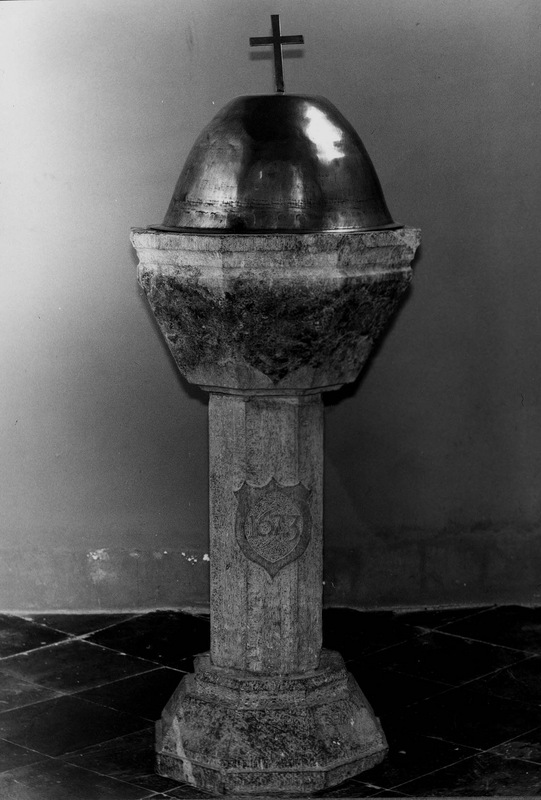
Image copyright © KIK-IRPA, Brussels (Belgium), 2026
CC-BY-4.0
Results: 1 records
view of font and cover
Scene Description: as shown in 1971
Copyright Statement: Image copyright © KIK-IRPA, Brussels (Belgium), 2026
Image Source: digital image of a 1971 B&W photograph [cliché M058971] in KIK-IRPA
Copyright Instructions: CC-BY-4.0
INFORMATION
Font ID: 26067GHC
Object Type: Baptismal Font1
Font Date: 1623
Font Century and Period/Style: 17th century (early)
Church / Chapel Name: Saint-Jean-Baptiste à Feschaux
Font Location in Church: Inside
Church Patron Saint(s): St. John the Baptist
Church Notes: church documented 1139; demolished 19thC; present church 1848 [cf. FontNotes]
Church Address: Rue des Firmandes 38, 5570 Beauraing, Belgium
Site Location: Namur, Wallonie / Wallonne, Belgium, Europe
Directions to Site: Located off (N) the N929, in the municipality of Firmandes, W of the N95, about 6 km NW of Beauraing, just E of the Border with France
Ecclesiastic Region: Diocèse de Namur
Additional Comments: disappeared font? (the one from te 12thC church here)
Town/City Wikipedia: https://fr.wikipedia.org/wiki/Feschaux
Font Notes:
Click to view
Baptismal font dated 1623 by an inscription listed and illustrated in BALaT KIK-IRPA [https://balat.kikirpa.be/object/10075260] [accessed 23 January 2026]: "fonts baptismaux [...] pierre calcaire [...] hauteur: 103 cm [...] datation, gravé, sur le socle: : 1623". Also listed in KIK-IRPA are two identical stone stoups of the mid-19th century [https://balat.kikirpa.be/object/10075259] [accessed 23 January 2026].
A communication to BSI from Pol Herman (e-mail of 21 December 2025) informs: "Feschaux. Cemetery used from Merovingian times up to the 12th century, with funeral chapel; église Saint-Jean-Baptiste 1075…1086 : Villa Fiscalium (the site where the tax is collected). Fescals, Fessaux, Faisseaux, Feissar, Feissaulx. At a location called Les Icoux, a Frankish/Merovingian cemetery containing 140 graves dating from between the 7th and 12th centuries was discovered. In the centre of these graves the remains of a square building were excavated. Several of the earliest tombs were destroyed by its foundations. A local legend recounts that a chapel dedicated to Saint John the Baptist once stood on this site. The interpretation of this building as a Christian oratory remains uncertain. The cemetery is located 2 km from the current village centre, thus continuity of occupation is unclear. Feschaux belonged to the lordship of Agimont. found 1075/1086—perhaps in 1076—Raguenus, priest of Feschaux, seized a portion of the “novales” tithes of the abbey of Saint-Hubert. He was caught in the act by provost Thierry—most likely the later abbot of Saint-Hubert Abbey—and the latter brought him before the court of Henry of Verdun, bishop of Liège, who was staying at Saint-Hubert Abbey. It appears that a procedure for flagrant offense was implemented before the episcopal synod. In fact, in addition to Thierry and Raguenus, the local “antiquiores vicini » were also summoned, acting as the Schreimannen (the heralds who cry to the people to pursue robbers), and by whose oath Raguenus was found guilty of his crime. Condemned to return the tithe he had stolen, he was also forced to transport it back to the abbey's barn by his own means. Arnulf II, count of Chiny, died in 1106. Before his death, he instructed his son, Otto II, then in Cologne, to relinquish the tithe of Feschaux and his property of Flohimont to the Abbey of Saint-Hubert. Until then, the pastor of Feschaux had collected the entire tithe from his parish. In 1139, Pope Innocent II confirmed that the following parishes owed offerings of the “croix bannaux” to the Abbey of Saint-Hubert: Feschaux. Very little seems to be known about the old church that was demolished in the 19th century. The current church was built in 1848.
Baptismal registers from 1688 onwards. The date 1623 is inscribed on the limestone baptismal font https://balat.kikirpa.be/object/10075260"
A communication to BSI from Pol Herman (e-mail of 21 December 2025) informs: "Feschaux. Cemetery used from Merovingian times up to the 12th century, with funeral chapel; église Saint-Jean-Baptiste 1075…1086 : Villa Fiscalium (the site where the tax is collected). Fescals, Fessaux, Faisseaux, Feissar, Feissaulx. At a location called Les Icoux, a Frankish/Merovingian cemetery containing 140 graves dating from between the 7th and 12th centuries was discovered. In the centre of these graves the remains of a square building were excavated. Several of the earliest tombs were destroyed by its foundations. A local legend recounts that a chapel dedicated to Saint John the Baptist once stood on this site. The interpretation of this building as a Christian oratory remains uncertain. The cemetery is located 2 km from the current village centre, thus continuity of occupation is unclear. Feschaux belonged to the lordship of Agimont. found 1075/1086—perhaps in 1076—Raguenus, priest of Feschaux, seized a portion of the “novales” tithes of the abbey of Saint-Hubert. He was caught in the act by provost Thierry—most likely the later abbot of Saint-Hubert Abbey—and the latter brought him before the court of Henry of Verdun, bishop of Liège, who was staying at Saint-Hubert Abbey. It appears that a procedure for flagrant offense was implemented before the episcopal synod. In fact, in addition to Thierry and Raguenus, the local “antiquiores vicini » were also summoned, acting as the Schreimannen (the heralds who cry to the people to pursue robbers), and by whose oath Raguenus was found guilty of his crime. Condemned to return the tithe he had stolen, he was also forced to transport it back to the abbey's barn by his own means. Arnulf II, count of Chiny, died in 1106. Before his death, he instructed his son, Otto II, then in Cologne, to relinquish the tithe of Feschaux and his property of Flohimont to the Abbey of Saint-Hubert. Until then, the pastor of Feschaux had collected the entire tithe from his parish. In 1139, Pope Innocent II confirmed that the following parishes owed offerings of the “croix bannaux” to the Abbey of Saint-Hubert: Feschaux. Very little seems to be known about the old church that was demolished in the 19th century. The current church was built in 1848.
Baptismal registers from 1688 onwards. The date 1623 is inscribed on the limestone baptismal font https://balat.kikirpa.be/object/10075260"
Credit and Acknowledgements: We are grateful to Pol Herman for bringing this font to our attention and for his help in documenting it
COORDINATES
Latitude & Longitude (Decimal): 50.15, 4.9
Latitude & Longitude (DMS): 50° 9′ 0″ N, 4° 54′ 0″ E
MEDIUM AND MEASUREMENTS
Material: stone, limestone
Font Shape: octagonal (mounted)
Basin Interior Shape: round
Basin Exterior Shape: octagonal
Font Height (less Plinth): 103 cm*
Notes on Measurements: [cf. FontNotes]
INSCRIPTION
Inscription Language: [numbers?]
Inscription Location: on the base
Inscription Text: 1623?
Inscription Notes: [cf. FontNotes]
Inscription Source: [cf. FontNotes]
LID INFORMATION
Material: metal, brass?
Notes: bell-shaped dome with Latic-cross finial
REFERENCES
- KIK-IRPA, BALaT KIK-IRPA, 2024. URL: https://balat.kikirpa.be/.