Flavion / Flavium
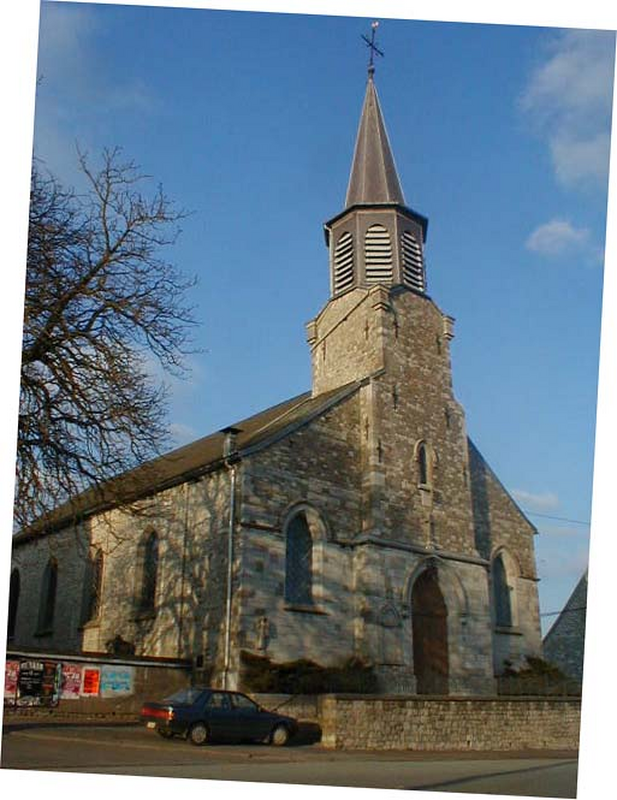
Image copyright © L. Mahin, 2007
GFDL / CC-BY-SA-3.0
Results: 1 records
view of church exterior - northwest end
Scene Description: "Church of Saint Martin in Flavion. Flavion, Florennes, Namur, Belgium"
Copyright Statement: Image copyright © L. Mahin, 2007
Image Source: digital photograph 25 March 2007 by L. Mahin
Copyright Instructions: GFDL / CC-BY-SA-3.0
INFORMATION
Font ID: 26064YYV
Object Type: Baptismal Font1?
Font Century and Period/Style: 12th century (?), Medieval?
Church / Chapel Name: Eglise Saint-Martin à Flavion
Church Patron Saint(s): St. Martin
Other Dedications: St. Walherus (5thC presbiter)
Church Notes: 12thC church [cf. FontNotes]
Church Address: Rue du Cobut 5/1, 5620 Florennes, Belgium
Site Location: Namur, Wallonie / Wallonne, Belgium, Europe
Directions to Site: Located off the N951, 8 km E of Florenne, about 25 km SW of Namur
Ecclesiastic Region: Diocèse de Namur
Additional Comments: disappeared font? (the one from the 12thC church here)
Font Notes:
Click to view
A communication to BSI from Pol Herman (email of 17 December 2025) informs: "Flavium (name mentionned in 1265) must have been a fairly important roman vicus in the second century AC. Remains of roman buildings, objects and cemetery testify of this. The occupation must have stretched to Frankish times (6th century), as tomb fields seem to indicate. All of these finds are located outside of the present village centre, and continuity of occupation is not proven. Among others, there was a long building divided into several rooms and ending in a semi-circular apse connected to another apse. Its lay-out seems to be reminiscent of cellae or primitive basilicas in Gallo-Roman villas. Based on this, some have hypothesized that a Christian oratory may have existed in the sixth century. Which is highly improbable. The mother-church (ecclesia integra) is mentioned in the 12th century. Gauthier (Galterus or Walterus), parish priest of Flavion and dean of Florennes, died in 1199. Not to be confused with Saint-Walhère). Philippe Le Noble (https://fr.wikipedia.org/wiki/Philippe_Ier_de_Namur) donna l’église de Flavion et la dîme du lieu aux religieux de l’abbaye de Brogne en 1212. « Philippus, comes Namurcensis, qui dedit nobis ecclesiam de Flavion integraliter, pro quo fiat anniversarium sollempne, et in canone semper ad omnibus memoriter habeatur. » (Obituaire de l’abbaye de Brogne) The village had a two-story, square defensive tower. The walls were 3 meters thick and there was no access at ground level. This keep had been destroyed by the Count of Lamarck, known as the "Wild Boar of the Ardennes". https://en.wikipedia.org/wiki/William_I_de_La_Marck. The village was ravaged by wars many times. In 1430: pillaging and sacking. In 1493, pillaging and deportation of prisoners. In 1554, further devastation. The local Saint Walhère (Walherus, Vohy) was priest of Flavion in the 12th century, before 1161. https://fr.wikipedia.org/wiki/Walh%C3%A8re_d%27Onhaye
https://www.memoireonline.com/11/12/6429/m_Les-doyens-ruraux-dans-le-diocese-de-liege-au-moyen-ge-Contribution--lhistoire-politique-e38.html
https://patrimoineculturel.cfwb.be/patrimoines-en-fwb/inventaire-du-patrimoine-mobilier-protege/pcmdetail/fwbpci-fiche/243/
https://balat.kikirpa.be/object/10092960 -- If one accepts that the Vita of Saint Walhère, written in 1603, is a legend and not historical, there is no certain trace of the cult of Saint Walhère before the end of the 15th century. Baptismal records begin in 1745. No information about a baptismal font"
https://www.memoireonline.com/11/12/6429/m_Les-doyens-ruraux-dans-le-diocese-de-liege-au-moyen-ge-Contribution--lhistoire-politique-e38.html
https://patrimoineculturel.cfwb.be/patrimoines-en-fwb/inventaire-du-patrimoine-mobilier-protege/pcmdetail/fwbpci-fiche/243/
https://balat.kikirpa.be/object/10092960 -- If one accepts that the Vita of Saint Walhère, written in 1603, is a legend and not historical, there is no certain trace of the cult of Saint Walhère before the end of the 15th century. Baptismal records begin in 1745. No information about a baptismal font"
Credit and Acknowledgements: We are grateful to Pol Herman for his help documenting this font
COORDINATES
UTM: 31U 622133 5567798
Latitude & Longitude (Decimal): 50.2497, 4.7131
Latitude & Longitude (DMS): 50° 14′ 58.92″ N, 4° 42′ 47.16″ E