Couvin / Cobinium / Covinium / Cowin / Cowing
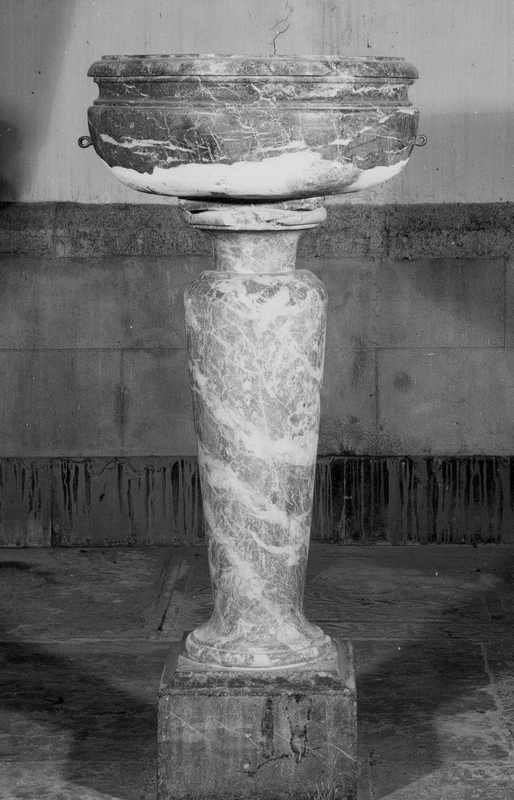
Image copyright © KIK-IRPA, 2026
CC-BY-NA-4.0
Results: 1 records
view of font
Scene Description: the 18thC font in this church
Copyright Statement: Image copyright © KIK-IRPA, 2026
Image Source: digital image of a 1976 B&W photograph [cliché M233734] [https://balat.kikirpa.be/object/10079544] [accessed 21 January 2026]
Copyright Instructions: CC-BY-NA-4.0
INFORMATION
Font ID: 26062IUT
Object Type: Baptismal Font1?
Font Century and Period/Style: 11th - 12th century (?), Medieval?
Cognate Fonts: We are gratefful to Pol Herman for his help documenting this font
Church / Chapel Name: Eglise Saint-Germain de Couvin [aka Notre-Dame]
Church Wikidata: https://fr.wikipedia.org/wiki/Église_Saint-Germain_de_Couvin
Church Patron Saint(s): St. Germanus
Church Address: Grand'Place, 5660 Couvin, Belgium
Site Location: Namur, Wallonie / Wallonne, Belgium, Europe
Directions to Site: Located off the N99-N5 crossroads, 11-12 km E of Chimay
Ecclesiastic Region: Diocèse de Namur
Additional Comments: disappeared font? (the one from the medieval church here)
Font Notes:
Click to view
The font in this church is lested and illustrated in BALaT KIK-IRPA [https://balat.kikirpa.be/object/10079544] [accessed 21 January 2026] as 118th-century.
A communication to BSI from Pol Herman (e-mail of 17 December 2025) informs: "Merovingian cemetery with Christian sanctuary? Disappeared castle chapel Notre-Dame. Disappeared Carolingian church Saint-Germain. 17th century parish church Notre-Dame, later Saint-Germain.
Cobinium, Covinium, Cowing, Cowin. Archaeological excavations have unearthed the remains of an ancient Merovingian cemetery at the site called “Tiene de la Chapelle”. The name of the location, the orientation of the tombs, the absence of grave gifts, the presence of a central small building consisting of two rooms which foundations cut through earlier Roman tombs led to the hypothesis that this had become a Christian burial site in the sixth century. However, the site is 2 km to the north-west of the town centre, and there is probably no historical continuity with present-day Couvin.
No traces of the existence of Couvin before ca. 829-843, when “Cubinium in pago Laumense” was given to the abbey of Saint-Germain-des-Prés by Louis le Pieux. This donation of « Cubinium » was confirmed by Charles le Chauve in 872. Monks from the Abbey of Saint-Germain-des-Prés in Paris built a Carolingian church, naturally placed under the patronage of Saint Germain. The church disappeared in the 18th century. In 919, without forming a priory, two monks of Saint-Germain (monachi ex monasterio sancti Germani)) perform in the villa of Couvin the divine service in honor of Saint-Venant (abott of Saint-Martin de Tours in the 4th century). It is unknown why his relics were at Couvin. In 1655, they were at the chapter of Saint-Venant at Tours. Later in the 10th century, the abbey donated the villa to Robert II, king of France, and the monks left Couvin. Through the marriage of Hadwige, daughter of Hugh Capet, and Renier IV, Count of Hainaut, Couvinum was part of the County of Hainaut from 996 to 1096. On June 16, 1096, Otbert, Prince-Bishop of Liège, purchased Couvin and all its dependencies from Baldwin II of Hainaut to finance his departure on crusade. In 1299, Couvin, already fortified, received the title of Good Town of the Principality of Liège. A castle chapel dedicated to Our Lady is mentioned in a document from 1218, describing the castle of Couvin (the castellum de Covino) on the hill above the city. As the town grew in importance, the chapel was replaced by a new parish church, dedicated to Our Lady, built within the fortifications, in the late 16th/early 17th century. The Carolingian-era Saint-Germain church been ruined by wars, this new church gradually eclipsed it during the 17th century. The old church still appears on the map of Ferraris (1770-1778), but was later demolished. With the exception of its tower topped by a Baroque-style bulbous spire dating from the early 18th century, the current church was rebuilt in the Neo-Gothic style in 1863-64, and then reconsecrated in 1870 to once again become the Church of Saint-Germain in memory of the pioneering monks of Saint-Germain-des-Prés. 18th c. baptismal font, no trace of older font.
https://balat.kikirpa.be/object/10079544"
A communication to BSI from Pol Herman (e-mail of 17 December 2025) informs: "Merovingian cemetery with Christian sanctuary? Disappeared castle chapel Notre-Dame. Disappeared Carolingian church Saint-Germain. 17th century parish church Notre-Dame, later Saint-Germain.
Cobinium, Covinium, Cowing, Cowin. Archaeological excavations have unearthed the remains of an ancient Merovingian cemetery at the site called “Tiene de la Chapelle”. The name of the location, the orientation of the tombs, the absence of grave gifts, the presence of a central small building consisting of two rooms which foundations cut through earlier Roman tombs led to the hypothesis that this had become a Christian burial site in the sixth century. However, the site is 2 km to the north-west of the town centre, and there is probably no historical continuity with present-day Couvin.
No traces of the existence of Couvin before ca. 829-843, when “Cubinium in pago Laumense” was given to the abbey of Saint-Germain-des-Prés by Louis le Pieux. This donation of « Cubinium » was confirmed by Charles le Chauve in 872. Monks from the Abbey of Saint-Germain-des-Prés in Paris built a Carolingian church, naturally placed under the patronage of Saint Germain. The church disappeared in the 18th century. In 919, without forming a priory, two monks of Saint-Germain (monachi ex monasterio sancti Germani)) perform in the villa of Couvin the divine service in honor of Saint-Venant (abott of Saint-Martin de Tours in the 4th century). It is unknown why his relics were at Couvin. In 1655, they were at the chapter of Saint-Venant at Tours. Later in the 10th century, the abbey donated the villa to Robert II, king of France, and the monks left Couvin. Through the marriage of Hadwige, daughter of Hugh Capet, and Renier IV, Count of Hainaut, Couvinum was part of the County of Hainaut from 996 to 1096. On June 16, 1096, Otbert, Prince-Bishop of Liège, purchased Couvin and all its dependencies from Baldwin II of Hainaut to finance his departure on crusade. In 1299, Couvin, already fortified, received the title of Good Town of the Principality of Liège. A castle chapel dedicated to Our Lady is mentioned in a document from 1218, describing the castle of Couvin (the castellum de Covino) on the hill above the city. As the town grew in importance, the chapel was replaced by a new parish church, dedicated to Our Lady, built within the fortifications, in the late 16th/early 17th century. The Carolingian-era Saint-Germain church been ruined by wars, this new church gradually eclipsed it during the 17th century. The old church still appears on the map of Ferraris (1770-1778), but was later demolished. With the exception of its tower topped by a Baroque-style bulbous spire dating from the early 18th century, the current church was rebuilt in the Neo-Gothic style in 1863-64, and then reconsecrated in 1870 to once again become the Church of Saint-Germain in memory of the pioneering monks of Saint-Germain-des-Prés. 18th c. baptismal font, no trace of older font.
https://balat.kikirpa.be/object/10079544"
Credit and Acknowledgements: We are grateful to Pol Herman for his help documenting this font
COORDINATES
UTM: 31U 607086 5545416
Latitude & Longitude (Decimal): 50.051389, 4.495833
Latitude & Longitude (DMS): 50° 3′ 5″ N, 4° 29′ 45″ E