Attenrode / Atorode / Aetrode
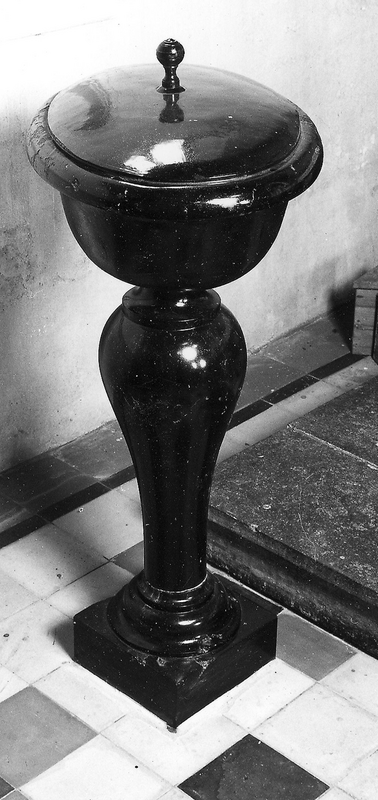
Image copyright © KIK-IRPA, 2026
CC-BY-NA-4.0
Results: 2 records
view of font and cover
Scene Description: the 18thC font [cf. FontNotes]
Copyright Statement: Image copyright © KIK-IRPA, 2026
Image Source: digital image of a 1974 B&W photograph [cliché M219036] by KIK [https://balat.kikirpa.be/object/5002] [accessed 20 January 2026]
Copyright Instructions: CC-BY-NA-4.0
view of church exterior - southwest view
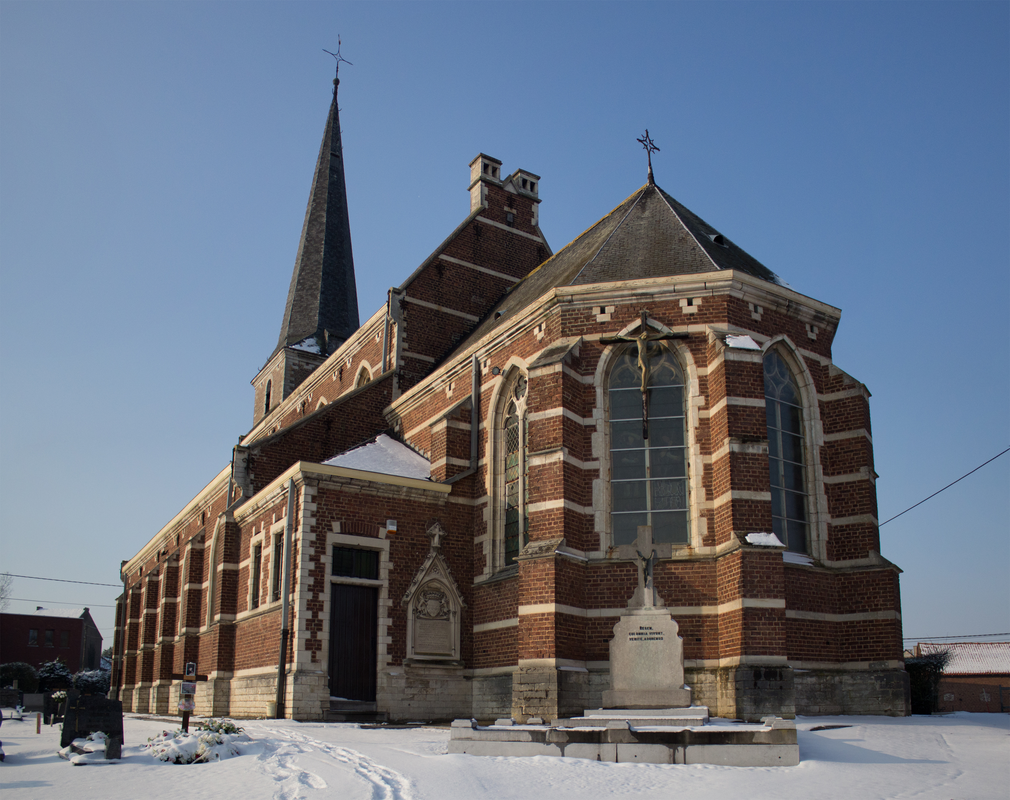
Scene Description: "Parochiekerk Sint-Andreas, Attenrode"
Copyright Statement: Image copyright © Johan Bakker, 2013
Image Source: digital photograph 16 January 2013 by Johan Bakker
Copyright Instructions: CC-BY-SA-3.0
INFORMATION
Font ID: 26054NPH
Object Type: Baptismal Font1
Font Century and Period/Style: 13th - 16th century (?), Medieval?
Church / Chapel Name: Sint Andries kerk Attenrode
Church Patron Saint(s): St. Andrew
Church Notes: church documented 1575 but existed much earlier as a 'quarter chapel'; present church is a 1911 re-building of a 17thC church
Church Address: Doelaagstraat 1/5, 3384 Glabbeek, Belgium -- Tel.: +32 474 72 14 82
Site Location: Vlaams-Brabant / Brabant Flamand, Vlaanderen / Flandres, Belgium, Europe
Directions to Site: Located off (W) the N29, in the municipality and 3 km WNW of Glabbeek, 11-12 km N of Tienen
Ecclesiastic Region: Diocèse de Bruxelles
Additional Comments: disappeared font? (the one from the original church here)
Font Notes:
Click to view
The present 18th-century baptismal font is listed and illustrated in BALaT KIK-IRPA [https://balat.kikirpa.be/object/5002] [accessed 20 January 2026]: "doopvont [...] Date: 1701 (onzeker) - 1800 (onzeker)".
A communication to BSI from Pol Herman (e-mail of 8 December 2025) informs: "Atorode, Aetrode, 1145: apud aterode. Attenrode was a small village, dependent on the court of nearby Kapellen. The claims of the chapter of St. John of Liège were confirmed in 1186 by Pope Urban III, who reigned from November 25, 1185, to October 20, 1187. In the Middle Ages, pastors were therefore appointed by the Chapter of St. John the Evangelist of Liège. The church was a quarter chapel. In 1575, the church had three bells. In 1623, the inhabitants of Attenrode sought refuge in the church, where they also transferred their belongings to keep them out of the hands of Spanish soldiers. Nevertheless, the latter plundered the church. The ciborium, however, escaped their plunder because the pastor of Attenrode had brought the treasure to safety in Tienen. The ruined tower was rebuilt in 1659. In 1705, troops of John Churchill, the Duke of Marlborough, who had breached the defense line of the French-Spanish troops at Wange, broke open the church door of Attenrode and stole the entire grain stock from the villagers, who had hidden it in the church for safekeeping. In 1724, lightning caused a fierce fire. The old church was a small building, 10 by 6 meters. It dated from the mid-17th century. The present church owes its appearance a very drastic renovation in 1911. The tower, dating from 1659, was adapted to the new church. Baptismal records exist since 1619. There is a 18th-century baptismal font. No information of older font. https://balat.kikirpa.be/object/5002".
A communication to BSI from Pol Herman (e-mail of 8 December 2025) informs: "Atorode, Aetrode, 1145: apud aterode. Attenrode was a small village, dependent on the court of nearby Kapellen. The claims of the chapter of St. John of Liège were confirmed in 1186 by Pope Urban III, who reigned from November 25, 1185, to October 20, 1187. In the Middle Ages, pastors were therefore appointed by the Chapter of St. John the Evangelist of Liège. The church was a quarter chapel. In 1575, the church had three bells. In 1623, the inhabitants of Attenrode sought refuge in the church, where they also transferred their belongings to keep them out of the hands of Spanish soldiers. Nevertheless, the latter plundered the church. The ciborium, however, escaped their plunder because the pastor of Attenrode had brought the treasure to safety in Tienen. The ruined tower was rebuilt in 1659. In 1705, troops of John Churchill, the Duke of Marlborough, who had breached the defense line of the French-Spanish troops at Wange, broke open the church door of Attenrode and stole the entire grain stock from the villagers, who had hidden it in the church for safekeeping. In 1724, lightning caused a fierce fire. The old church was a small building, 10 by 6 meters. It dated from the mid-17th century. The present church owes its appearance a very drastic renovation in 1911. The tower, dating from 1659, was adapted to the new church. Baptismal records exist since 1619. There is a 18th-century baptismal font. No information of older font. https://balat.kikirpa.be/object/5002".
Credit and Acknowledgements: We are grateful to Pol Herman for his help documenting this font
COORDINATES
UTM: 31U 635309 5637950
Latitude & Longitude (Decimal): 50.87737, 4.92332
Latitude & Longitude (DMS): 50° 52′ 38.53″ N, 4° 55′ 23.95″ E