Muno No. 2 / Monneau
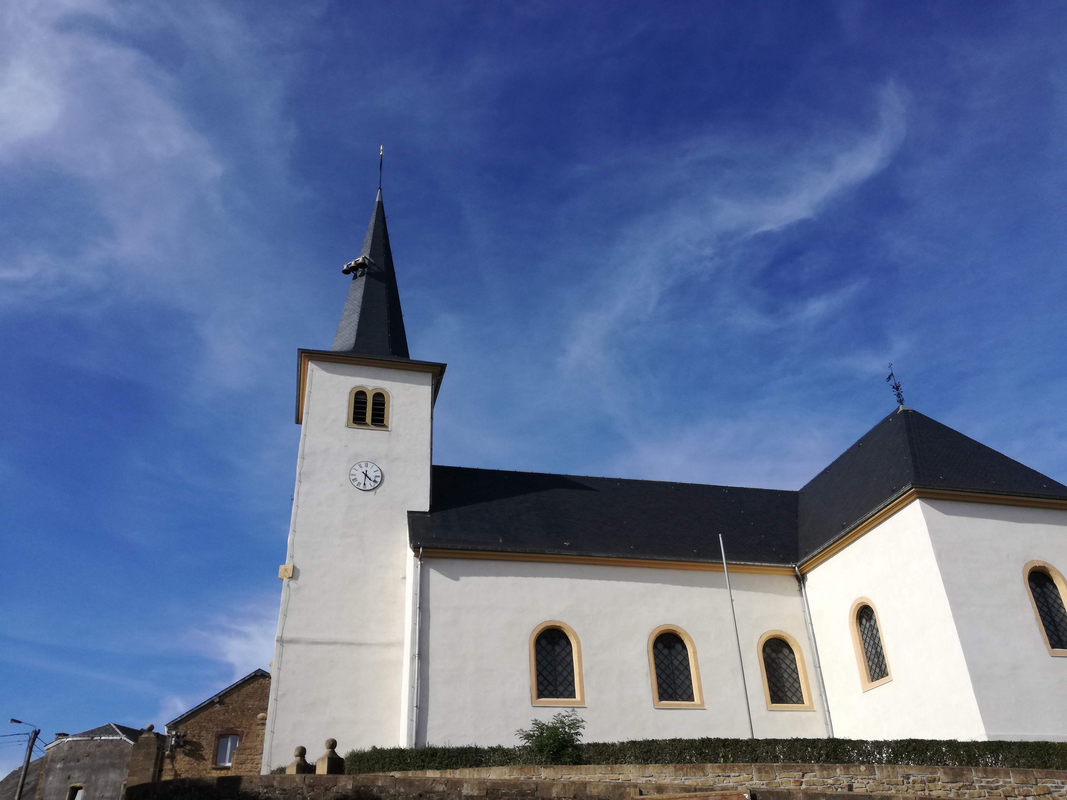
Image copyright © Butaes, 2018
CC-BY-SA-4.0
Results: 2 records
view of church exterior
Scene Description: Eglise de Saint-Martin, Muno, Florenville, Belgique
Copyright Statement: Image copyright © Butaes, 2018
Image Source: digital photograph 16 September 2018 by Butaes [https://commons.wikimedia.org/wiki/File:Saint-Martin,_Muno,_Florenville.jpg] [accessed 19 January 2026]
Copyright Instructions: CC-BY-SA-4.0
view of stoup
![[cf. FontNotes entry regarding the dating]](/static-50478a99ec6f36a15d6234548c59f63da52304e5/compressed/1260119003_compressed.png)
Scene Description: [cf. FontNotes entry regarding the dating]
Copyright Statement: Image copyright © KIK-IRPA, 2026
Image Source: digital image of a 1976 B&W photograph [cliché M253658] by IRPA [https://balat.kikirpa.be/object/10081588] [accessed 19 January 2026]
Copyright Instructions: CC-BY-NA-4.0
INFORMATION
Font ID: 26048NVH
Object Type: Stoup
Font Century and Period/Style: 19th century (?) / 17th century (?)
Cognate Fonts: [cf. FontNotes]
Church / Chapel Name: Eglise Saint-Martin de Muno
Font Location in Church: Inside
Church Patron Saint(s): St. Martin
Church Address: Muno Eglise, 6820 Florenville, Belgium
Site Location: Luxembourg / Luxemburg, Wallonie / Wallonne, Belgium, Europe
Directions to Site: Located off the N844, in the municipality and WNW of Florenville, just E of the border with France
Ecclesiastic Region: Diocèse de Namur
Additional Comments: the stoup and the font appear to be contemporary but the KIK-IRPA datings are totally different; Pol Herman suggests they should match [cf. FontNotes]
Town/City Wikipedia: https://fr.wikipedia.org/wiki/Muno
Font Notes:
Click to view
The holy-water stoup in this church is listed and illustrated in BALaT KIK-IRPA [https://balat.kikirpa.be/object/10081588] [accessed 19 January 2026]
[accessed 19 January 2026]: "bénitier [...] grès [...] hauteur: 110 cm [...] Date: 1801 - 1900" [cf. infra].
A communication to BSI from Pol Herman (e-mail of 4 January 2026) informs: "The Muno estate has always been important and was originally part of the possessions of the House of Ardennes, which had developed on the borders of the three bishoprics of Liège, Trier, and Reims. Following the Treaty of Verdun (843), Muno became the property of Count Herman, a descendant of Charlemagne. The oldest documents (990 ?) record the donation by the son of Godefroid le Barbu of the "predium" called "Monnau" to the Benedictine Abbey of St. Vanne in Verdun. The charter of confirmation by Emperor Conrad II granted, in 1031, to the Verdun monastery: four manses and a parish church. In the 11th century (around 1053), the monks established a simple priory in Muno from which they could administer their property. The first mention of a place of worship appears only in a charter of 1188, which mentions the Church of Saint Bartholomew. This name likely applies only to the priory chapel, since the parish church was dedicated to Saint Martin. There is evidence of a prior in 1208. Documentation is completely lacking for the period between 1346 and the 16th century. At the beginning of the 17th century, the ecclesiastical seigneury of Muno was ceded to the Jesuits of Liège. The entire complex was abandoned in 1773. The current parish church, with a single nave and a wide transept, was built in 1665 (dated) on the site of an older building, and is dedicated to Saint Martin of Tours. Baptismal records : 1797. The stoup and the baptismal font look very similar. Why one is dated 19th century and the other 1693 (inscription and name of donor Iuliot Marceau) is not clear. Their square design combined with gadroons is unique. https://balat.kikirpa.be/object/10081588 -- https://balat.kikirpa.be/object/10081590"
[accessed 19 January 2026]: "bénitier [...] grès [...] hauteur: 110 cm [...] Date: 1801 - 1900" [cf. infra].
A communication to BSI from Pol Herman (e-mail of 4 January 2026) informs: "The Muno estate has always been important and was originally part of the possessions of the House of Ardennes, which had developed on the borders of the three bishoprics of Liège, Trier, and Reims. Following the Treaty of Verdun (843), Muno became the property of Count Herman, a descendant of Charlemagne. The oldest documents (990 ?) record the donation by the son of Godefroid le Barbu of the "predium" called "Monnau" to the Benedictine Abbey of St. Vanne in Verdun. The charter of confirmation by Emperor Conrad II granted, in 1031, to the Verdun monastery: four manses and a parish church. In the 11th century (around 1053), the monks established a simple priory in Muno from which they could administer their property. The first mention of a place of worship appears only in a charter of 1188, which mentions the Church of Saint Bartholomew. This name likely applies only to the priory chapel, since the parish church was dedicated to Saint Martin. There is evidence of a prior in 1208. Documentation is completely lacking for the period between 1346 and the 16th century. At the beginning of the 17th century, the ecclesiastical seigneury of Muno was ceded to the Jesuits of Liège. The entire complex was abandoned in 1773. The current parish church, with a single nave and a wide transept, was built in 1665 (dated) on the site of an older building, and is dedicated to Saint Martin of Tours. Baptismal records : 1797. The stoup and the baptismal font look very similar. Why one is dated 19th century and the other 1693 (inscription and name of donor Iuliot Marceau) is not clear. Their square design combined with gadroons is unique. https://balat.kikirpa.be/object/10081588 -- https://balat.kikirpa.be/object/10081590"
Credit and Acknowledgements: We are grateful to Pol Herman for his help documenting this stoup
COORDINATES
Latitude & Longitude (Decimal): 49.717, 5.175
Latitude & Longitude (DMS): 49° 43′ 1.2″ N, 5° 10′ 30″ E
MEDIUM AND MEASUREMENTS
Material: stone, sandstone
Font Shape: square
Basin Exterior Shape: square
Font Height (less Plinth): 110 cm*
Notes on Measurements: [cf. FontNotes]