Baisy-Thy / Baisi / Baisy / Baisier / Baisieu / Baisiu / Båjhî / Basciu / Baseio / Basiers / Basieu / Basiu / Basy / Baziu / Bezy
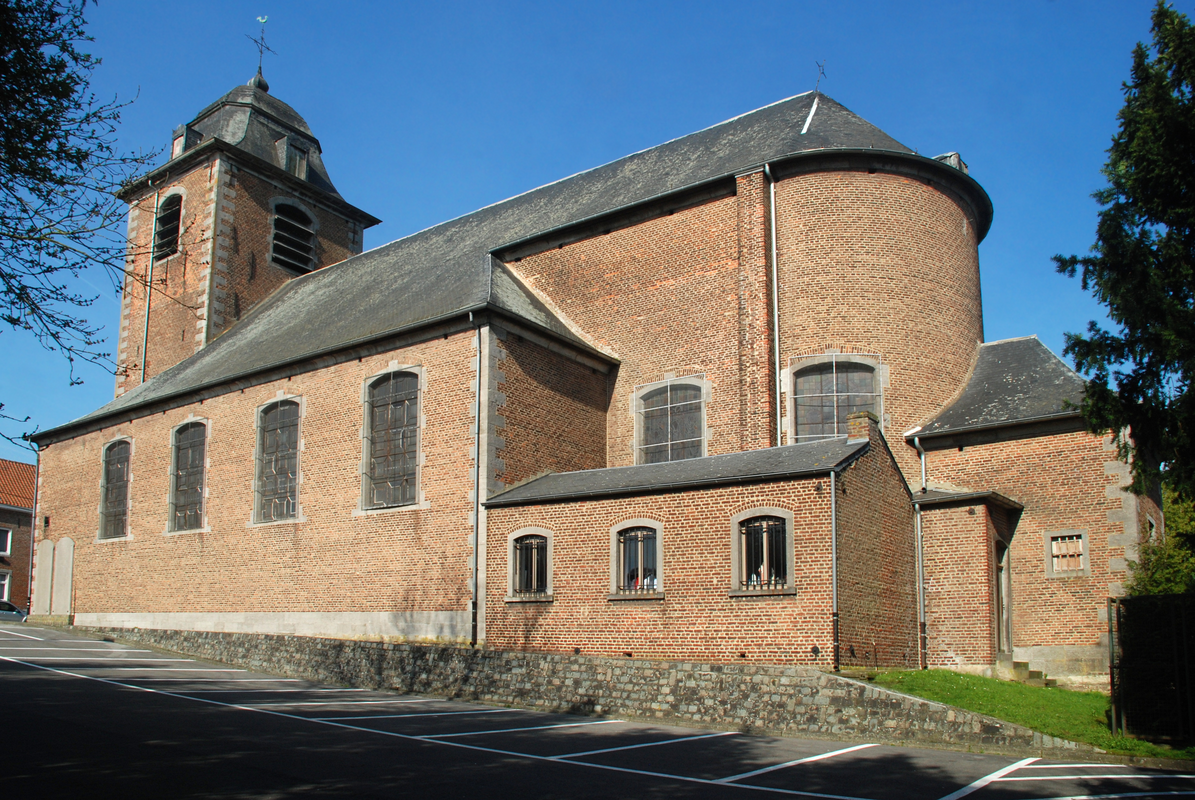
Image copyright © EmDee, 2017
CC-BY-SA-4.0
Results: 2 records
view of church exterior - southeast view
Scene Description: Belgique - Brabant wallon - Genappe - Baisy-Thy - Église Saint-Hubert
Copyright Statement: Image copyright © EmDee, 2017
Image Source: digital photograph 25 March 2017 by EmDee [https://commons.wikimedia.org/wiki/File:Eglise_Saint-Hubert_de_Baisy-Thy_-_Extérieur_-_02.jpg] [accessed 18nJanuary 2026]
Copyright Instructions: CC-BY-SA-4.0
view of font and cover in context

Image Source: source unknown
Copyright Instructions: IMAGE NOT FOR PUBLIC USE
INFORMATION
Font ID: 26045PFG
Object Type: Baptismal Font1
Font Century and Period/Style: 16th century (?), Late Gothic
Workshop/Group/Artisan: Hainaut type font
Church / Chapel Name: Eglise Saint-Hubert de Baisy-Thy (ancienne Notre-Dame
Font Location in Church: Inside
Church Wikidata: https://fr.wikipedia.org/wiki/Église_Saint-Hubert_de_Baisy-Thy
Church Patron Saint(s): St. Hubert
Other Dedications: St. Mary the Virgin
Church Address: rue Godefroid de Bouillon. 1470 Genappe, Belgium
Site Location: Brabant Wallon / Wallon Brabant, Wallonie / Wallonne, Belgium, Europe
Directions to Site: Located off (E) the N5, in the municipality and 5-6 km SSE of Genappe, 25-30 km N of Charleroi
Ecclesiastic Region: Diocèse de Bruxelles
Additional Comments: disappeared font? (the one from the medieval church here) -- famous-person font (the disappeared font said to be the one in which Godfrey of Bouillon was baptised [cf. FontNotes]
Town/City Wikipedia: https://fr.wikipedia.org/wiki/Baisy-Thy
Font Notes:
Click to view
Baptismal font in this church not listed in KIK-IRPA.
A communication to BSI from Pol Herman (e-mail of 15 January 2026) informs: "Basciu, Baseio, Baisiu, Basiers, Basiu, Baisi, Baziu, Baisieu, Basieu, Basy, Baisy, Baisier, Bezy,… 1018: King Henry II approves the transfer by Gerberga of France of some possessions to the monastery of Gembloux, located in the « parrochia Basciu ». In 1094: a charter concerning the Louvain family mentions "in Bazeio villa... in Bracbante."
Baisy, like Genappe, later passed to the Counts of Boulogne. Before 1096, Ide of Boulogne gave to the chapter of the church of Nivelles the "matrem ecclesiam in Baseio villa, que propria ab antiquo sui patrimonii in Bracbant erat, juxta Nivigellam". The church had therefore existed for a long time. The church was dedicated to Our Lady. It is located on a plateau, near the site formerly occupied by the local castle. It was bequeathed to the monastery of Saint-Hubert in 1096 and adopted Saint Hubert as its patron saint. The patronage, by virtue of an exchange agreement between the abbeys of Saint-Hubert and Aywières, had belonged to the latter community since 1253. In the 18th century, the churches in the region were falling into ruin because the tithe collectors were not concerned with their upkeep. The Austrian authorities demanded an improvement in the condition of the churches, which explains why several churches of Walloon Brabant were rebuilt during the second half of the 18th century. The current church in Baisy dates from 1763. In 1803, the Concordat made it a branch church (ecclesia media) of the parish of Houtain-le-Val. There is an octagonal, limestone, Hainaut-type, gothic font. Not included in KIK-IRPA. No good pictures. The present baptismal font is said to be from the 15th century, but I would suggest 16th c. The church being mentioned in 1096, and having been owned at that time by the famous family “de Boulogne”, there must have been an earlier font. The font of Baisy is part of the (legendary ?) description of the live of https://en.wikipedia.org/wiki/Godfrey_of_Bouillon, Godfrey of Bouillon, son of Eustace II, Count of Boulogne, and Ida of Ardennes, daughter of Godfrey, Duke of Lotharingia, was born in Baisy, according to the most widely accepted opinion of Belgian historians, around the middle of the 11th century (1061?). Jan van Boendale (https://en.wikipedia.org/wiki/Jan_van_Boendale), writing in the early years of the 14th century, speaks of Ida's habitual residence in Brabant: "She lived almost constantly," he says, "in Brussels and the surrounding area; she had, as is recorded, a house near Genappe, where she resided most often and where she raised her children herself." This passage coincides perfectly with the sentence from a Latin Chronicle of Brabant, where it is said that Godfrey, Baldwin and Eustace de Bouillon were born and raised in Baisy, near Genappe (nati tantem et nutrili sunt in Brabant, vidïlicet apud Baisiu apud Genapiam, castrum ducis Brabantie). Une “Vie d'Ide”, by Jean Gillemans (1427-1487), monk of the priory of Rouge-Cloître, adds new details to these ancient traditions. According to him, in his time, near Genappe, the baptismal font was still shown where Godfrey, Ide's eldest son, had been baptized: monstratur illic usque hodie fons sacri baptisterii in quo Godfridus eius primogenitus fertur fuisse initiatus. According to Blondeau (†1695), the mound or hill on which Godefroid's castle had been built was still visible in his time. It still exists, albeit much reduced, in a meadow east of the rectory, called Pré del Motte or Prairie à la Motte. Note that French historians claim that Godefroid was born and baptised in Boulogne and that his name should be Godefroid de Boulogne, arguing that the confusion is due to the Latin name of the cities Boulogne and Bouillon being the same: Boulonium."
A communication to BSI from Pol Herman (e-mail of 15 January 2026) informs: "Basciu, Baseio, Baisiu, Basiers, Basiu, Baisi, Baziu, Baisieu, Basieu, Basy, Baisy, Baisier, Bezy,… 1018: King Henry II approves the transfer by Gerberga of France of some possessions to the monastery of Gembloux, located in the « parrochia Basciu ». In 1094: a charter concerning the Louvain family mentions "in Bazeio villa... in Bracbante."
Baisy, like Genappe, later passed to the Counts of Boulogne. Before 1096, Ide of Boulogne gave to the chapter of the church of Nivelles the "matrem ecclesiam in Baseio villa, que propria ab antiquo sui patrimonii in Bracbant erat, juxta Nivigellam". The church had therefore existed for a long time. The church was dedicated to Our Lady. It is located on a plateau, near the site formerly occupied by the local castle. It was bequeathed to the monastery of Saint-Hubert in 1096 and adopted Saint Hubert as its patron saint. The patronage, by virtue of an exchange agreement between the abbeys of Saint-Hubert and Aywières, had belonged to the latter community since 1253. In the 18th century, the churches in the region were falling into ruin because the tithe collectors were not concerned with their upkeep. The Austrian authorities demanded an improvement in the condition of the churches, which explains why several churches of Walloon Brabant were rebuilt during the second half of the 18th century. The current church in Baisy dates from 1763. In 1803, the Concordat made it a branch church (ecclesia media) of the parish of Houtain-le-Val. There is an octagonal, limestone, Hainaut-type, gothic font. Not included in KIK-IRPA. No good pictures. The present baptismal font is said to be from the 15th century, but I would suggest 16th c. The church being mentioned in 1096, and having been owned at that time by the famous family “de Boulogne”, there must have been an earlier font. The font of Baisy is part of the (legendary ?) description of the live of https://en.wikipedia.org/wiki/Godfrey_of_Bouillon, Godfrey of Bouillon, son of Eustace II, Count of Boulogne, and Ida of Ardennes, daughter of Godfrey, Duke of Lotharingia, was born in Baisy, according to the most widely accepted opinion of Belgian historians, around the middle of the 11th century (1061?). Jan van Boendale (https://en.wikipedia.org/wiki/Jan_van_Boendale), writing in the early years of the 14th century, speaks of Ida's habitual residence in Brabant: "She lived almost constantly," he says, "in Brussels and the surrounding area; she had, as is recorded, a house near Genappe, where she resided most often and where she raised her children herself." This passage coincides perfectly with the sentence from a Latin Chronicle of Brabant, where it is said that Godfrey, Baldwin and Eustace de Bouillon were born and raised in Baisy, near Genappe (nati tantem et nutrili sunt in Brabant, vidïlicet apud Baisiu apud Genapiam, castrum ducis Brabantie). Une “Vie d'Ide”, by Jean Gillemans (1427-1487), monk of the priory of Rouge-Cloître, adds new details to these ancient traditions. According to him, in his time, near Genappe, the baptismal font was still shown where Godfrey, Ide's eldest son, had been baptized: monstratur illic usque hodie fons sacri baptisterii in quo Godfridus eius primogenitus fertur fuisse initiatus. According to Blondeau (†1695), the mound or hill on which Godefroid's castle had been built was still visible in his time. It still exists, albeit much reduced, in a meadow east of the rectory, called Pré del Motte or Prairie à la Motte. Note that French historians claim that Godefroid was born and baptised in Boulogne and that his name should be Godefroid de Boulogne, arguing that the confusion is due to the Latin name of the cities Boulogne and Bouillon being the same: Boulonium."
Credit and Acknowledgements: We are grateful to Polm Herman for his help documenting this font
COORDINATES
UTM: 31U 603737 5605670
Latitude & Longitude (Decimal): 50.5937, 4.46565
Latitude & Longitude (DMS): 50° 35′ 37.32″ N, 4° 27′ 56.34″ E
MEDIUM AND MEASUREMENTS
Material: stone
Font Shape: octagonal (mounted)
Basin Interior Shape: round
Basin Exterior Shape: octagonal
LID INFORMATION
Material: metal, brass
Notes: moulded dome with Latin-cross finial