Gottem
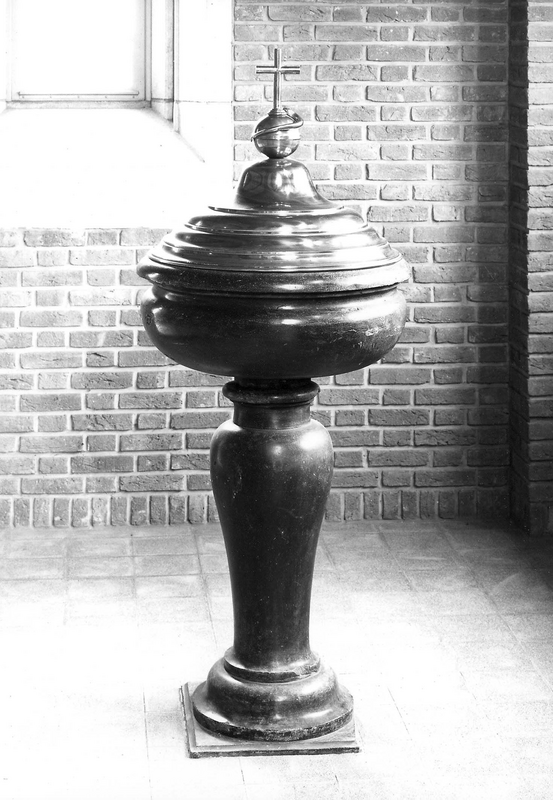
Image copyright © KIK-IRPA, 2026
CC-BY-NA-4.0
Results: 1 records
view of font and cover
Scene Description: the 18th-century font
Copyright Statement: Image copyright © KIK-IRPA, 2026
Image Source: digital image of a 1973 B&W photograph by Wildemeersch[studio], KIK [https://balat.kikirpa.be/object/69172] [accessed 8 January 2026]
Copyright Instructions: CC-BY-NA-4.0
INFORMATION
Font ID: 26031WKM
Object Type: Baptismal Font1?
Font Century and Period/Style: 12th - 13th century, Medieval
Church / Chapel Name: Kerk Sint-Martinus en Eutropius
Font Location in Church: Inside
Church Wikidata: https://nl.wikipedia.org/wiki/Sint-Martinus_en_Sint-Eutropiuskerk
Church Patron Saint(s): St. Martin & St. Eutropius
Church Notes: church first mentioned 1171; much modified since, damaged, re-bult and restored
Church Address: Ardense Jagersstraat-Gottem 8, 9800 Deinze, Belgium -- Tel.: +32 479 67 69 29
Site Location: Oost-Vlaanderen / Flandre Est, Vlaanderen / Flandres, Belgium, Europe
Directions to Site: Located off the N440, 6-7 km WSW of Deinze, 25-30 km WSW of Ghent
Ecclesiastic Region: Bisdom Gent / Diocèse de Gand
Additional Comments: disappeared font? (the one from the medieval church here)
Town/City Wikipedia: https://nl.wikipedia.org/wiki/Gottem
Font Notes:
Click to view
The present font, dated to the 18th century is listed and illustrated in BALaT KIK-IRPA [https://balat.kikirpa.be/object/69172] [accessed 8 January 2026]. [NB: we have no information on the font of the medieval church here].
A communication to BSI from Pol Herman (e-mail of 7 January 2026) informs: "The old Heirbaan is the connecting road between the villages of Gottem and Grammene and may have Roman origins. Archeological finds prove that the site was certainly already inhabited by the Romans.
Gottem was first mentioned in the Liber Traditionem of St. Peter's Abbey in Ghent (814-840) as Gothemia. Legend has it that two wealthy sisters Could not agree on the location of a new church. They each pursued their own agenda, resulting in two villages: Gottem and Grammene. There existed presumably an early medieval place of worship (see the location, the Germanic name, and the patrocinium saint Martin). In 1171, a church owned by the chapter of Tournai is mentioned. The square base of the crossing tower, made of Tournai stone in irregular bond, may be of Romanesque origin. At the end of the 13th century, there was a single-nave cruciform church, of which the early Gothic choir and transept have been preserved. Around 1400, an octagonal bell tower was built. In 1860, the single nave was replaced by a three-nave neo-Gothic structure. In 1918, and later in May 1940, the church was damaged. In 1941, the choir, transept, and tower were restored. A modern single-nave church was built between 1951 and 1953, preserving the old transept, choir, and tower. According to the visit report of the deacon, there was no baptismal font in 1613, and a stone jar containing baptismal water was kept in the tabernacle. However, the baptismal register begins precisely in that same year.
There is no trace of a 17th-century baptismal font (or an earlier one). The current font appears to date from the 18th century."
A communication to BSI from Pol Herman (e-mail of 7 January 2026) informs: "The old Heirbaan is the connecting road between the villages of Gottem and Grammene and may have Roman origins. Archeological finds prove that the site was certainly already inhabited by the Romans.
Gottem was first mentioned in the Liber Traditionem of St. Peter's Abbey in Ghent (814-840) as Gothemia. Legend has it that two wealthy sisters Could not agree on the location of a new church. They each pursued their own agenda, resulting in two villages: Gottem and Grammene. There existed presumably an early medieval place of worship (see the location, the Germanic name, and the patrocinium saint Martin). In 1171, a church owned by the chapter of Tournai is mentioned. The square base of the crossing tower, made of Tournai stone in irregular bond, may be of Romanesque origin. At the end of the 13th century, there was a single-nave cruciform church, of which the early Gothic choir and transept have been preserved. Around 1400, an octagonal bell tower was built. In 1860, the single nave was replaced by a three-nave neo-Gothic structure. In 1918, and later in May 1940, the church was damaged. In 1941, the choir, transept, and tower were restored. A modern single-nave church was built between 1951 and 1953, preserving the old transept, choir, and tower. According to the visit report of the deacon, there was no baptismal font in 1613, and a stone jar containing baptismal water was kept in the tabernacle. However, the baptismal register begins precisely in that same year.
There is no trace of a 17th-century baptismal font (or an earlier one). The current font appears to date from the 18th century."
Credit and Acknowledgements: We are grateful tp Pol Herman for his infomation on this font and site
COORDINATES
UTM: 31U 532549 5645958
Latitude & Longitude (Decimal): 50.964311, 3.463506
Latitude & Longitude (DMS): 50° 57′ 51.52″ N, 3° 27′ 48.62″ E