Assebroek / Ars(e)brouc / Ascebroc / Ver-Assebroek
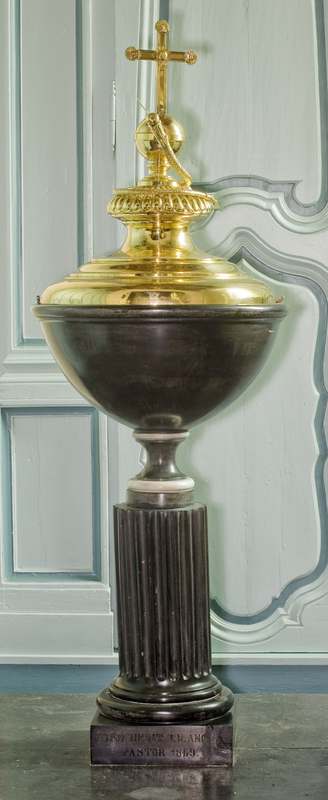
Image copyright © KIK-IRPA, Brussels (Belgium), 2026
CC-BY-4.0
Results: 2 records
view of font and cover
Scene Description: mid-19thC font with inscription: "DONO DEDIT R.D.ANCILLIS PASTOR 1869"
Copyright Statement: Image copyright © KIK-IRPA, Brussels (Belgium), 2026
Image Source: digital photograph [cliché X038564] 2010 by Arijs, Hilke, KIK https://balat.kikirpa.be/object/89587
Copyright Instructions: CC-BY-4.0
view of church exterior - southwest view
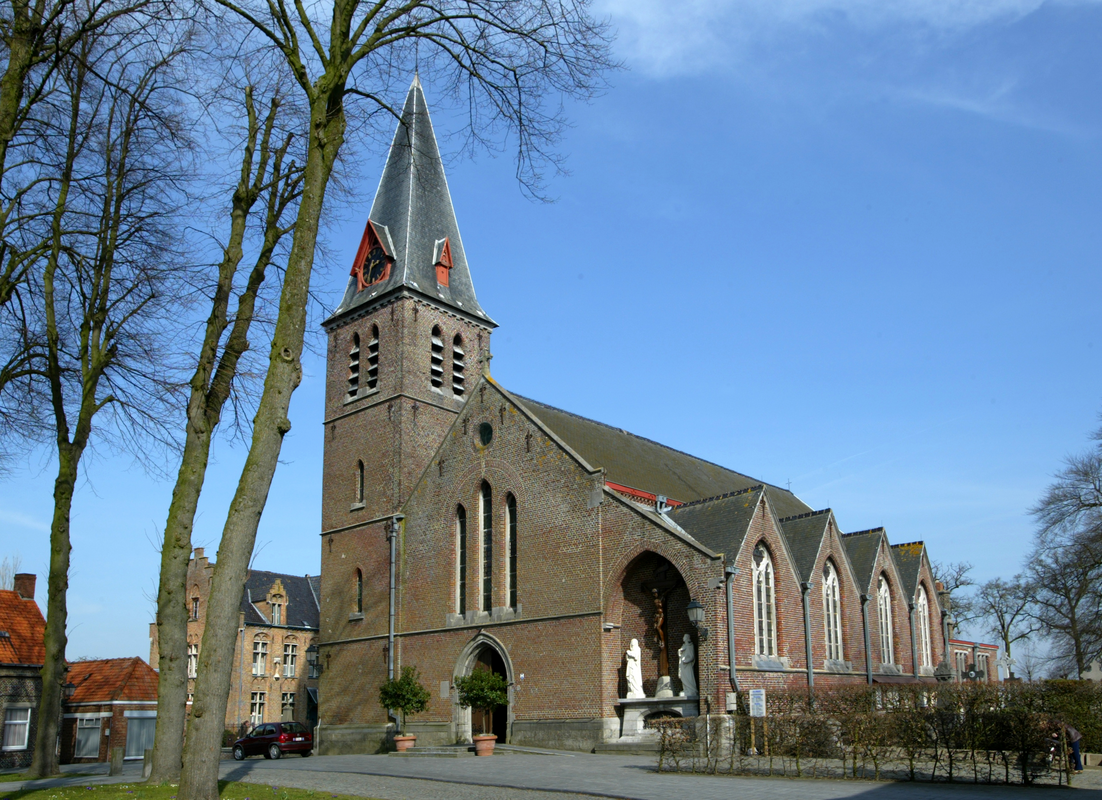
Scene Description: "Onze-Lieve-Vrouw Onbevlekte Ontvangeniskerk te Assebroek"
Copyright Statement: Image copyright © Kris Vandevorst, 2005
Image Source: digital photograph 2005 by Vandevorst, Kris
Copyright Instructions: CC-BY-SA-4.0
INFORMATION
Font ID: 25982ASS
Object Type: Baptismal Font1?
Font Date: n.d.
Font Century and Period/Style: 12th century (?), Romanesque?
Church / Chapel Name: Kerk O.L.Vrouw Onbevlekt Ontvangen [formerly Maria-Magdalenakerk], Assebroek
Font Location in Church: disappeared
Church Patron Saint(s): St. Mary the Virgin [formerly dedicated to St. Mary Magdalene]
Church Notes: [cf. FontNotes]
Church Address: Pastoor Verhaegheplein, 8310 Brugge, Belgium -- Tel.: +32 50 37 76 82
Site Location: West-Vlaanderen / Flandre Occidentale, Vlaanderen / Flandres, Belgium, Europe
Directions to Site: Located off the N337 [aka Astridla an], just S of Ver-Assebroek town centre, in the SE outskirts of Bruges
Ecclesiastic Region: Bisdom Brugge / Diocèse de Bruges
Additional Comments: disappeared font? (the one from the 12thC church here?)
Town/City Wikipedia: https://nl.wikipedia.org/wiki/Assebroek
Font Notes:
Click to view
The modern font in this church is listed and illustrated in BALaT KIK-IRPA [https://balat.kikirpa.be/object/89587] [accessed 28 November 2025]. A more recent digital photograph of this modern font, taken 24 Match 2022 by Spotter2, may be seen in Wikimedia [https://commons.wikimedia.org/wiki/File:Doopvont_-_Onze-Lieve-Vrouw-Onbevlekt-Ontvangenkerk_-_Ver-Assebroek.jpg] [accessed 28 November 2025].
A communication to BSI from Pol herman (e-mail of 27 November 2025) informs: "The original settlement of Assebroek is located on the site of present-day Ver-Assebroek. Ascebroc or Ars(e)brouc, was first mentioned in 1187. As early as the end of the 12th century, a chapel or small church for this modest parish, founded by the lords of Assebroek and dedicated to Mary Magdalene, is said to have existed. Documents from 1242 and 1286 mention the burial of nobles in the church choir. In 1572, the church was destroyed by the Geuzen (Beggars). The wall and tower were demolished around 1578, and the ruins remained visible for 50 years. Reconstruction of a new church building began around 1628, initiated by Jacques de Noyelles, the lord of Assebroek, the pastor Jan Bringhendal, and the patron Niklaas van Houtte. The single-nave church, with its small bell tower, was consecrated on July 3, 1633, and rededicated to Mary Magdalene. In 1797, during the French occupation, the church was closed and its furnishings sold. In 1803, the parish of Assebroek, together with the then parish of Sint-Katarina (with the lost village of Odegem), became the independent municipality of Assebroek. The municipality was given the name of Assebroek, the only parish then still with a church. The church was enlarged in the Neo-Gothic style between 1887 and 1890. No trace of original font Marble font in Empire style, gift by priest Ancillis, dated 1869."
A communication to BSI from Pol herman (e-mail of 27 November 2025) informs: "The original settlement of Assebroek is located on the site of present-day Ver-Assebroek. Ascebroc or Ars(e)brouc, was first mentioned in 1187. As early as the end of the 12th century, a chapel or small church for this modest parish, founded by the lords of Assebroek and dedicated to Mary Magdalene, is said to have existed. Documents from 1242 and 1286 mention the burial of nobles in the church choir. In 1572, the church was destroyed by the Geuzen (Beggars). The wall and tower were demolished around 1578, and the ruins remained visible for 50 years. Reconstruction of a new church building began around 1628, initiated by Jacques de Noyelles, the lord of Assebroek, the pastor Jan Bringhendal, and the patron Niklaas van Houtte. The single-nave church, with its small bell tower, was consecrated on July 3, 1633, and rededicated to Mary Magdalene. In 1797, during the French occupation, the church was closed and its furnishings sold. In 1803, the parish of Assebroek, together with the then parish of Sint-Katarina (with the lost village of Odegem), became the independent municipality of Assebroek. The municipality was given the name of Assebroek, the only parish then still with a church. The church was enlarged in the Neo-Gothic style between 1887 and 1890. No trace of original font Marble font in Empire style, gift by priest Ancillis, dated 1869."
Credit and Acknowledgements: We are grateful to Pol Herman for bringing this site to our attention and for his help documenting it.
COORDINATES
UTM: 31U 519205 5670754
Latitude & Longitude (Decimal): 51.187881, 3.274806
Latitude & Longitude (DMS): 51° 11′ 16.37″ N, 3° 16′ 29.3″ E
REFERENCES
- KIK-IRPA, BALaT KIK-IRPA, 2024. URL: https://balat.kikirpa.be/.