Mainz No. 5 / Maguntia / Meyence
Results: 3 records
view of basin - fragment
design element - patterns - tracery
Scene Description: [cf. FontNotes]
view of font in context
![the fragment of the Gothic font originally from Bodenheim as displayed in the Dom- und Diözesanmuseum Mainz [cf. FontNotes]](/static-50478a99ec6f36a15d6234548c59f63da52304e5/others/permission_not_available.jpg)
Scene Description: the fragment of the Gothic font originally from Bodenheim as displayed in the Dom- und Diözesanmuseum Mainz [cf. FontNotes]
INFORMATION
Font ID: 25160MAI
Object Type: Baptismal Font1, basin only
Font Date: n.d.
Font Century and Period/Style: 14th - 15th century [basin only, Gothic [basin only]
Museum: Dom- und Diözesanmuseum Mainz / Lapidarium des Dommuseums zu Mainz
Church / Chapel Name: Dom- und Diözesanmuseum Mainz
Font Location in Church: [cf. FontNotes]
Previous Font Location(s): originally from the Katholische Pfarrkirche St. Alban? Later in the Heimatsmuseum in Bodenheim, Am Dollesplatz 3 (im Bürgerhaus Dolles), Bodenheim
Church Notes: two previous buildings (12th and 17thC) preceded the present 19thC church in Bodenheim
Church Address: [address & coordinates are for the Mainz Dom] Markt 10, 55116 Mainz, Germany -- Tel.: +49 6131 253412
Site Location: Mainz-Bingen, Rheinland-Pfalz, Germany, Europe
Directions to Site: The Dom is located near the market, in the old city centre, W of the L431 [aka Rheinstrasse], on the W bank of the Rhein river, 25-30 km WSW of Frankfurt-am-Main
Ecclesiastic Region: Bistum Mainz
Additional Comments: disused font / fragment of a font
Font Notes:
Click to view
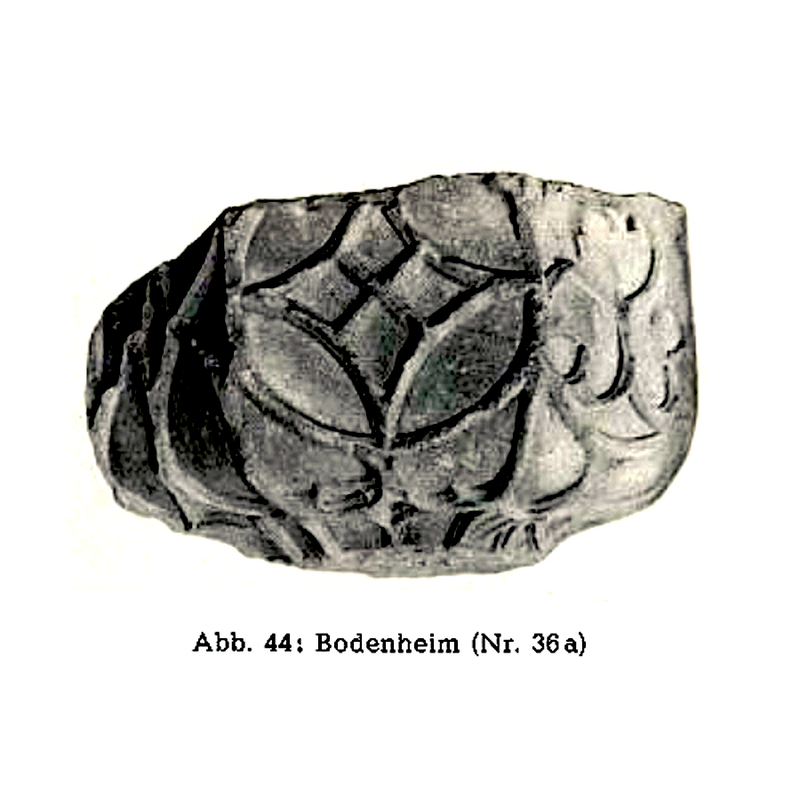
A high-medieval baptismal font originally from Bodenheim is reported in the Lapidarium des Dommuseums in Meinz in Azzola (1995-1996). Catalogued and illustrated in Böcher (1961-1962) as a fragment of a basin described as the surviving fragment of an octagonal basin of sandstone located now [i.e. ] in the interior of Mainz cathedral [https://www.worms.de/neu-de-wAssets/docs/bildung-bieten/Stadtarchiv/Wormsgau/Der-Wormsgau-5-1961-1962/Nr.3_bd.5WG_-5.-Band.pdf] [accessed 16 December 2023] as "Bodenheim bei Mainz (Rheinhessen), ehemals Katholische Pfarrkirche St. Alban (jetzt Mainz, Dom- und Diözesanmuseum); the corresponding illustration in this source, however, shows a basin decorated with Gothic tracery [cf. ImagesArea] ["Die achtseitige Kuppa aus gelblichem Sandstein, deren Fuß verloren ist, wird zur Zeit im Mainzer Domkreuzgang aufbewahrt. Trotz teilweise schwerer Beschädigungen verrät der in Dekoration und Maßen mit Weisenau (Nr. 36) unmittelbar verwandte Stein hohe kunsthandwerkliche Qualität. Die geraden Felder der Kuppa weisen Maßwerkblenden aus unterschiedlich zusammengeordneten genasten Fischblasen und Kreuzbogen auf; der stark verjüngte konische Unterteil ist regelmäßig mit genasten Fischblasen dekoriert"].
Credit and Acknowledgements: We are grateful to Pol Herman for bringing this font to our attention and for his help in documenting it
COORDINATES
UTM: 32U 447961 5538760
Latitude & Longitude (Decimal): 49.998889, 8.273889
Latitude & Longitude (DMS): 49° 59′ 56″ N, 8° 16′ 26″ E
MEDIUM AND MEASUREMENTS
Material: stone, sandstone
Font Shape: basin
Basin Interior Shape: round
Basin Exterior Shape: round
REFERENCES
- Böcher, Otto, "Die Entwicklung des Löwentaufsteins in der hessischen und rheinfränkischen Gotik", 5 (1961/1962), Der Wormsgau, 1961-1962, pp. 31-84. Abb. 30-62; [https://www.worms.de/neu-de-wAssets/docs/bildung-bieten/Stadtarchiv/Wormsgau/Der-Wormsgau-5-1961-1962/Nr.3_bd.5WG_-5.-Band.pdf] [accessed 16 December 2023]