Gustrow No. 2 / Guestrow / Gustrovium / Güstrow / Gustrowe
Results: 9 records
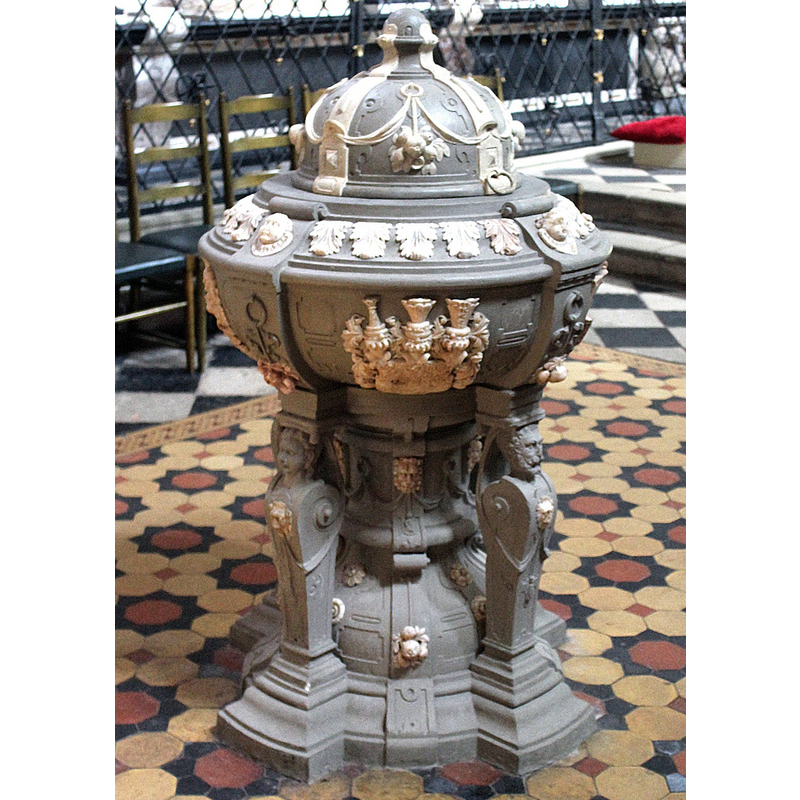
view of font and cover
Scene Description: Source caption: "Güstrow, Dom, das Taufbecken"
view of font and cover
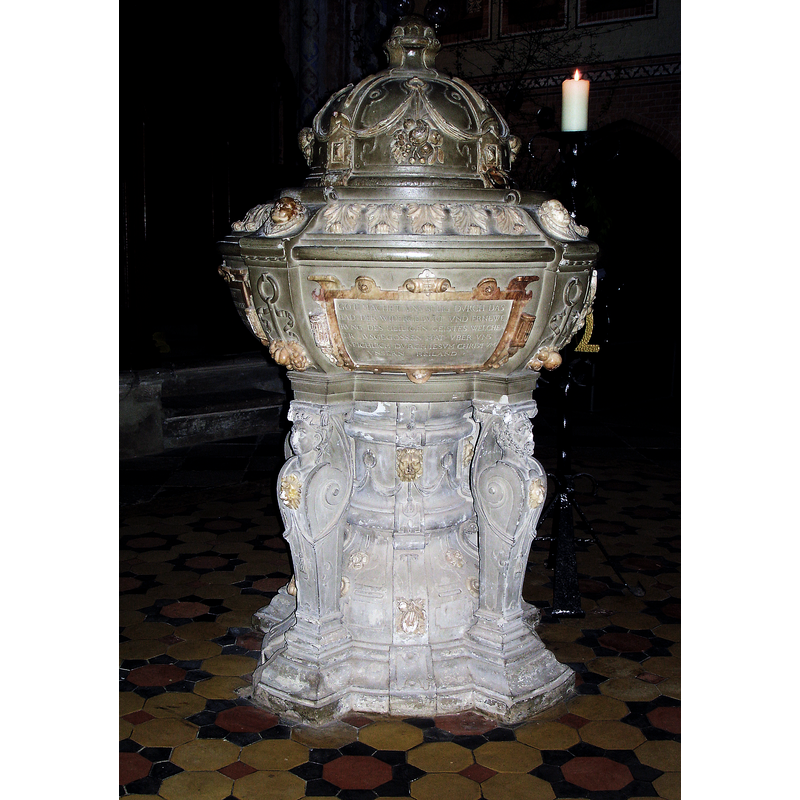
Scene Description: Source caption: "Guestrow Dom Taufstein 1591"
view of font and cover
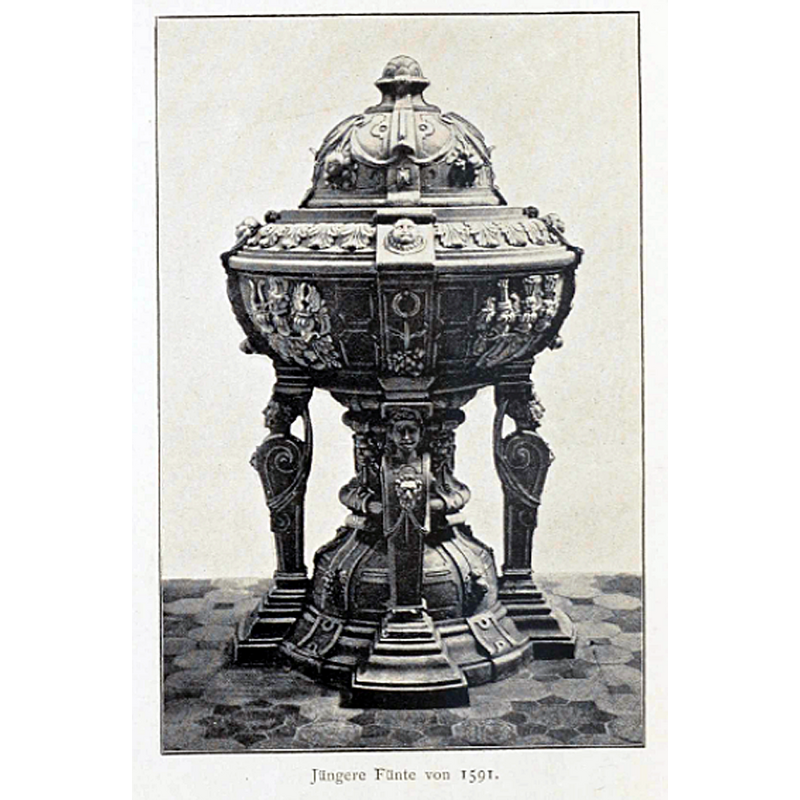
Scene Description: the baptismal font of 1591
symbol - shield - coat of arms - Ulrich and Anna
Scene Description: the donors of the font [cf. FontNotes]
inscription - in a cartouche
Scene Description: at least two of them; the one seen here is a text from Titus, 2+
human figure - bust or demi-figure - 3
Scene Description: [cf. FontNotes]
animal - mammal - lion - head
Scene Description: several such around the base
design element - motifs - floral
Scene Description: many of them around the base
design element - motifs - varied
Scene Description: mouldings, cartouches, etc., all around the base
INFORMATION
Font ID: 25128GUS
Object Type: Baptismal Font1
Font Date: 1592
Font Century and Period/Style: Renaissance
Workshop/Group/Artisan: heraldic font / by Claus Midow, school of Philippe Brandin
Church / Chapel Name: Evangelish-lutherische Güstrower Dom St. Maria, St. Johannes Evangelista und St. Cäcilia
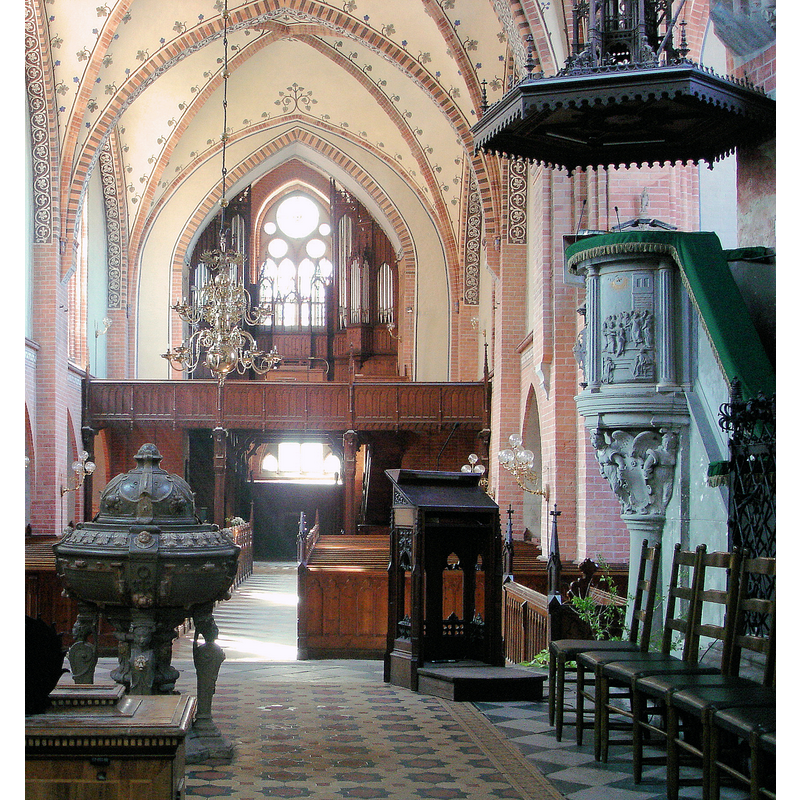
Font Location in Church: Inside the church
Church Patron Saint(s): St. Mary the Virgin?, St. John the Baptist and St. Cecilia
Church Notes: original church completed 1335 [it is a collegiate church, not officially a cathedral, despite the name]
Church Address: Dompl. 4, 18273 Güstrow, Germany
Site Location: Rostock, Mecklenburg-Vorpommern, Germany, Europe
Directions to Site: Güstrow is located off the Bd104, about 40 km S of Rostck. The church is located inside the town walls, in the SW area
Font Notes:
Click to view
The Dom zu Güstrow site [https://dom-guestrow.de/08-taufstein.html] [accessed 5 December 2023] describes and illustrates a baptismal font in this church [https://dom-guestrow.de/08-taufstein.html] [accessed 5 December 2023], a Renaissance baptismal font made in 1592 by Claus Midow, school of Philippe Brandin, bearing the armorial devices of the donors, Ulrich and Anna; the font is made of stone and alabaster, and is supported by three pillars incorporating human busts, one of which represents the Greek god Hermes; the matching font cover is made of wood. ["Die Renaissance-Taufe wurde von Brandins Schülern 1592 geschaffen. Die Wappen deuten auf die Stifter: Ulrich und Anna. Die Taufe ist aus Sandstein und Alabaster, die Haube aus Holz. Das Becken wird von Hermenpilastern getragen. Hermes ist der Götterbote und Seelenführer der griechischen Götterwelt, hieran wird wieder deutlich, wie die Renaissance die antike Welt und die christliche Welt miteinander verband"].
Credit and Acknowledgements: We are grateful to Pol Herman for his help documenting this font
COORDINATES
Latitude & Longitude (Decimal): 53.791, 12.1734
Latitude & Longitude (DMS): 53° 47′ 27.6″ N, 12° 10′ 24.24″ E
MEDIUM AND MEASUREMENTS
Material: stone, [partly alabaster]
Font Shape: hemispheric, mounted
Basin Exterior Shape: round
INSCRIPTION
Inscription Language: German
Inscription Text: 1) "GOT MACHET VNS SELIG DVRCH DAS / BAD DER WIDERGEBVRT VND ERNEWE/RVNG DES HEILIGEN GEISTES WELCHEN/ER AVSGEGOSSEN HAT VBER VNS / REICHICH DVURCH IESVM CHRISTVM / VNSERN HEILAND"
2) N/A
Inscription Notes: 1) appears to be a version of Titus 2+
2) N/A
LID INFORMATION
Material: wood
Apparatus: no
Notes: [cf. FontNotes]