Kalmar no. 2
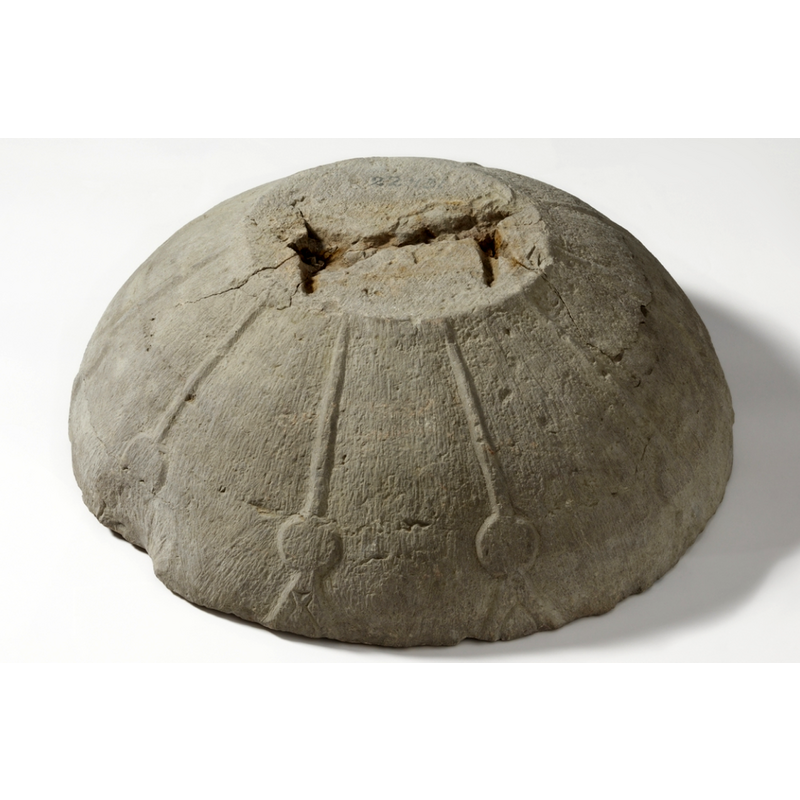
Image copyright © Pierre Rosberg / Kalmar Läns Museum , 2017
CC-BY-NC-ND-4.0
Results: 4 records
view of basin - fragment
Scene Description: Source caption: "Dopfunt. KLM 22431. Dopfunt, del av. Av kalksten, huggen. Botten av cuppan till godronnerad funt. Daterad till 1200-tal. Jfr. KLM 22766. Det finns vissa likheter."
Copyright Statement: Image copyright © Pierre Rosberg / Kalmar Läns Museum , 2017
Image Source: ditital image of a photograph by Pierre Rosber [KLM022431], in the Kalmar Läns Museum [https://digitaltmuseum.se/011023026491/dopfunt] [accessed 6 October 2021]
Copyright Instructions: CC-BY-NC-ND-4.0
design element - architectural - arcade - pointed arches - columns - columns with capitals - detail
Scene Description: only the stylised capitals and columns remains on the fragment of what was a characteristic arcade of a Visbytype Paradise font from Gotland -- the scar at the bottom of the underbowl [seen atop here] was made to fit the metal cross it supported, and part of which still remains attached, when it was being used in the churchyard [cf. FontNotes]
Copyright Statement: Image copyright © Pierre Rosberg / Kalmar Läns Museum , 2017
Image Source: ditital image of a photograph by Pierre Rosber [KLM022431], in the Kalmar Läns Museum [https://digitaltmuseum.se/011023026491/dopfunt] [accessed 6 October 2021]
Copyright Instructions: CC-BY-NC-ND-4.0
view of church exterior in context
![Source caption: "Kalmar stad på en avbildning från 1645 av Erik Dahlberg. Kyrkan syns i bildens högra del som den stora byggnaden som syns vida över alla andra." [NB: the church was blown up in 1678]](/static-50478a99ec6f36a15d6234548c59f63da52304e5/compressed/0211006004_compressed.png)
Scene Description: Source caption: "Kalmar stad på en avbildning från 1645 av Erik Dahlberg. Kyrkan syns i bildens högra del som den stora byggnaden som syns vida över alla andra." [NB: the church was blown up in 1678]
Copyright Statement: Image copyright © [in the public domain]
Image Source: digital image of a 1645 illustration by Erik Dahlberg, reproduced in Nicholas Nilsson [https://www.kalmarlansmuseum.se/blogg/kalmar-storkyrka/] [accessed 6 October 2021]
Copyright Instructions: PD
view of fragment

Scene Description: shown in Olsson's page as fig. 178
Copyright Statement: Image copyright © Martin Olsson, 1974
Image Source: digital image of an illustration in Olsson (1974)
Copyright Instructions: PERMISSION NOT AVAILABLE -- IMAGE NOT FOR PUBLIC USE
INFORMATION
Font ID: 23469KAL
Object Type: Baptismal Font1, fragment
Font Date: ca. 1240?
Font Century and Period/Style: 13th century (mid?), Late Romanesque / Early Gothic?
Workshop/Group/Artisan: Paradise font / Paradisenfunten / Visbytypen [Reutersvärd]
Museum: Kalmar läns Museum, KLM 22431
Church / Chapel Name: Storkyrkan / Maryakyrkan / Bykyrkan [disappeared]
Font Location in Church: [in a museum]
Church Patron Saint(s): St. Nicholas [later St. Mary]
Church Notes: original church ca. 1200; expanded/modified 14th and 15thC -- badly damaged in the Kalmar War (1611-1613) -- the church was blown up in 1678 -- documented in Martin Olsson's Kalmar gamla stads kyrkor (Stockholm: Almqvist & Wiksell, 1974-1976) [http://samla.raa.se/xmlui/handle/raa/7003?show=full]
Church Address: [NB: the disappeared church was located in the Gamla staden, west of Kalmar castle; only part of the old cemetery remains now]
Site Location: Småland, Kalmar län, Sweden, Europe
Directions to Site: The site of the disappeared church of which only the old cemetery remains is the Gamla staden [old town], off Slottsvägen, W of Kalmar slott
Ecclesiastic Region: Växjö stift
Historical Region: Norra Möre härad, Kalmar kn
Font Notes:
Click to view
Noted in Reutersvärd (1967) as a fragment of a 'Visbytypen' font made ca. 1240. Noted and illustrated by Martin Olsson in Sveriges Kyrkor (vol. 162: 209 and fig. 178) as the underbowl fragment of a limestone baptismal font located in the old cemetery, where it was used as a base for a metal cross on a tomb; part of the metal from the cross is still visible in what would be the bottom of the underbowl; the fragment is clearly part of a font of the 'paradisfuntartype'. The disappeared church whence this font came from is found in Olsson's Kalmar gamla stads kyrkor (Stockholm: Almqvist & Wiksell, 1974-1976) [http://samla.raa.se/xmlui/handle/raa/7003?show=full] [accessed 6 October 2021]; there Olsson refers to the 1604 inventory where a brass font i="Fonthar af Messing l st."] is noted; Olsson (ibid.) mentions also a fragment (44 x 45 cm] of a Romanesque limestone font found in 1922 in the former churchyard, the font being originally four-sided; Olsson notes that the fragment is at the museum without inventory number, and describes the fragment as having animals on it [lion, unicorn, and palmette-like vegetation, and suggests a date in the 13th century. Olsson also notes the fragment in the museum of the KLM 22431 fragment in the museum. Inventoried and illustrated in Brog (2002) who mentions all of the above sources in his entry and accepts the ca. 1240 date for the fragment. The fragment is noted and illustrated in the Kalmar läns Museum [https://digitaltmuseum.se/011023026491/dopfunt] [accessed 6 October 2021] entry: "Dopfunt. KLM 22431. Dopfunt, del av. Av kalksten, huggen. Botten av cuppan till godronnerad funt. Daterad till 1200-tal. Jfr. KLM 22766. Det finns vissa likheter." and gives the information from Olsson above.
COORDINATES
UTM: 33V 582856 6280401
Latitude & Longitude (Decimal): 56.6604, 16.3517
Latitude & Longitude (DMS): 56° 39′ 37.44″ N, 16° 21′ 6.12″ E
MEDIUM AND MEASUREMENTS
Material: stone, limestone
Font Shape: hemispheric, mounted
Basin Interior Shape: round
Basin Exterior Shape: round
Drainage System: no drainage system
Drainage Notes: no lining
Diameter (includes rim): 80 cm* / **
Height of Basin Side: 30 cm* / **
Notes on Measurements: * Borg (2002) / ** KLM [NB: measurements of the fragment]
REFERENCES
- Borg, Raine, Smålands medeltida dopfuntar, Göteborg: Acta Universitatis Gothoburgensis, 2002, p. 270-271