Utrecht No. 3
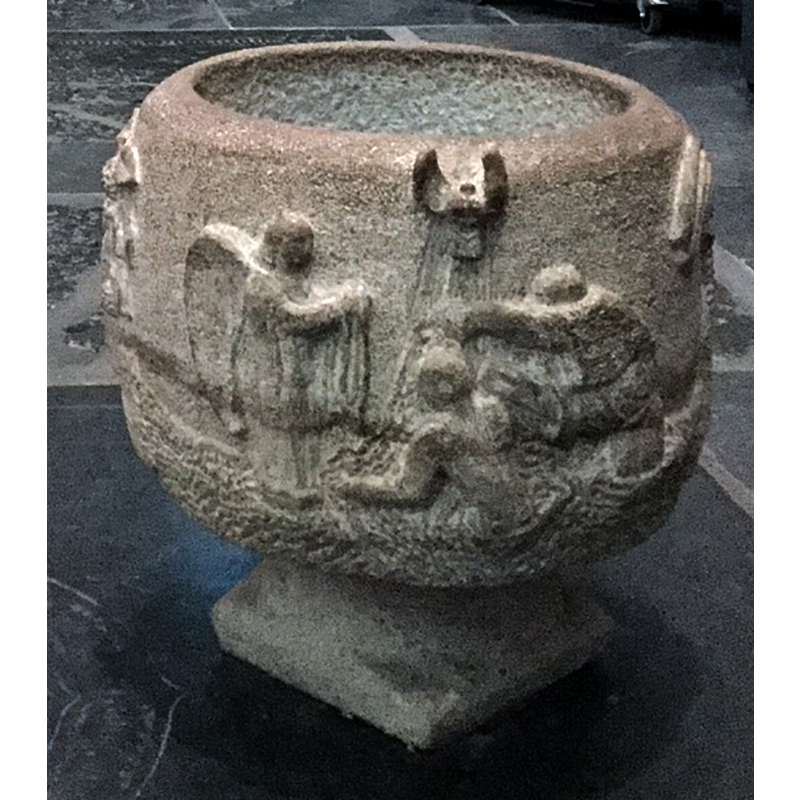
Image copyright © Leonid Maximenkov, 2019
Image and permission received from the author (e-mail of 19 June 2019)
Results: 7 records
view of font
Scene Description: the modern font of 1978
Copyright Statement: Image copyright © Leonid Maximenkov, 2019
Image Source: digital photograph taken 16 June 2019 by Leonid Maximenkov
Copyright Instructions: Image and permission received from the author (e-mail of 19 June 2019)
view of font in context
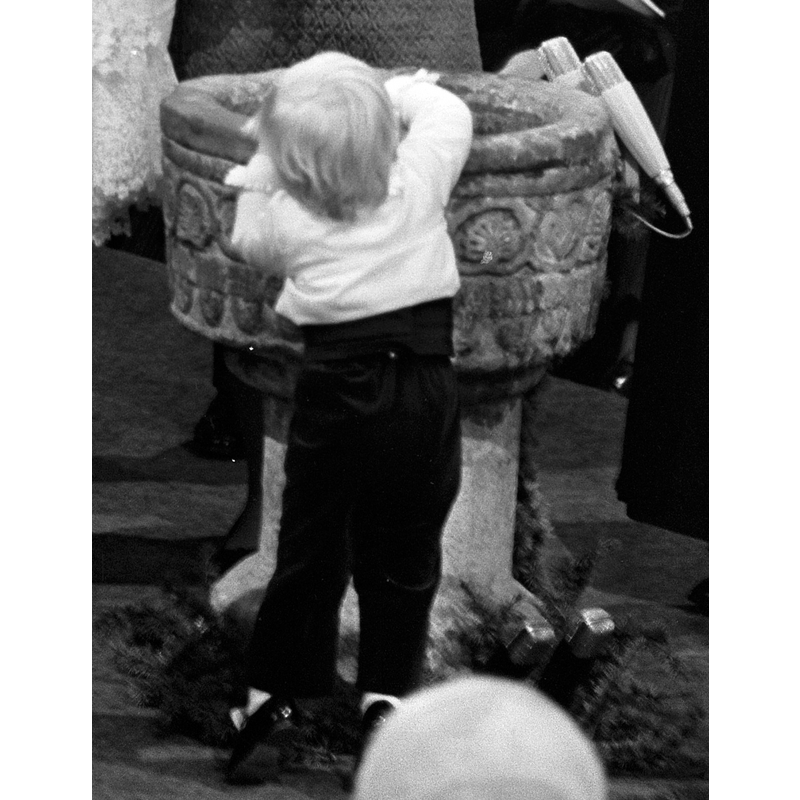
Scene Description: detail of a photograph taken during the baptism of prince Johan Friso; the child reaching into the old font is prince Willem Alexander
Copyright Statement: Image copyright © Nationaal Archief, 1968
Image Source: edited detail of a digital image of a B&W negative taken 28 December 1968, photographer unknown, in the Fotocollectie Anefo, Bestanddeelnummer : 921-9738, Nationaal Archief [https://commons.wikimedia.org/wiki/File:Doop_van_prins_Johan_Friso_in_de_Domkerk_te_Utrecht._Vlnr_koningin_Juliana,_prin,_Bestanddeelnr_921-9738.jpg] [accessed 19 June 2019]
Copyright Instructions: CC-Zero
design element - motifs - vine - palmette
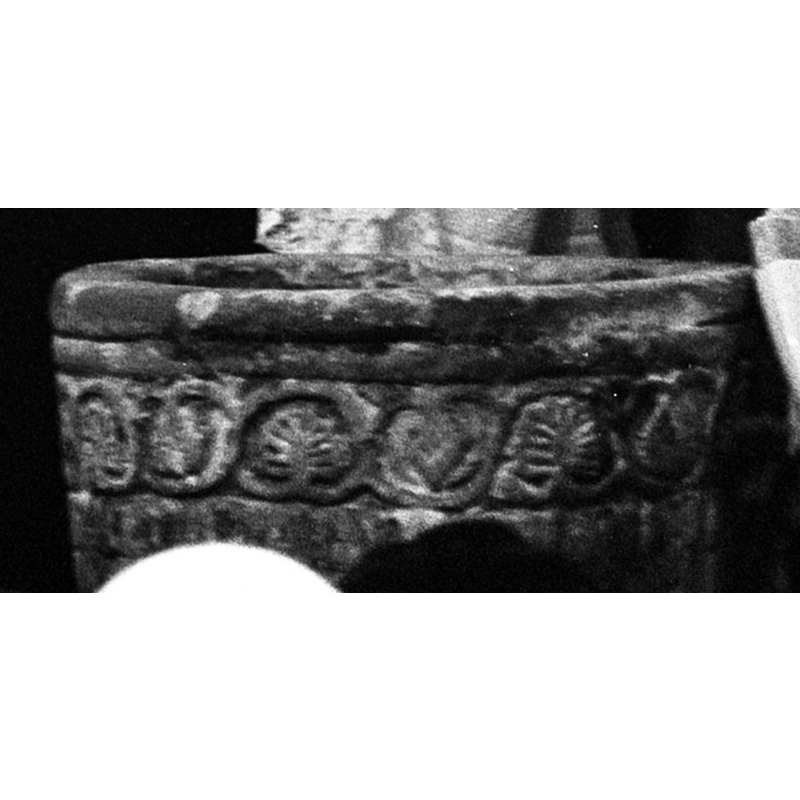
Copyright Statement: Image copyright © Nationaal Archief, 1968
Image Source: edited detail of a digital image of a B&W negative taken 28 December 1968, photographer unknown, now in the Fotocollectie Anefo, Nationaal Archief [www.nationaalarchief.nl/onderzoeken/fotocollectie/detail/ab5966c8-d0b4-102d-bcf8-003048976d84] [accessed 19 June 2019]
Copyright Instructions: CC-Zero
design element - motifs - moulding - parallel - 2
Copyright Statement: Image copyright © Nationaal Archief, 1968
Image Source: edited detail of a digital image of a B&W negative taken 28 December 1968, photographer unknown, now in the Fotocollectie Anefo, Nationaal Archief [www.nationaalarchief.nl/onderzoeken/fotocollectie/detail/ab5966c8-d0b4-102d-bcf8-003048976d84] [accessed 19 June 2019]
Copyright Instructions: CC-Zero
view of church exterior - southwest view
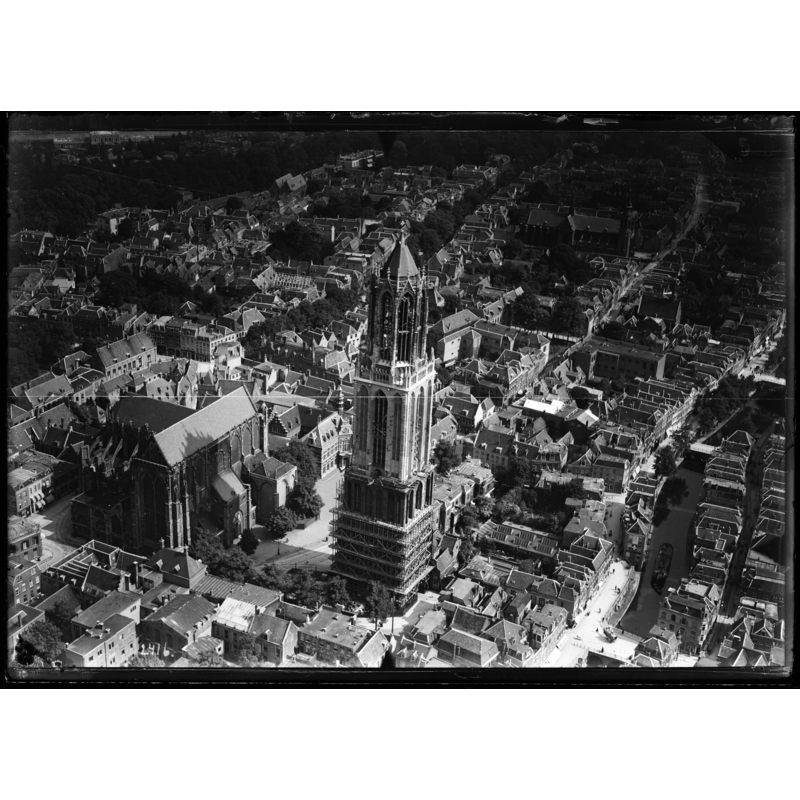
Scene Description: The gap between the tower on the right and the chancel on the left is permanent; the nave was lost to a storm in 1674 and never re-built, which left the tower detached from the body of the church by the by the space now called locally 'Domplen'
Copyright Statement: Image copyright © Nederlands Instituut voor Militaire Historie (NIMH, Netherlands Institute of Military History), 2017
Image Source: digital image of a Gelatin negative glass plate, B&W, taken between 1920 and 1940 [Nimh-beeldbank.defensie.nl object 2011-0518] [https://commons.wikimedia.org/wiki/File:NIMH_-_2011_-_0518_-_Aerial_photograph_of_Utrecht,_The_Netherlands_-_1920_-_1940.jpg] [accessed 19 June 2019]
Copyright Instructions: CC-BY-SA-4.0
view of font in context
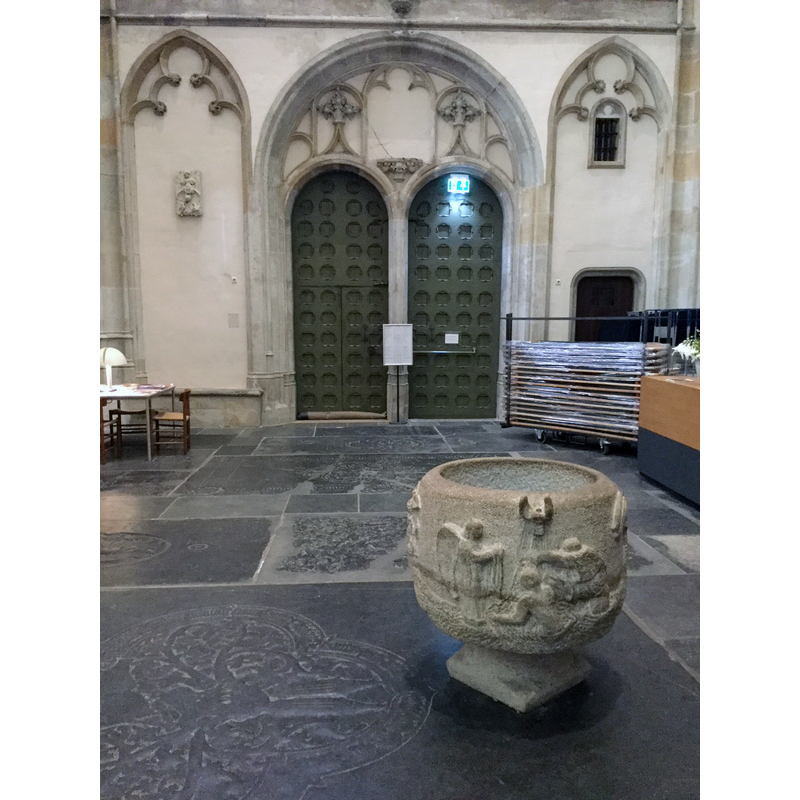
Scene Description: the modern font of 1978
Copyright Statement: Image copyright © Leonid Maximenkov, 2019
Image Source: digital photograph taken 16 June 2019 by Leonid Maximenkov
Copyright Instructions: Image and permission received from the author (e-mail of 19 June 2019)
view of font in context
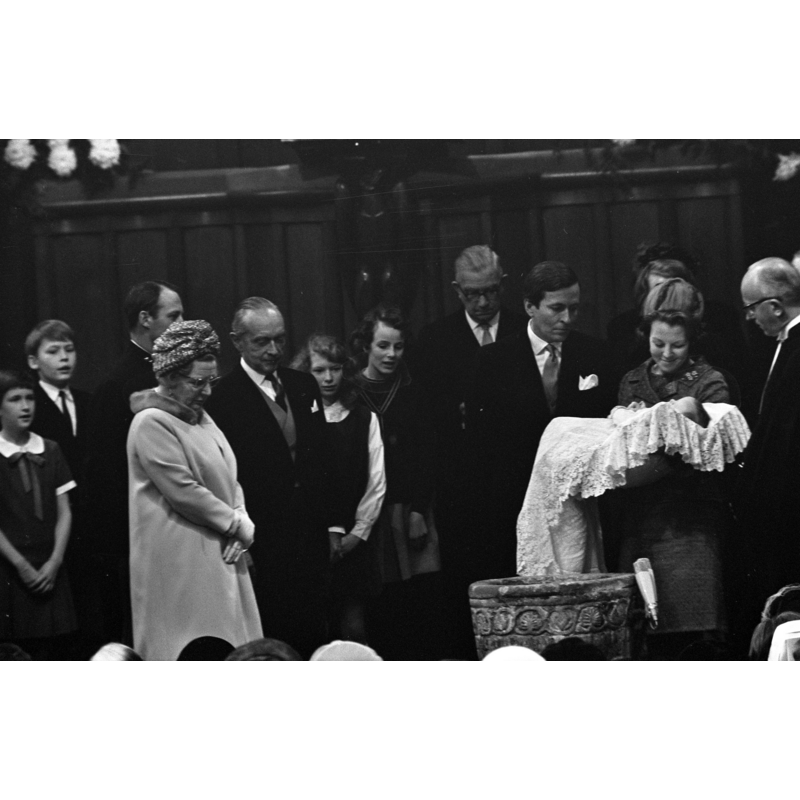
Scene Description: Source caption: "Doop Prins Johan Friso in Domkerk te Utrecht bij het doopvont v.l.n.r. Prins Claus , Prinses Beatrix met Prins Johan Friso en ds. Kater".
Copyright Statement: Image copyright © Nationaal Archief, 1968
Image Source: digital image of a B&W negative taken 28 December 1968, photographer unknown, now in the Fotocollectie Anefo, Nationaal Archief [www.nationaalarchief.nl/onderzoeken/fotocollectie/detail/ab5966c8-d0b4-102d-bcf8-003048976d84] [accessed 19 June 2019]
Copyright Instructions: CC-Zero
INFORMATION
Font ID: 22196UTR
Object Type: Baptismal Font1?
Font Century and Period/Style: 7th - 9th century (?), Early Medieval?
Workshop/Group/Artisan: Bentheim font, Berge b. Type II [Drake]
Museum: Museum Catharijneconvent, Utrecht
Church / Chapel Name: Domkerk St. Maartens
Font Location in Church: cf. FontNotes
Church Patron Saint(s): St. Martin of Tours
Church Notes: first Merovingian chapel of ca. 630; destroyed by Frisians soon thereafter; second chapel was dedicated to St Martin; destroyed by Normans in thr 9thC; re-built 10thC; became cathedral of the Diocese of Utrecht; destroyed and re-built through the centuries; Protestant since 1580; nave lost to a storm 1674, never re-built, which leaves the tower detached from the body of the church by the 'Domplen'
Church Address: [NB: address and coordinates are given for the cathedral site] Achter de Dom 1, 3512 JN Utrecht, Netherlands -- Tel.: 030 231 04 03
Site Location: Utrecht, Netherlands, Europe
Directions to Site: The cathedral is in the old town centre, between the A2 (W) and the A28 (E)
Ecclesiastic Region: Diocese of Utrecht [medieval]
Additional Comments: destroyed font?
Font Notes:
Click to view
The present baptismal font in use was made of sandstone in 1978 by Taeke Friso de Jon; it has two main scenes on its sides: one from the Old Testament, the arrival of the Israelites into the Promised land, the other from the New Testament, the Baptism of Christ in the river Jordan. It replaced an earlier font.
A communication to BSI by Pol Herman (e-mail of 11 November 2025) notes: "The font that was used in the Domkerk at Utrecht for the baptisms of the Dutch princes Johan Friso, Constantijn and Bernhard has no relation with that church. It is the Bentheimer-type font “from the Saint-Jacob’s church at Winterswijk”. It is objectnumber ABM bs610 of the Museum Catherijneconvent at Utrecht. 20180UTR The museum had only loaned the baptismal font for the duration of these baptisms. An identical modern copy of this font now stands in the church of Winterswijk.]
Pol Herman's communication further notes: "The collegiate Saint-Martin’s Domkerk at Utrecht never had a baptismal font. It was never a catholic parish church. Rituals leading up to baptism could be done in the Domkerk, but the baptismal sacrament could originally only be performed in the adjacent “oratorium or chapel of the Holy Cross”, where the only font of the city stood. [https://nl.wikipedia.org/wiki/Heilig_Kruiskapel_(Utrecht). At an unknown date, the “very old” stone baptismal font was moved from the Holy Cross chapel to the also adjacent Saint-Salvatorchurch (also called Oudmunster). [https://nl.wikipedia.org/wiki/Sint-Salvatorkerk_(Utrecht)
When the Saint-Salvatorchurch was demolished in 1587, Johan Mersman made a description of the church and mentioned a very old stone font. It was carved from a single block of stone and was covered with a wooden lid that could be locked. There was “sculptura” on the font. In the 11th century, 3 new churches were built (Saint-Peter 23747UTR, Saint-John-the-Baptist, Our Lady). They were collegiate and did not acquire parish status. As long as they were catholic, none of these churches had a baptismal font. The annexed document describes the complex rituals that emerged from this situation. The following churches in Utrecht had parochial rights and a baptismal font:
Buurkerk (ecclesia civilium or ecclesia civilis; probably 10th c.), font destroyed in 1566. Nicolaïkerk (12th c.), The first time the baptismal font is documented in 1437. The churchwarden justifies an expense for the construction of a pan for the baptismal font, probably the font was no longer watertight. In 1441, the parish ordered a new stone baptismal font from the architect of the cathedral, Mr. Heynrick van Bontsfort. In 1467, the baptismal font was moved to the new baptistery. The font was damaged in 1566 and was replaced in 1579 by a simple metal bowl on a wooden support. Jacobikerk (12th c.) Geertekerk (13th c.) 24447UTR".
A communication of 16 November 2025 further adds: "The historical reality about baptism/baptismal font in collegiate churches is not as clear cut as the theory (and the ecclesiastical rules) would lead us to believe. For example: when studying the history of the Romanesque Tournai-type font of the Saint-Martin’s church of Kortrijk/Courtrai, I discovered that the nearby collegiate church of Our Lady (adjacent to the count's castle) tried to exert baptismal rights for the families of its own lay personnel and for the count's family. It served as a parish church for them. This led to a long legal battle between the churches, and the collegiate church had to give up the baptismal font, which could from then onwards only be used for the Easter liturgy."
A communication to BSI by Pol Herman (e-mail of 11 November 2025) notes: "The font that was used in the Domkerk at Utrecht for the baptisms of the Dutch princes Johan Friso, Constantijn and Bernhard has no relation with that church. It is the Bentheimer-type font “from the Saint-Jacob’s church at Winterswijk”. It is objectnumber ABM bs610 of the Museum Catherijneconvent at Utrecht. 20180UTR The museum had only loaned the baptismal font for the duration of these baptisms. An identical modern copy of this font now stands in the church of Winterswijk.]
Pol Herman's communication further notes: "The collegiate Saint-Martin’s Domkerk at Utrecht never had a baptismal font. It was never a catholic parish church. Rituals leading up to baptism could be done in the Domkerk, but the baptismal sacrament could originally only be performed in the adjacent “oratorium or chapel of the Holy Cross”, where the only font of the city stood. [https://nl.wikipedia.org/wiki/Heilig_Kruiskapel_(Utrecht). At an unknown date, the “very old” stone baptismal font was moved from the Holy Cross chapel to the also adjacent Saint-Salvatorchurch (also called Oudmunster). [https://nl.wikipedia.org/wiki/Sint-Salvatorkerk_(Utrecht)
When the Saint-Salvatorchurch was demolished in 1587, Johan Mersman made a description of the church and mentioned a very old stone font. It was carved from a single block of stone and was covered with a wooden lid that could be locked. There was “sculptura” on the font. In the 11th century, 3 new churches were built (Saint-Peter 23747UTR, Saint-John-the-Baptist, Our Lady). They were collegiate and did not acquire parish status. As long as they were catholic, none of these churches had a baptismal font. The annexed document describes the complex rituals that emerged from this situation. The following churches in Utrecht had parochial rights and a baptismal font:
Buurkerk (ecclesia civilium or ecclesia civilis; probably 10th c.), font destroyed in 1566. Nicolaïkerk (12th c.), The first time the baptismal font is documented in 1437. The churchwarden justifies an expense for the construction of a pan for the baptismal font, probably the font was no longer watertight. In 1441, the parish ordered a new stone baptismal font from the architect of the cathedral, Mr. Heynrick van Bontsfort. In 1467, the baptismal font was moved to the new baptistery. The font was damaged in 1566 and was replaced in 1579 by a simple metal bowl on a wooden support. Jacobikerk (12th c.) Geertekerk (13th c.) 24447UTR".
A communication of 16 November 2025 further adds: "The historical reality about baptism/baptismal font in collegiate churches is not as clear cut as the theory (and the ecclesiastical rules) would lead us to believe. For example: when studying the history of the Romanesque Tournai-type font of the Saint-Martin’s church of Kortrijk/Courtrai, I discovered that the nearby collegiate church of Our Lady (adjacent to the count's castle) tried to exert baptismal rights for the families of its own lay personnel and for the count's family. It served as a parish church for them. This led to a long legal battle between the churches, and the collegiate church had to give up the baptismal font, which could from then onwards only be used for the Easter liturgy."
Credit and Acknowledgements: We are grateful to Leonid Maximenkow for his photograph of the modern font in the cathedral. We are also gratful to Pol Herman for the additional information on the temporarily loan font -- cf. FontNotes
COORDINATES
UTM: 31U 645350 5773265
Latitude & Longitude (Decimal): 52.090833, 5.121667
Latitude & Longitude (DMS): 52° 5′ 27″ N, 5° 7′ 18″ E