Seville No. 6 / Hispalis / Sevilla
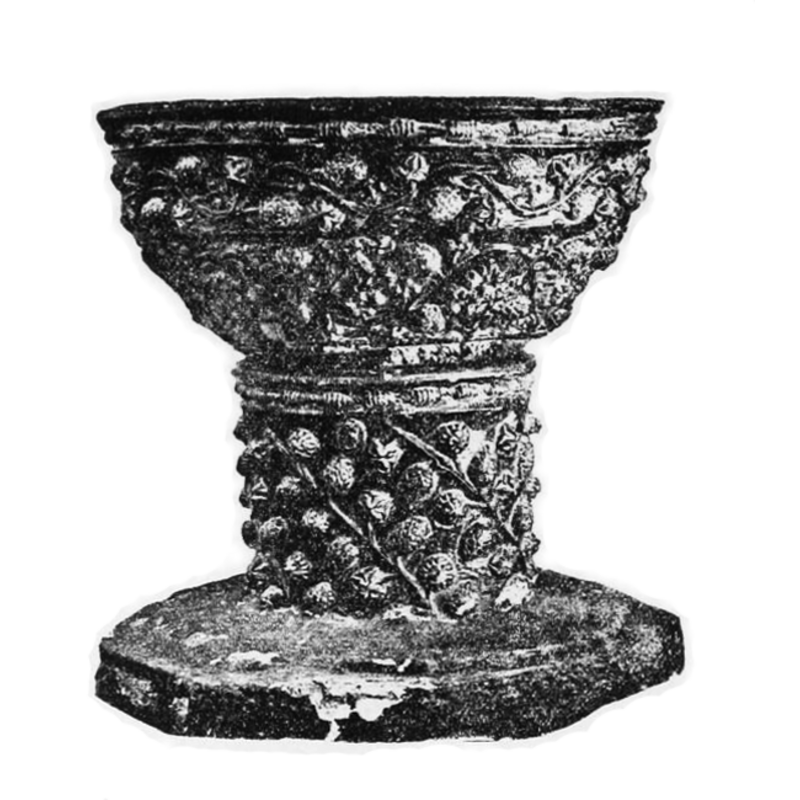
Image copyright © [in the public domain]
PD
Results: 12 records
view of font
Scene Description: ca. 1919?
Copyright Statement: Image copyright © [in the public domain]
Image Source: Fototipia de Hauser y Menet, Madrid, in Gestoso y Pérez (1919)
Copyright Instructions: PD
view of font

Copyright Statement: Image copyright © Pleguezuelo, 2007
Image Source: photograph in Pleguezuelo, 2007
Copyright Instructions: PERMISSION NOT AVAILABLE -- IMAGE NOT FOR PUBLIC USE
design element - motifs - moulding
Scene Description: [cf. Font notes]
Copyright Statement: Image copyright © Pleguezuelo, 2007
Image Source: detail of a photograph in Pleguezuelo, 2007
Copyright Instructions: PERMISSION NOT AVAILABLE -- IMAGE NOT FOR PUBLIC USE
Christ - Christ Child - crowned
Scene Description: [cf. Font notes]
Copyright Statement: Image copyright © Pleguezuelo, 2007
Image Source: detail of a photograph in Pleguezuelo, 2007
Copyright Instructions: PERMISSION NOT AVAILABLE -- IMAGE NOT FOR PUBLIC USE
Christ - monogram - IHS - in a shield - 4?
Scene Description: [cf. Font notes]
Copyright Statement: Image copyright © Pleguezuelo, 2007
Image Source: detail of a photograph in Pleguezuelo, 2007
Copyright Instructions: PERMISSION NOT AVAILABLE -- IMAGE NOT FOR PUBLIC USE
design element - motifs - floral - lily
Scene Description: [cf. Font notes]
Copyright Statement: Image copyright © Pleguezuelo, 2007
Image Source: detail of a photograph in Pleguezuelo, 2007
Copyright Instructions: PERMISSION NOT AVAILABLE -- IMAGE NOT FOR PUBLIC USE
symbol - varied
Scene Description: [cf. Font notes]
Copyright Statement: Image copyright © Pleguezuelo, 2007
Image Source: detail of a photograph in Pleguezuelo, 2007
Copyright Instructions: PERMISSION NOT AVAILABLE -- IMAGE NOT FOR PUBLIC USE
design element - motifs - varied
Scene Description: [cf. Font notes]
Copyright Statement: Image copyright © Pleguezuelo, 2007
Image Source: detail of a photograph in Pleguezuelo, 2007
Copyright Instructions: PERMISSION NOT AVAILABLE -- IMAGE NOT FOR PUBLIC USE
design element - motifs - moulding
Scene Description: [cf. Font notes]
Copyright Statement: Image copyright © Pleguezuelo, 2007
Image Source: detail of a photograph in Pleguezuelo, 2007
Copyright Instructions: PERMISSION NOT AVAILABLE -- IMAGE NOT FOR PUBLIC USE
design element - motifs - varied
Scene Description: [cf. Font notes]
Copyright Statement: Image copyright © Pleguezuelo, 2007
Image Source: detail of a photograph in Pleguezuelo, 2007
Copyright Instructions: PERMISSION NOT AVAILABLE -- IMAGE NOT FOR PUBLIC USE
human figure - child - putto?
Scene Description: [cf. Font notes]
Copyright Statement: Image copyright © Pleguezuelo, 2007
Image Source: detail of a photograph in Pleguezuelo, 2007
Copyright Instructions: PERMISSION NOT AVAILABLE -- IMAGE NOT FOR PUBLIC USE
symbol - varied
Scene Description: [cf. Font notes]
Copyright Statement: Image copyright © Pleguezuelo, 2007
Image Source: detail of a photograph in Pleguezuelo, 2007
Copyright Instructions: PERMISSION NOT AVAILABLE -- IMAGE NOT FOR PUBLIC USE
INFORMATION
Font ID: 13898SEV
Object Type: Baptismal Font1
Font Century and Period/Style: 15th century (late?), Late Medieval
Cognate Fonts: there is a similar font in the city's Museo Arqueologico [cf. Index entry for Sevilla No. 7]
Museum: Museo de Bellas Artes de Sevilla
Church / Chapel Name: Hospital de San Lázaro de Sevilla
Font Location in Church: in a museum by 1919
Church Patron Saint(s): St. Lazarus of Bethany
Church Address: Av. Dr. Fedriani, 56, 41009 Sevilla, Spain -- Tel.: +34 954 54 43 09
Site Location: Sevilla, Andalucía, Spain, Europe
Directions to Site: Located off the Ronda Urbana Norte [aka A-8083], in the Macarena barrio, 1 km off the city N wall
Additional Comments: disused font (in a museum)
Font Notes:
Click to view
Gestoso y Pérez (1919) notes and illustrates a ceramic font originally from the Hospital de San Lázaro, in Seville, and already at the city's Museo de Pinturas by his time; the author notes the presence of pineapple motifs on this font. Noted and illustrated in Pleguezuelo (2007): Baptismal font. Sevilla, end of the 15th century. Glazed terracotta with relief decoration. Hospital de San Lázaro. The font consists of a round basin with tapering sides, a curved underbowl and a cylindrical pedestal base; the upper rim of the basin has three mouldings, the middle of which is patterned with striated intervals; below these are two rows of varied motifs and symbols (including a Christ Child, shells, Sun-disks, floral, and the IHS emblem), all these repeated several times around the basin; between these two rows are inserted small fleurs-de-lis; the lower end of the basin side has a moulding representing the knotted Franciscan cingulum that would later become quite common in Mexican fonts of the 16th century; on the rounded underbowl are large leaves;the pedestal base is moulded at both ends and has rows of motifs all around, as well as a Christ Child [or is it a putto?]. The whole is covered in a dark green glaze. A metal band is used for reinforcement all around the basin, just under the upper rim.
A set of digital photograph of this font including details of the inscription on the plinth are posted in Wikimedia [https://commons.wikimedia.org/wiki/Category:Baptismal_font_from_the_Hospital_de_San_Lázaro_in_Sevilla] [accessed 22 August 2025]
A set of digital photograph of this font including details of the inscription on the plinth are posted in Wikimedia [https://commons.wikimedia.org/wiki/Category:Baptismal_font_from_the_Hospital_de_San_Lázaro_in_Sevilla] [accessed 22 August 2025]
COORDINATES
UTM: 30S 236070 4145021
Latitude & Longitude (Decimal): 37.414405, -5.982209
Latitude & Longitude (DMS): 37° 24′ 51.86″ N, 5° 58′ 55.95″ W
MEDIUM AND MEASUREMENTS
Material: ceramic, glazed terracotta
Font Shape: round, mounted
Basin Interior Shape: round
Basin Exterior Shape: round
INSCRIPTION
Inscription Language: initials
Inscription Location: on the sides of the basin
Inscription Text: "IHS"
Inscription Notes: repeated several times [cf. FontNotes]
REFERENCES
- Gestoso y Pérez, José, "Cerámica sevillana", 27 (1919), 1er trimestre, Boletín de la Sociedad Española de Excursiones, 1919, pp. 2-19; p. 11 and fig. 2
- Pleguezuelo, Alfonso, "Cerámicas de ida y de vuelta: Castilla, América y Asia", Talaveras de Puebla: cerámica colonial mexicana, siglos XVII a XXI, Barcelona: Lunwerg, 2007, p. 26