Winwick / Winequic / Winewich / Winwick with Hulme / Wynequic / Wynequick / Wynewyc
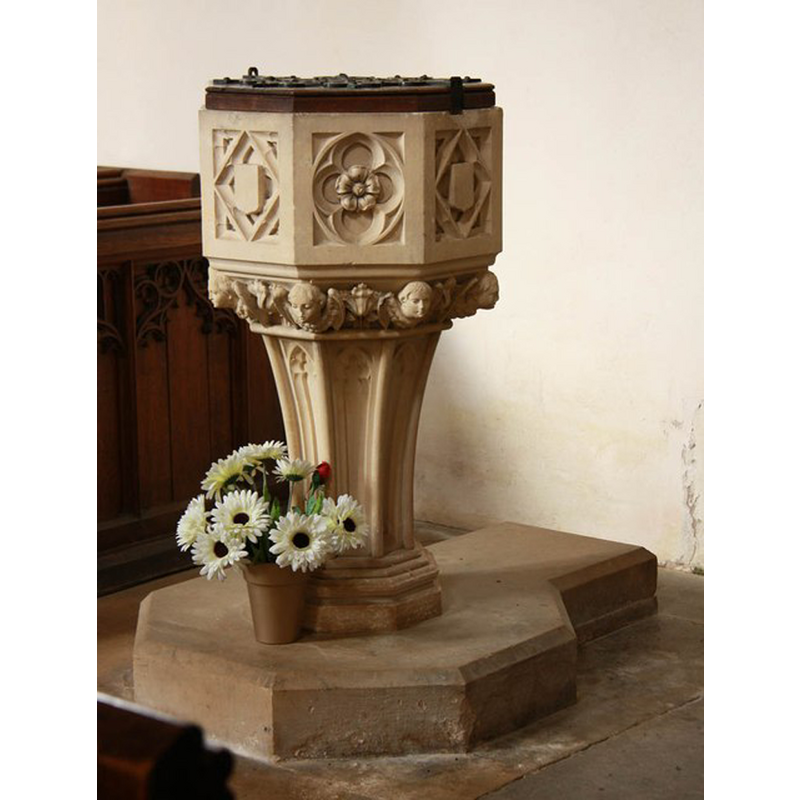
Image copyright © David Dixon, 2012
CC-BY-SA-3.0
Results: 8 records
view of font and cover
Scene Description: the modern font and cover
Copyright Statement: Image copyright © David Dixon, 2012
Image Source: digital photograph taken 24 March 2012 by David Dixon
Copyright Instructions: CC-BY-SA-3.0
view of font
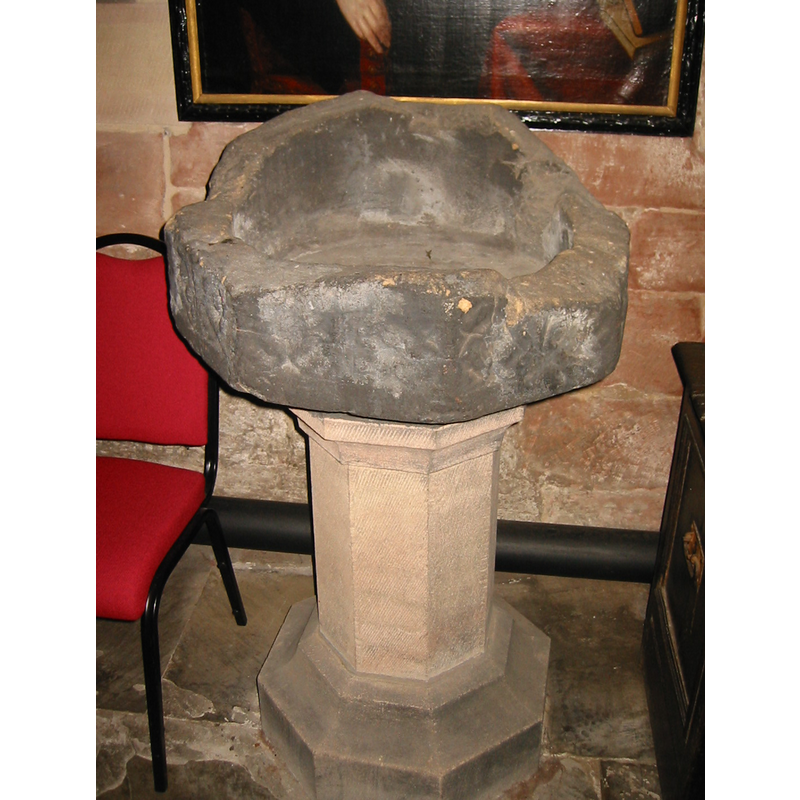
Scene Description: only the basin is original
Copyright Statement: Image copyright © Malcolm Geddis, 2009
Image Source: digital photograph taken 22 July 2009 by Malcolm Geddis
Copyright Instructions: Image and permission received (e-mail of 23 July 2009)
view of font
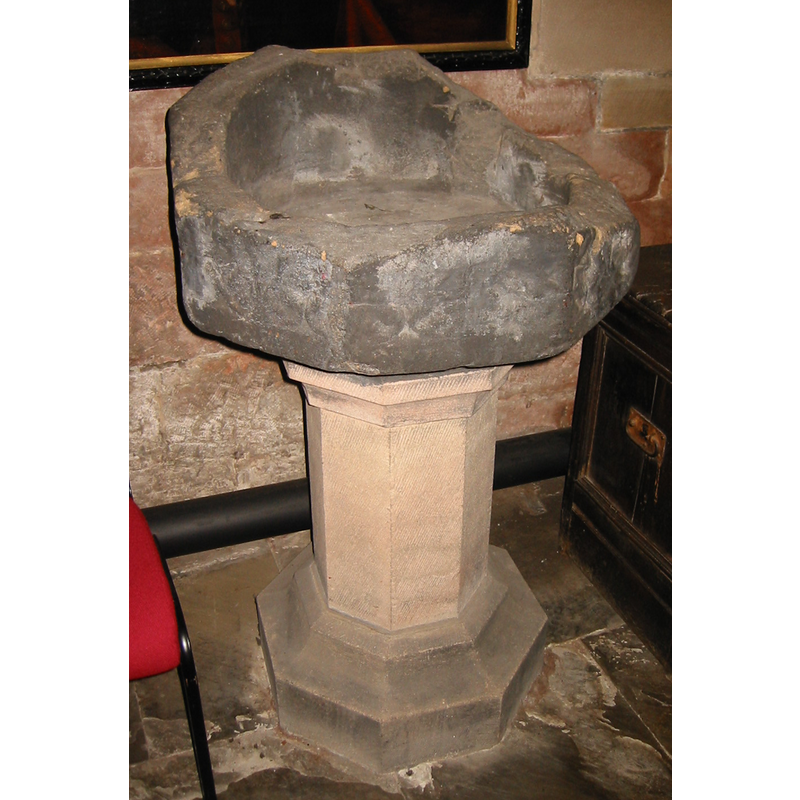
Scene Description: only the basin is original
Copyright Statement: Image copyright © Malcolm Geddis, 2009
Image Source: digital photograph taken 22 July 2009 by Malcolm Geddis
Copyright Instructions: Image and permission received (e-mail of 23 July 2009)
view of basin - interior
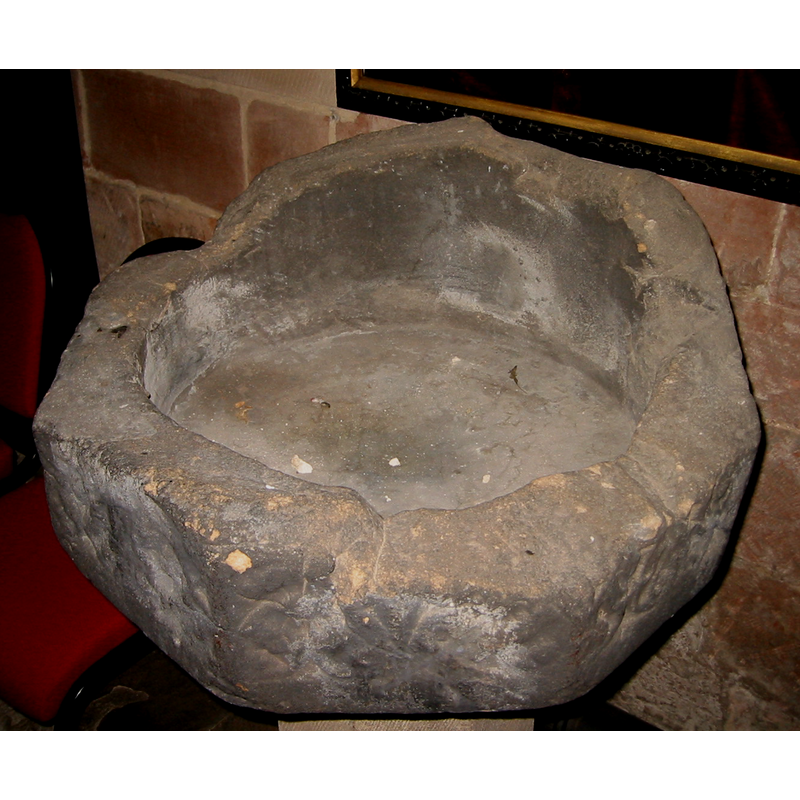
Scene Description: the drain is plugged now
Copyright Statement: Image copyright © Malcolm Geddis, 2009
Image Source: digital photograph taken 22 July 2009 by Malcolm Geddis
Copyright Instructions: Image and permission received (e-mail of 23 July 2009)
design element - motifs - floral - 4-petal
![now hardly discernible [cf. Font notes]](/static-50478a99ec6f36a15d6234548c59f63da52304e5/compressed/1090724003_compressed.png)
Scene Description: now hardly discernible [cf. Font notes]
Copyright Statement: Image copyright © Malcolm Geddis, 2009
Image Source: digital photograph taken 22 July 2009 by Malcolm Geddis
Copyright Instructions: Image and permission received (e-mail of 23 July 2009)
view of church exterior - southeast view
![Photo caption: "The parish church of Winwick is dedicated to St Oswald (LinkExternal link ), a seventh century king of Northumbria who is believed to have been killed in the Winwick area. The oldest part of the present church dates from the early 13th century [...] It has been designated by English Heritage as a Grade I listed building. [...] The main body of the church is currently closed because a serious infestation of Death Watch Beetle. Restoration work is in progress to remedy this".](/static-50478a99ec6f36a15d6234548c59f63da52304e5/compressed/1140719025_compressed.png)
Scene Description: Photo caption: "The parish church of Winwick is dedicated to St Oswald (LinkExternal link ), a seventh century king of Northumbria who is believed to have been killed in the Winwick area. The oldest part of the present church dates from the early 13th century [...] It has been designated by English Heritage as a Grade I listed building. [...] The main body of the church is currently closed because a serious infestation of Death Watch Beetle. Restoration work is in progress to remedy this".
Copyright Statement: Image copyright © David Dixon, 2012
Image Source: digital photograph taken 24 March 2012 by David Dixon [www.geograph.org.uk/photo/2864650] [accessed 16 July 2014]
Copyright Instructions: CC-BY-SA-3.0
view of church interior - nave - looking west
![the modern font is partially visible about halfway down the nave, on the right [north] side](/static-50478a99ec6f36a15d6234548c59f63da52304e5/compressed/1140719027_compressed.png)
Scene Description: the modern font is partially visible about halfway down the nave, on the right [north] side
Copyright Statement: Image copyright © David Dixon, 2012
Image Source: digital photograph taken 24 March 2012 by David Dixon
Copyright Instructions: CC-BY-SA-3.0
view of church interior - nave - looking east
![the modern font partially visible on the left [north] side](/static-50478a99ec6f36a15d6234548c59f63da52304e5/compressed/1140719026_compressed.png)
Scene Description: the modern font partially visible on the left [north] side
Copyright Statement: Image copyright © David Dixon, 2012
Image Source: digital photograph taken 24 March 2012 by David Dixon
Copyright Instructions: CC-BY-SA-3.0
INFORMATION
Font ID: 12152WIN
Object Type: Baptismal Font1, fragment?
Font Date: ca. 1400?
Font Century and Period/Style: 14th - 15th century [fragment], Decorated? / Perpendicular?
Church / Chapel Name: Parish Church of St. Oswald
Font Location in Church: [cf. FontNotes]
Church Patron Saint(s): St. Oswald of Nothumbria
Church Address: Church Walk, Winwick, Warrington WA2 8TA, UK
Site Location: Cheshire, North West, England, United Kingdom
Directions to Site: Located on the A49, near Newton-le-Willows, 5 km N of Warrington
Ecclesiastic Region: Diocese of Liverpool
Historical Region: formerly Lancashire -- Hundred of West Derby
Additional Comments: buried font / abandoned font? / disused font? / restored font? / fragment of font [cf. FontNotes]
Font Notes:
Click to view
There is no individual entry for this Winwick in the Domesday survey, although it may be one of the 'berewicks' in the hundred of Newton [Neutone], perhaps one of its three churches [http://domesdaymap.co.uk/place/SJ6092/winwick/] [accessed 17 July 2014]. Ellis (1902) notes: "The bowl of what has originally been a beautiful font, but too badly damaged to be of any further use, was discovered beneath the floor of the church during the restoration in 1877. This fragment now stands in the churchyard, beneath the east window of the church. [cf. infra] It is octagonal, of mill stone grit, and each face of the octagon has once borne upon it four elborately carved four-leaved flowers with central bosses, but these ornaments are so worn down as to be distinguishable only with difficulty. [...] From the character of its ornament this fonts appears to have been a typical specimen of [D]ecorated work (fourteenth century)". The Victoria County History (Lancashire, vol. 4, 1911) notes in its entry for Winwick: "In 1086 the church of St. Oswald held two ploughlands exempt from all taxation, (fn. 8) and was given by Roger of Poitou to the canons of St. Oswald, Nostell." And, on the font, the VCH (ibid.) adds: "The octagonal bowl of a 14th-century font found in 1877 beneath the floor of the church now lies outside the east end of the chancel [...] It is much worn, but has had four-leaved flowers on each face, with raised centres, and must have been a good piece of work when perfect". This is likely the same object mentioned in Pevsner (1969) and in Pollard & Pevsner (2006): "In the N chapel fragment of a big Perp[endicular] font", and in the Parish web site [http://newton-le-willows.com/index.php?option=com_content&task=view&id=563&Itemid=1] [accessed 22 April 2009]: "During excavations in 1877, we discovered an ancient font, buried beneath our church. The font now lies in the churchyard, below the East window. The workmanship of the font belongs to the early part of the fourteenth century,—a date when a considerable amount of building work took place here." [NB: this same source adds: "The present font is of relatively modern date—though it is carved in the style and shape of a font of the fifteenth century."] The Parish web site [http://www.stoswaldwinwick.com/page_23] [accessed 7 May 2009] shows the fragment of the basin -the lower half approximately- standing now on a later octagonal pedestal base by the wall of the nave]
Credit and Acknowledgements: We are grateful to Malcolm Geddis for the photographs of this font
COORDINATES
UTM: 30U 526716 5920271
Latitude & Longitude (Decimal): 53.4308, -2.5979
Latitude & Longitude (DMS): 53° 25′ 50.88″ N, 2° 35′ 52.44″ W
MEDIUM AND MEASUREMENTS
Material: stone
Number of Pieces: fragment?
Font Shape: octagonal, mounted
Basin Interior Shape: round
Basin Exterior Shape: octagonal
Drainage System: centre hole in basin
Drainage Notes: the hole is now plugged
Rim Thickness: 8.75 cm [calculated]
Diameter (inside rim): 50 cm*
Diameter (includes rim): 67.5 cm*
Basin Total Height: 30 cm*
Notes on Measurements: * [in inches in Ellis (1902: 69)]
REFERENCES
- Ellis, John W., "The Mediaeval Fonts of the Hundreds of West Derby and Wirral", LVIII (New series: XVII), Transactions of the Historic Society of Lancashire and Cheshire, 1902, pp. 59-80; p. 69
- Gardner, Samuel, A Guide to English Gothic Architecture (illustrated by numerous drawings & photographs), Cambridge: Cambridge University Press, 1925, Lancaster, vol. 4: 122-132 / [www.british-history.ac.uk/report.asp?compid=41392] [accessed 12 September 2006]
- Gardner, Samuel, A Guide to English Gothic Architecture (illustrated by numerous drawings & photographs), Cambridge: Cambridge University Press, 1925, Lancaster, vol. 4: 140-142 / [www.british-history.ac.uk/report.asp?compid=41395] [accessed 17 July 2014]
- Pevsner, Nikolaus, Lancashire, Harmondsworth: Penguin Books, 1969, vol. 1: 431
- Pollard, Richard, Lancashire: Liverpool and the South-West, New Haven, London: Yale University Press, 2006, p. 681