Everingham / Engderingham / Evringham
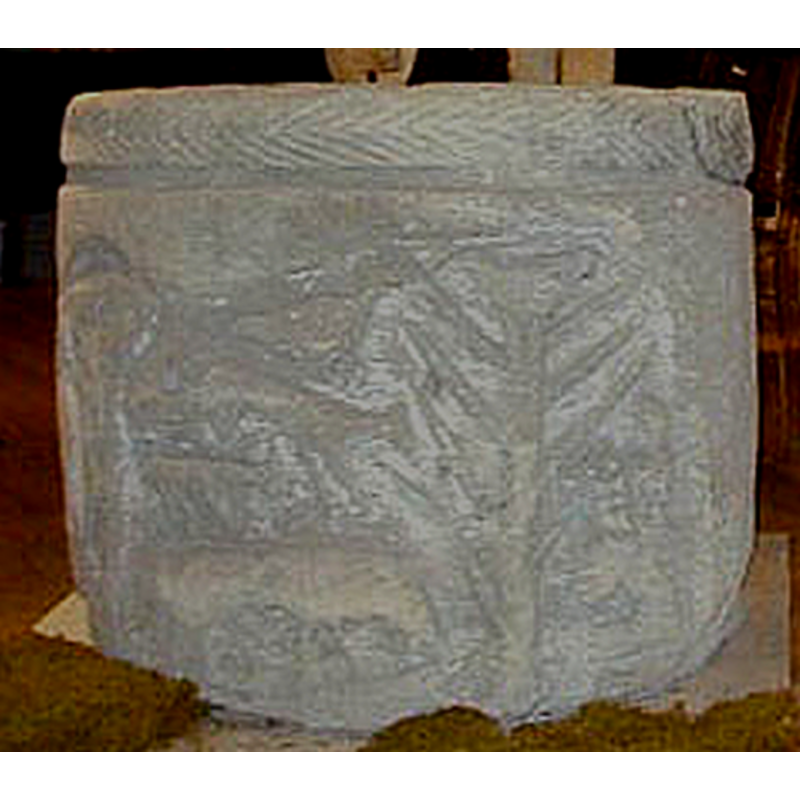
Image copyright © Richard Philp, 2005
Permission received
Results: 10 records
view of font
Copyright Statement: Image copyright © Richard Philp, 2005
Image Source: Detail of a digital image in www.richardphilp.com
Copyright Instructions: Permission received
view of font in context
![the font in the context of the exhibition (2003?) [cf. Font notes]](/static-50478a99ec6f36a15d6234548c59f63da52304e5/compressed/1051102007_compressed.png)
Scene Description: the font in the context of the exhibition (2003?) [cf. Font notes]
Copyright Statement: Image copyright © Richard Philp, 2005
Image Source: Digital image in www.richardphilp.com
Copyright Instructions: Permission received
animal - unidentified - 4
Scene Description: Described in Pevsner as four beasts
Copyright Statement: Image copyright © Richard Philp, 2005
Image Source: Detail of a digital image in www.richardphilp.com
Copyright Instructions: Permission received
animal - bird
Copyright Statement: Image copyright © Richard Philp, 2005
Image Source: Detail of a digital image in www.richardphilp.com
Copyright Instructions: Permission received
symbol - tree - bird on it - Yggdrasil?
Scene Description: Perhaps a representation of the myth of Yggdrasil, the World Ash tree of Scandinavian lore
Copyright Statement: Image copyright © Richard Philp, 2005
Image Source: Detail of a digital image in www.richardphilp.com
Copyright Instructions: Permission received
design element - motifs - braid
Scene Description: braid or rope, but very densely carved
Copyright Statement: Image copyright © Richard Philp, 2005
Image Source: Detail of a digital image in www.richardphilp.com
Copyright Instructions: Permission received
view of church exterior - north view
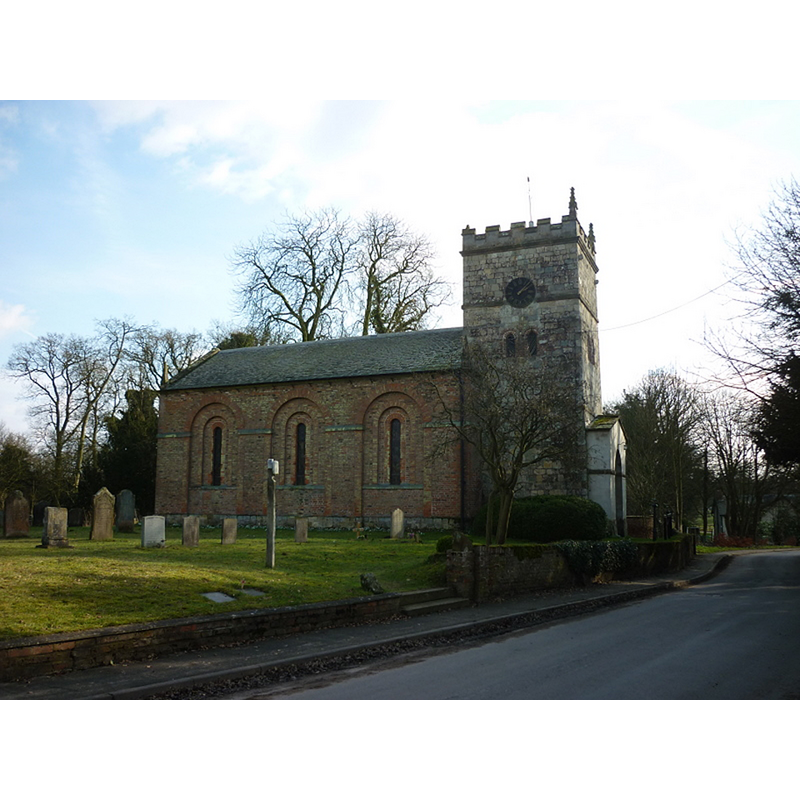
Scene Description: modern St. Everilda's
Copyright Statement: Image copyright © Ian S, 2011
Image Source: digital photograph taken 1 March 2011 by Ian S [www.geograph.org.uk/photo/2289450] [accessed 28 May 2016]
Copyright Instructions: CC-BY-SA-2.0
view of font

Copyright Statement: Image copyright © Mann, 1985
Image Source: Mann (1985: ill. opp. p. 14
Copyright Instructions: PERMISSION NOT AVAILABLE -- NOT FOR PUBLIC USE
human figure - on horseback


human figure - archer - with bow
INFORMATION
Font ID: 08481EVE
Object Type: Baptismal Font1
Font Date: ca. 1100?
Font Century and Period/Style: 11th - 12th century, Norman
Workshop/Group/Artisan: [cf. FontNotes]
Cognate Fonts: The font from Hutton Cranswick may be from this workshop [cf. FontNotes]
Church / Chapel Name: [orig. from the old Norman church; later in the Chapel of the Virgin and St. Everilda [aka St. Emeldis] (Roman Catholic); by 1985 in the porch]
Font Location in Church: November 2005: in a private collection in the United States [cf. FontNotes]
Church Patron Saint(s): St. Mary the Virgin& St. Everilda [St. Evereldis / Emeldis?]
Previous Font Location(s): originally from the old Norman church; later in the Chapel of the Virgin and St. Everilda [aka St. Emeldis] (Roman Catholic); by 1985 in the porch)
Church Notes: NB: this is not the same as the church of St. Everilda, also in Everingham
Church Address: [NB: location and coordinates are for the later chapel] Everingham, East Riding of Yorkshire, YO42 4JA
Site Location: East Riding of Yorkshire, Yorkshire and the Humber, England, United Kingdom
Directions to Site: Everingham is located 8 km W of Market Weighton. This 19th-century chapel is located right next to the Hall
Ecclesiastic Region: Diocese of York
Historical Region: Hundred of Pocklington [in Domesday] / Hundred/wapentake of Harthill
Additional Comments: disused font / recycled font -- later abandoned font: in the porch of a later chapel, no longer in use -- in the Richard Philp Gallery, London as of ca. 2003 -- later sold to a private collector in the United States [emailed the gallery on 4 Nov. 2005 -- reply received -- see BSI print files]
Font Notes:
Click to view
There is an entry for Everingham [alternate spelling] in the Domesday survey [https://opendomesday.org/place/SE8042/everingham/] [accessed 10 June 2025]; it mentions neither priest nor church in it. Gough (1792) notes: a very old font ornamented with Saxon carving and lately turned out of the church. Reported in Lewis (1831) as a noteworthy baptismal font "of ancient date and curious workmanship". Moule, writing ca. 1827, notes: "The ancient font, removed from the parish church, is placed in the gardens of this seat, it is of early Anglo-Norman workship ." Sheahan & Whellan (1857) note that ''an apothecary's mortar, embedded in one of the pillars, serves as a font'' in the church of the Blessed Virgin [which probably refers to the Roman Catholic Chapel of the Immaculate Conception of the Virgin and St. Everildis, by the side of Eeveringham Hall]. Described and illustrated in Mann (1985) as a font from the old Norman church, later relegated to the porch of the Roman Catholic Chapel of the Virgin and St. Everilda. Mann (ibid.) suggests a date towards the late 11th century. Described in Pevsner & Neave (1995): "a Norman drum-shaped font with an unorganized representation of the Tree of Life with a horseman, four beasts and a bird. Also a tree with a bird and a man with a bow"; they give the location "In the porch, rather pushed away". [NB: P & N (ibid.) and Mann (ibid.), who suggests that "they may represent the Scandinavian myth of the Wolrd Ash tree, Yggdrasil", report that the old font was replaced by a new one dated to the early 20th century [1901 in P&N]]. Mann (ibid.) informs that "the back of the font is not carved, except for the moulding which runs around the upper edge", and speculates, among other possibilities, whether the font was never finished, and therefore its program remains incomplete, or it was simply meant to stand in a corner in which case "any carving on the back would be superfluous". The International Fine Art and Antique Dealers Show and the San Francisco Art & Antiques Fair of 2003 featured this font among the exhbits. A report by the Richard Philp Gallery (London, UK) (?) noted the following: "The centre piece of the exhibition at both of these fairs was our new acquisition: a[n] English romanesque font from Everigham parish church, East Riding, Yorkshire. This twelfth-century sculpture is remarkable: a drum-shaped font, fully-carved on three-quarters of its circumference, depicts animated scenes of animals, trees and cryptic symbolism. Its complex and intriguing iconography mixes the symbols of medieval pastoral care with that of lay imagery. Some of the subjects suggest both religious and secular meanings; for example, the two trees could represent the Tree of Knowledge (with the serpent) and the other might be associated with the group of animals, bowman and hunter -- a secular scene with loose reference to the hunt for salvation. The association with pagan imagery, moral tales and traditional font symbolism makes this piece a fine example of the sculptural ptrogrammes of English romanesque parish churches." This same source notes the local style of carving particular to a group of East Yorkshire fonts, such as the one from Hutton Cranswick [now at the York Museum]. The Richard Philp Gallery of London, England, informs that the font is now [November 2005] in a private collection in the United States. Studied and illustrated in Wood (2011), who describes it as "one of the most elaborate examples in a group of over fifty cylindrical fonts in the East Riding which date from the first hald of the twelfth century. Its apparently unorganised imagery is found to embody a teaching scheme reminiscent of metgods described in St Augustine of Hippo's manual for instructing baptism candidates, and the design seems to ba based on a text of Hugh of St Victor, from his moral interpretation of Noah's Ark." Wood (ibid.) compares its motifs to those on the font at Bessingby (East Riding), and on the timpana at Ribbesford (Worcestershire) and Stoke-sub-Hamdon (Somerset).
Credit and Acknowledgements: We are grateful to Richard Philp and the gallery staff for their kind help in documenting this font, and the photographs thereof.
COORDINATES
UTM: 30U 646141 5971623
Latitude & Longitude (Decimal): 53.87247, -0.77715
Latitude & Longitude (DMS): 53° 52′ 20.89″ N, 0° 46′ 37.74″ W
MEDIUM AND MEASUREMENTS
Material: stone, limestone
Number of Pieces: one
Font Shape: cylindrical, unmounted
Basin Interior Shape: round
Basin Exterior Shape: round
Drainage System: centre hole in basin
Drainage Notes: not discernible now; probably obliterated or filled in
Diameter (includes rim): 91.5 cm*
Font Height (less Plinth): 72.3*
Notes on Measurements: * Courtesy of The Richard Philp Gallery, London
REFERENCES
- Gough, Richard, "Description of the old font in the Church of East Meon, Hampshire, 1789: with some observations on fonts", X, Archaeologia, 1792, pp. 183-209; p. 188
- Lewis, Samuel, A Topographical Dictionary of England, Comprising the Several Counties, Cities, Boroughs, Corporate and Market Towns, Parishes, Chapelries, and Townships, and the Islands of Guernsy, Jersey, and Man, with Historical and Statistical Descriptions [...], London: S. Lewis, 1831, p. 632
- Mann, Faith, Early Medieval Church Sculpture: a Study of 12th Century Fragments in East Yorkshire, Beverley: Hutton Press, 1985, p. 9-10, 16, 32, 40, 48 and ill. opp. p. 14
- Pevsner, Nikolaus, Yorkshire: York and the East Riding, London: Penguin, 1995, p. 35, 412
- Sheahan, James Joseph, History and topography of the city of York; the East Riding of Yorkshire and a portion of the West Riding […], Beverley: printed for the publishers by John Green, Market Place, 1857, p. 578 / [http://books.google.co.uk/books?id=pnEMAAAAYAAJ&pg=PA484&lpg=PA484&dq=lowthorpe+church+font&source=web&ots=voqP9Oob0V&sig=eG9y4rQzjY9QXoOVBZVVv4af2Sc&hl=en&sa=X&oi=book_result&resnum=1&ct=result#PPP5,M1] [accessed 5 July 2008]