Urroz Villa / Urrotz-Hiria / Urroz-Villa
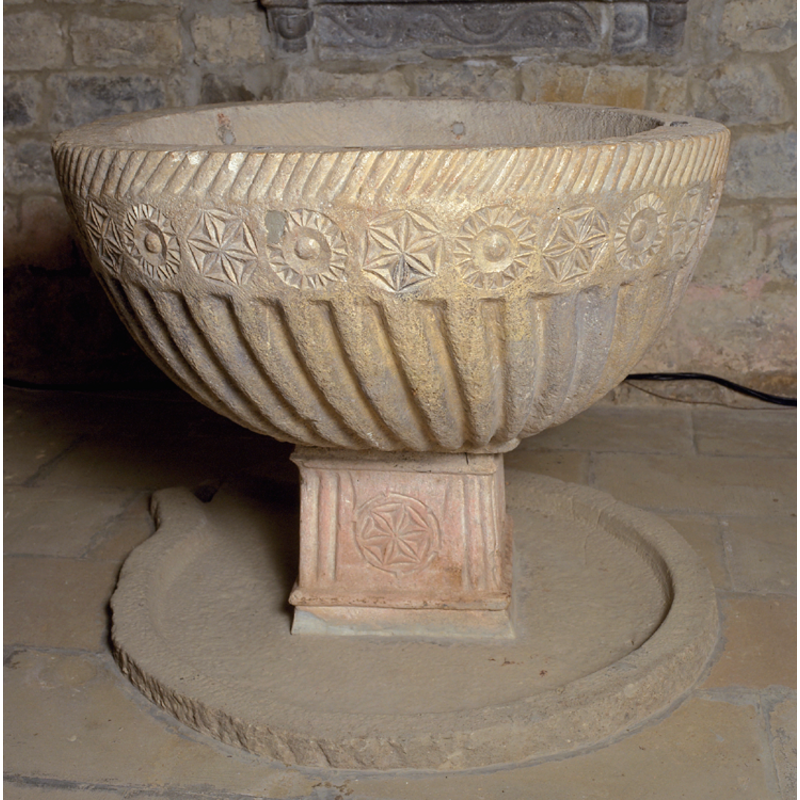
Image copyright © Institución Príncipe de Viana, 2003
Image and permission received (file letter of June 2001)
Results: 7 records
B01: design element - patterns - ribbed - diagonal
Copyright Statement: Image copyright © Institución Príncipe de Viana, 2003
Image Source: Institución Príncipe de Viana and photgraphers Larrión & Pimoulier (Pamplona, Spain)
Copyright Instructions: Image and permission received (file letter of June 2001)
BBU01: design element - motifs - floral - rosette - in a circle
Copyright Statement: Image copyright © Institución Príncipe de Viana, 2003
Image Source: Institución Príncipe de Viana and photgraphers Larrión & Pimoulier (Pamplona, Spain)
Copyright Instructions: Image and permission received (file letter of June 2001)
BBU02: symbol - star - in a circle
Copyright Statement: Image copyright © Institución Príncipe de Viana, 2003
Image Source: Institución Príncipe de Viana and photgraphers Larrión & Pimoulier (Pamplona, Spain)
Copyright Instructions: Image and permission received (file letter of June 2001)
LB01: design element - motifs - floral - rosette - in a circle - 4
Scene Description: one on each side
Copyright Statement: Image copyright © Institución Príncipe de Viana, 2003
Image Source: Institución Príncipe de Viana and photgraphers Larrión & Pimoulier (Pamplona, Spain)
Copyright Instructions: Image and permission received (file letter of June 2001)
R01: design element - motifs - rope moulding
Copyright Statement: Image copyright © Institución Príncipe de Viana, 2003
Image Source: Institución Príncipe de Viana and photgraphers Larrión & Pimoulier (Pamplona, Spain)
Copyright Instructions: Image and permission received (file letter of June 2001)
view of font
Copyright Statement: Image copyright © Institución Príncipe de Viana, 2003
Image Source: Institución Príncipe de Viana and photgraphers Larrión & Pimoulier (Pamplona, Spain)
Copyright Instructions: Image and permission received (file letter of June 2001)
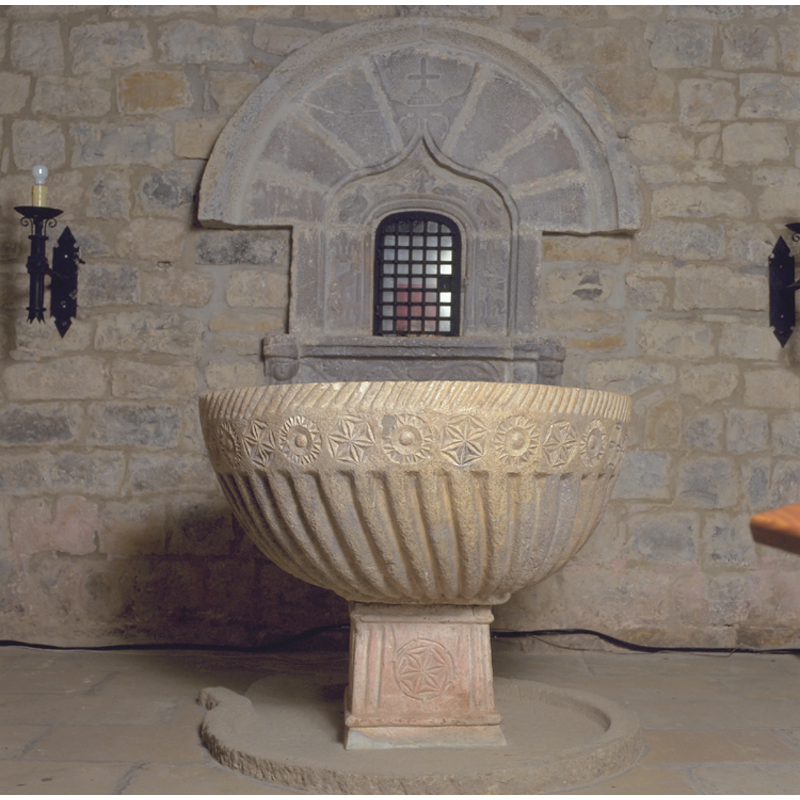
view of font in context
Copyright Statement: Image copyright © Institución Príncipe de Viana, 2003
Image Source: Institución Príncipe de Viana and photgraphers Larrión & Pimoulier (Pamplona, Spain)
Copyright Instructions: Image and permission received (file letter of June 2001)
INFORMATION
Font ID: 08026URR
Object Type: Baptismal Font1
Font Century and Period/Style: 12th - 16th century, Medieval
Cognate Fonts: Fonts at Aldaba, Azoz, Echarri, Ollacarizqueta and Ubani, according to the Catálogo Monumental de Navarra (1990?, vol. V**: 75)
Church / Chapel Name: Iglesia Parroquial de la Asunción de Urroz-Villa
Font Location in Church: Inside the church, in the crossing, N side chapel
Church Patron Saint(s): The Assumption of St. Mary
Church Notes: 12thC church
Church Address: C. Santo Tomás, 5, 31420 Urroz Villa, Navarra, Spain
Site Location: Navarra, Comunidad Foral de Navarra, Spain, Europe
Directions to Site: Located off the NA-234 and NA-150 crossroads, 19 km E of Pamplona
Ecclesiastic Region: Diócesis de Pamplona
Historical Region: Merindad de Sangüesa
Additional Comments: recycled font: the plinth of this font may be a mill stone
Font Notes:
Click to view
Listed in the Gran Enciclopedia Navarra (1990, v. 11: 258). Described and illustrated in the Catálogo Monumental de Navarra (1990?- , vol. IV**: 575 and pl. 688) as a medieval baptismal font; large hemispherical basin ornamented with a stylised rope motif at the rim; below it is a band alternating hexagons with circles that contain rather complex geometrical motifs; the rest of the sides and underbowl are covered in slightly oblique ribbed pattern; the pedestal base is square with moulded corners and 6-point flowers or stars inscribed. It is interesting to note that the illustration in the CMdeN [cf. supra] shows the font mounted on what appears to be a plinth with a raised border and a drain side, a rare occurrence in Navarra, and in Spain itself; it is probably a mill stone re-used as a suppoort for the font. Described and illustrated in Domeño (1992: 181 and pl. 49). [The CMdeN (ibid.) mentions a holy-water stoup in the south side, by the door: tetra-lobed basin raised on a cylindrical base and a pyramidal lower base -- not dated -- not listed in this Index]
Credit and Acknowledgements: We are grateful to the Institución Príncipe de Viana and photgraphers Larrión & Pimoulier, of Pamplona, Spain, for the images of this font
COORDINATES
UTM: 30T 626022 4737324
Latitude & Longitude (Decimal): 42.778091, -1.459424
Latitude & Longitude (DMS): 42° 46′ 41.13″ N, 1° 27′ 33.92″ W
MEDIUM AND MEASUREMENTS
Material: stone
Number of Pieces: two
Font Shape: hemispheric, mounted
Basin Interior Shape: round
Basin Exterior Shape: round
REFERENCES
- Gran enciclopedia Navarra (11 vols.), Pamplona: Caja de Ahorros de Navarra, 1990, vol. 11: 258
- Bilbao López, Garbiñe, Iconografía de las pilas bautismales del románico castellano: Burgos y Palencia, Burgos: Editorial La Olmeda, S.L., 1996, p. 68 fn 2, 81 fn51
- Domeño Martínez de Morentín, Asunción, Pilas bautismales medievales en Navarra, Pamplona: Gobierno de Navarra, 1992, p. 54, 115, 181 and pl. 49, 159
- García Gainza, María Concepción, Catálogo monumental de Navarra, Pamplona: Gobierno de Navarra, Arzobispado de Navarra, Universidad de Navarra, [1990?], vol. IV**: 575 and pl. 688