Ugborough
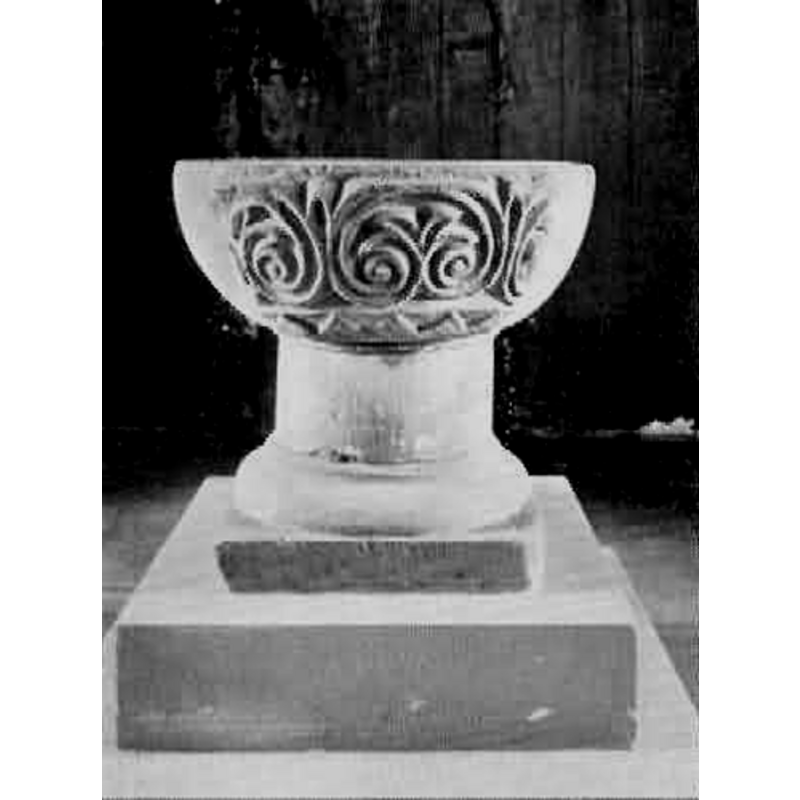
Image copyright © Roger Peters, 2005
Permission received (email of 9 January 2005)
Results: 5 records
B01: design element - motifs - foliage - honeysuckle or palmetto
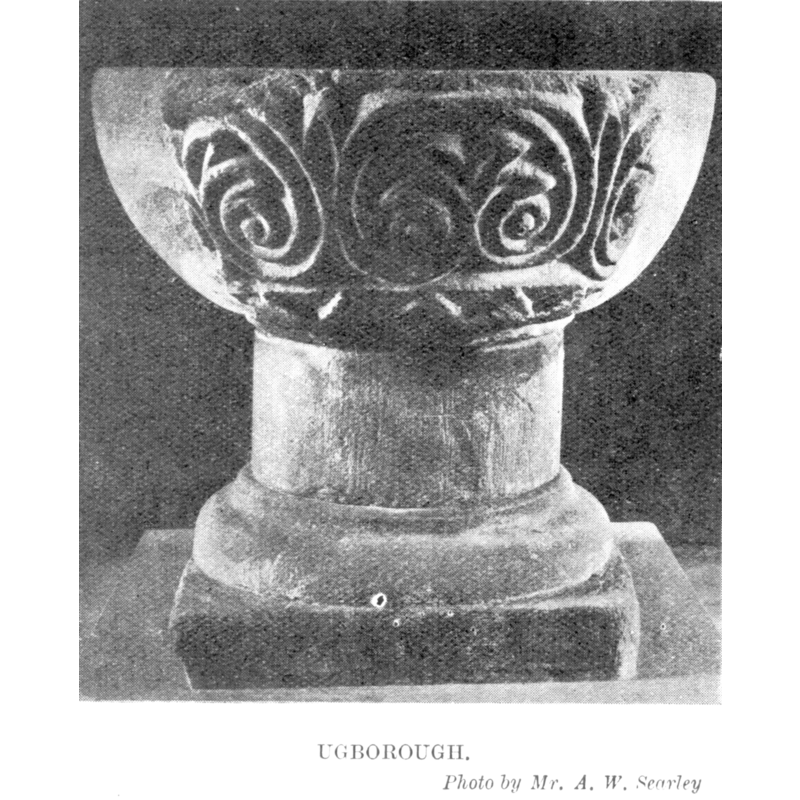
Scene Description: originaly all around the basin; only a samll portion of it remains now
Copyright Statement: Image copyright © [in the public domain]
Image Source: digital image from an illustration in Clarke (1916)
Copyright Instructions: PD
BBU01: design element - motifs - rope moulding
Scene Description: originaly all around the basin; only a samll portion of it remains now
Copyright Statement: Image copyright © [in the public domain]
Image Source: digital image from an illustration in Clarke (1916)
Copyright Instructions: PD
BU01: design element - motifs - sawtooth
Scene Description: originaly all around the basin; only a samll portion of it remains now
Copyright Statement: Image copyright © [in the public domain]
Image Source: digital image from an illustration in Clarke (1916)
Copyright Instructions: PD
view of font
Copyright Statement: Image copyright © Roger Peters, 2005
Image Source: Roger Peters [www.wissensdrang.com]
Copyright Instructions: Permission received (email of 9 January 2005)
view of font
Copyright Statement: Image copyright © [in the public domain]
Image Source: digital image from an illustration in Clarke (1916)
Copyright Instructions: PD
INFORMATION
Font ID: 06626UGB
Object Type: Baptismal Font1
Font Century and Period/Style: 12th century, Norman
Cognate Fonts: Fonts of this type at: Ashprington, Blackauton, Buckfastleigh, Denbury, Cornworthy, Dartmouth St. Petrock's, Paignton St Andrew's, Plymstock, South Brent, Thurlestone, Ugborough and Wolbororugh, all in Devon
Church / Chapel Name: Parish Church of St. Peter
Font Location in Church: Inside the church, in the W end of the nave
Church Patron Saint(s): St. Peter
Site Location: Devon, South West, England, United Kingdom
Directions to Site: Located sandwiched between the A3121 and the A38, 5 km E of Ivybridge, about 27 km EES of Plymouth
Additional Comments: damaged font: re-tooled -- only the part of the basin that was against the pillar has retained its ornamentation. Stabb (1908) writes: "The Norman font in this church [plate 242c] has a rather peculiar feature, the carving is only on one portion of the bowl, the remainder being plain. This is accounted for by the fact that the font, which now stands at the west end of the nave, at one time stood against a pillar, so that the carved part was protected from the hands of the despoilers who ruthlessly destroyed all they could reach: when the font was removed the plaster was cleared out of the carved portion remaining, and it is now as fresh as if it had just left the workman's hands. When one sees so much destruction of beautiful objects in our churches, one is at a loss to find a reason for it. One could understand, while not approving, the destruction of a crucifix or an image of the Blessed Virgin, from the point of view of those who committed the destruction, but in a case like this, when there are no figures or religious symbols of any kind in the carving, there is no excuse to be found for such wanton damage."
Font Notes:
Click to view
Listed in Lysons (1806-1822) as a baptismal font "among many of circular form and an early age, enriched with various carved mouldings, wreaths, scrolls, or foliage". Lewis' Dictionary of 1848 reports "a Norman font" in this church. Listed in Cox & Harvey (1907) as having a baptismal font of the Norman period. Stabb (1908) expresses his inability to understand the "wanton damage" done to this font. Described and illustrated in Clarke (1916) as one of twelve Devon fonts of about the same period [Norman/Late Norman] decorated with a prominent band of honeysuckle or palmetto motif all around the basin [the twelve are: Ashprington, Blackauton, Buckfastleigh, Denbury, Cornworthy, Dartmouth St. Petrock's, Paignton St Andrew's, Plymstock, South Brent, Thurlestone, Ugborough and Wolbororugh, all in Devon]. Clarke (ibid.) writes that "This font must originally have been one of the finest in its class, but it has been sadly mutilated. Only about 25 inches remain of the rich honeysuckle ornament and a corresponding length of saw-tooth which originally encircled the whole bowl. All the rest was planed away; the small section that is left was only saved because it happened to have been built into a pillar, and could not be reached by the devastator. In witness whereof the mark on the pillar is still shown. As if this were not enough the rim was cut down to the extent of at least 4 inches; there are slight traces of a cable twist for a few inches, and probably there was a round moulding above the cable." Kelly's Directory of 1923 [cited in http://www.devonheritage.org/Places/Ugborough/UgboroughsentryinKellysDirectoryof1923.htm [accessed 18 March 2009]] reports a Norman font in this church. Noted in Pevsner (1952): "Circular, plain, Norman, of red sandstone."
Credit and Acknowledgements: We are grateful to Dr. Roger Peters, of www.wissensdrang.com, for his permission to use the transcription of and images from Stabb (1908)]
MEDIUM AND MEASUREMENTS
Material: stone, sandstone (red)
Font Shape: hemispheric, mounted
Basin Interior Shape: round
Basin Exterior Shape: round
Rim Thickness: 12 cm [calculated]
Diameter (inside rim): 51.25 cm*
Diameter (includes rim): 75.6 cm*
Basin Depth: 17.5 cm*
Basin Total Height: 25 cm*
Height of Central Column: 18.75 cm*
Font Height (less Plinth): 71.25 cm*
Notes on Measurements: *[measurements given in inches in Clarke (1916: 319) -- all measurements correspond to the altered font]
REFERENCES
- Clarke, Kate M., "The baptismal fonts of Devon -- Part IV", 48, Report and Transactions of the Devonshire Association for the Advancement of Science, Literature and Art, 1916, pp. 302-319; p. 314-315, 319 and pl. VII (opp. p. 314)
- Clarke, Kate M., "The baptismal fonts of Devon -- Part IX", 54, Report and Transactions of the Devonshire Association for the Advancement of Science, Literature and Art, 1922, pp. 216-223; p. 222
- Clarke, Kate M., "The baptismal fonts of Devon -- Part V", 50, Report and Transactions of the Devonshire Association for the Advancement of Science, Literature and Art, 1918, pp. 583-587; p. 587
- Cox, John Charles, English Church Furniture, New York: E.P. Dutton & Co., 1907, p. 196
- Lewis, Samuel, A Topographical Dictionary of England, Comprising the Several Counties, Cities, Boroughs, Corporate and Market Towns, Parishes, Chapelries, and Townships, and the Islands of Guernsy, Jersey, and Man, with Historical and Statistical Descriptions [...], London: S. Lewis, 1831, [www.british-history.ac.uk/report.asp?compid=51360] [accessed 14 March 2007]
- Lysons, Daniel, Magna Britannia, being a concise topographical account of the several counties of Great Britain, London: Printed for T. Cadell and W. Davies, 1806-1822, vol. 6: p. cccxxx
- Pevsner, Nikolaus, South Devon, Harmondsworth: Penguin Books, 1952, p. 302
- Stabb, John, Some old Devon churches, their roods, pulpits, fonts, etc., London: Simkin, [et al.], 1908-1916, p. 242 and pl. 242c