Clawton
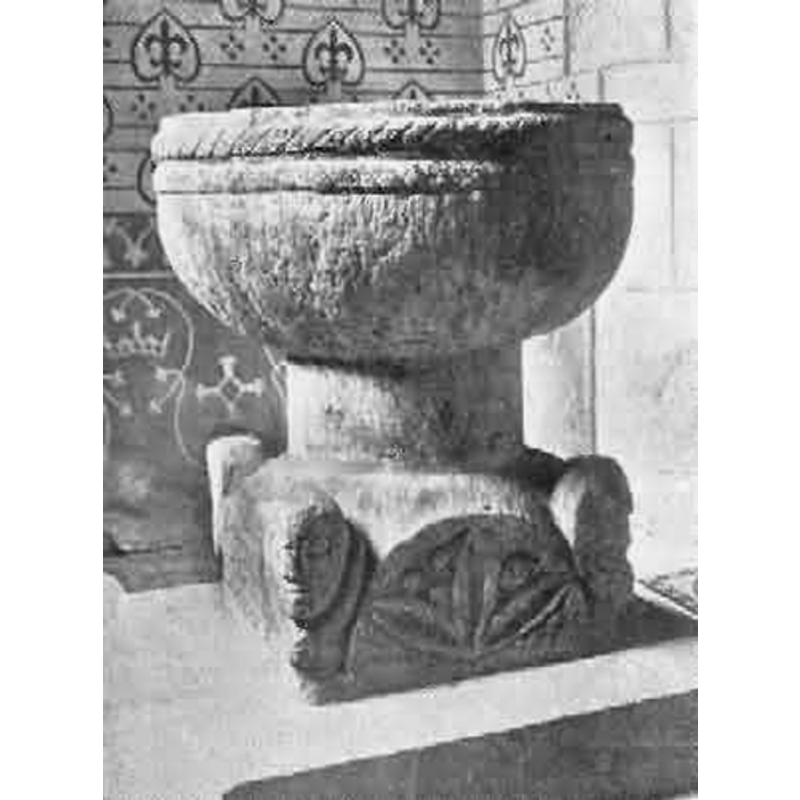
Image copyright © Roger Peters, 2005
Permission received (email of 9 January 2005)
Results: 5 records
BBU01: design element - motifs - rope moulding - parallel - 2
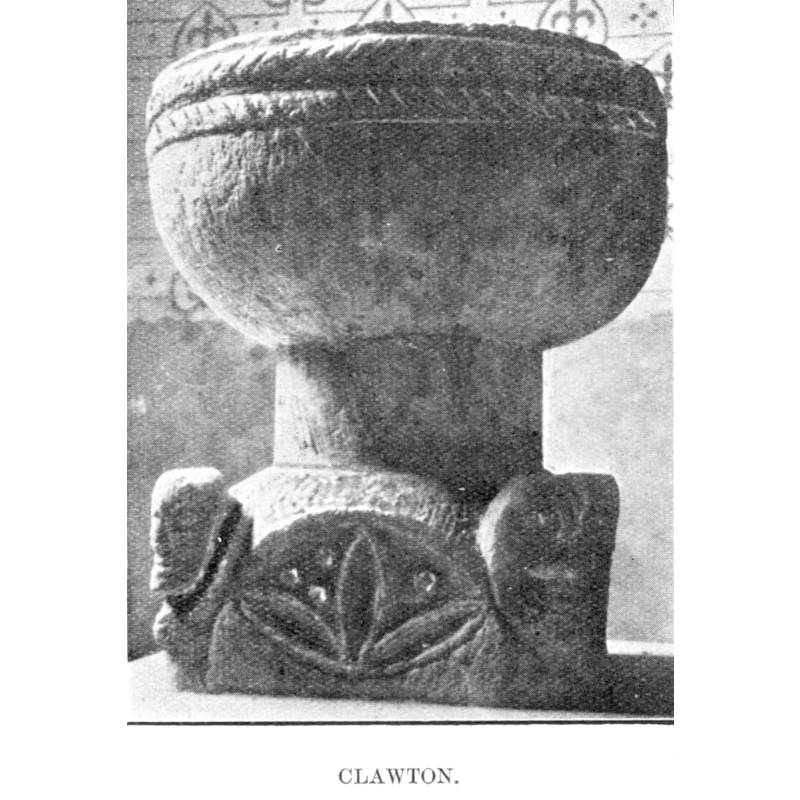
Scene Description: the pattern of the rope runs in opposite directions: to the right on the upper moulding, to the lft on the lower moulding
Copyright Statement: Image copyright © [in the public domain]
Image Source: digital image from an illustration in Clarke (1918)
Copyright Instructions: PD
LB01: design element - motifs - varied (pellet, leaf or star, etc.)
Scene Description: on the east and south sides; the north and west sides are blank
Copyright Statement: Image copyright © [in the public domain]
Image Source: digital image from an illustration in Clarke (1918)
Copyright Instructions: PD
LBH01: human figure - grotesque or fantastic - head - 4
Scene Description: [cf. Font notes for details of the four heads]
Copyright Statement: Image copyright © [in the public domain]
Image Source: digital image from an illustration in Clarke (1918)
Copyright Instructions: PD
view of font
Copyright Statement: Image copyright © Roger Peters, 2005
Image Source: Roger Peters [www.wissensdrang.com]
Copyright Instructions: Permission received (email of 9 January 2005)
view of font
Copyright Statement: Image copyright © [in the public domain]
Image Source: digital image from an illustration in Clarke (1918)
Copyright Instructions: PD
INFORMATION
Font ID: 06607CLA
Object Type: Baptismal Font1
Font Century and Period/Style: 11th - 13th century, Norman
Cognate Fonts: A similar, though not identical base, at Tetcott, Devon
Church / Chapel Name: Parish Church of St. Leonard
Font Location in Church: Inside the church
Church Patron Saint(s): St. Leonard
Site Location: Devon, South West, England, United Kingdom
Directions to Site: Located on the A388, about 16 km N of Launceston
Additional Comments: influence of the Cornish-style fonts
Font Notes:
Click to view
Listed in Cox & Harvey (1907: 196) as having a baptismal font of the Norman period. Noted in Stabb (1908): "There is a good Norman font." Described and illustrated in Clarke (1918): "Two cable mouldings are the only ornament on the bowl of the Clawton font; they are not accurately worked as in the older fonts, the twist is merely suggested by incised diagonal lines, which in the upper moulding run to the right, and in the lower to the left. We met with similar sketchy cables at Abbotsham and Beaford [cf. Index entries]. The low shaft is cylindrical. The cushion base has at the corners Norman masks of the usual type; they vary in length from 6 to 8 1/2 inches. The mask of the south-east corner has two arms coming from behind the head, with hands clasped below the chin. The face at the south-west corner has a beard. The large mask at the north-west has the tongue lolling out, and the one at the north-east has a grinning mouth. It may be that the first two were meant to symbolize the principle of good, and the others the principle of evil. This suggestion appears in other Norman fonts, for instance, at Hartland. The semicircular face of the cushion towards the east has carved on it three lobes of a star; the space between two lobes on the left has three pellets, and the corresponding space on the right one large patera. The south face has an oblong panel, bearing a device something like a portcullis, with a pellet in each square opening. The pellets are irregular in size and shape; some resemble scalop shells. The northern and western faces are plain. The material of the font is polyphant stone; the bowl is not lined, but the water does not run away properly. The holes that originally held the staples of the cover are now filled with cement. The font is raised on two slate slabs, on a beautiful pavement of old tiles." Clarke (ibid.) then remarks on an interesting aspect of the fonts of this area: "In this district, near the county border, the fonts display many features characteristic of Cornwall: here they appear in the masks, so general in that county, and the cable, which was retained there long after it had been discarded in other parts of England. The fonts at Launcells and St. Stephen's by Launceston both have their bowls encircled by a double cable moulding, the twist in each case being in opposite directions, as we find at Clawton." In Pevsner (1952): "Font. Norman, circular, of blue stone with one top band of cable. The base more elaborately decorated with four faces at the angles and half-rosettes on the main surfaces, as if it were a fragmentary re-used font itself, of the Cornish St. Thomas-by-Launceston type (cf. Tetcott nearby)". [NB: recent [2004] confirmation of the font in www.visitbude.info/locally4.htm (BUDE: The Official Tourist Information web site)] [We are grateful to Dr. Roger Peters, of www.wissensdrang.com, for his permission to use the transcription of and images from Stabb (1908)]
Credit and Acknowledgements: We are grateful to Dr. Roger Peters, of www.wissensdrang.com, for his permission to use the transcription of and images from Stabb (1908)]
MEDIUM AND MEASUREMENTS
Material: stone, polyphant stone
Font Shape: hemispheric, mounted
Basin Interior Shape: round
Basin Exterior Shape: round
Drainage System: [cf. FontNotes]
Drainage Notes: no lining
Rim Thickness: 9 - 10 cm [calculated]
Diameter (inside rim): 50 cm*
Diameter (includes rim): 67.5 - 70 cm*
Basin Depth: 25 cm*
Basin Total Height: 32.5 cm*
Height of Central Column: 17.5 cm*
Font Height (less Plinth): 80 cm* [includes 27.5 cm* for the lower base]
Notes on Measurements: * [measurements given in inches in Clarke (1918: 588)]
LID INFORMATION
Notes: [plugged staple holes of the old cover]
REFERENCES
- Clarke, Kate M., "The baptismal fonts of Devon -- Part V", 50, Report and Transactions of the Devonshire Association for the Advancement of Science, Literature and Art, 1918, pp. 583-587; p. 584-585, 586, 588 and pl. II (opp. p. 584)
- Clarke, Kate M., "The baptismal fonts of Devon -- Part VI", 51, Report and Transactions of the Devonshire Association for the Advancement of Science, Literature and Art, 1919, pp. 211-221; p. 212
- Cox, John Charles, English Church Furniture, New York: E.P. Dutton & Co., 1907, p. 196
- Pevsner, Nikolaus, North Devon, Harmondsworth: Penguin, 1952, p. 72
- Stabb, John, Some old Devon churches, their roods, pulpits, fonts, etc., London: Simkin, [et al.], 1908-1916, p. 60 and pl. 60b