Pinhoe
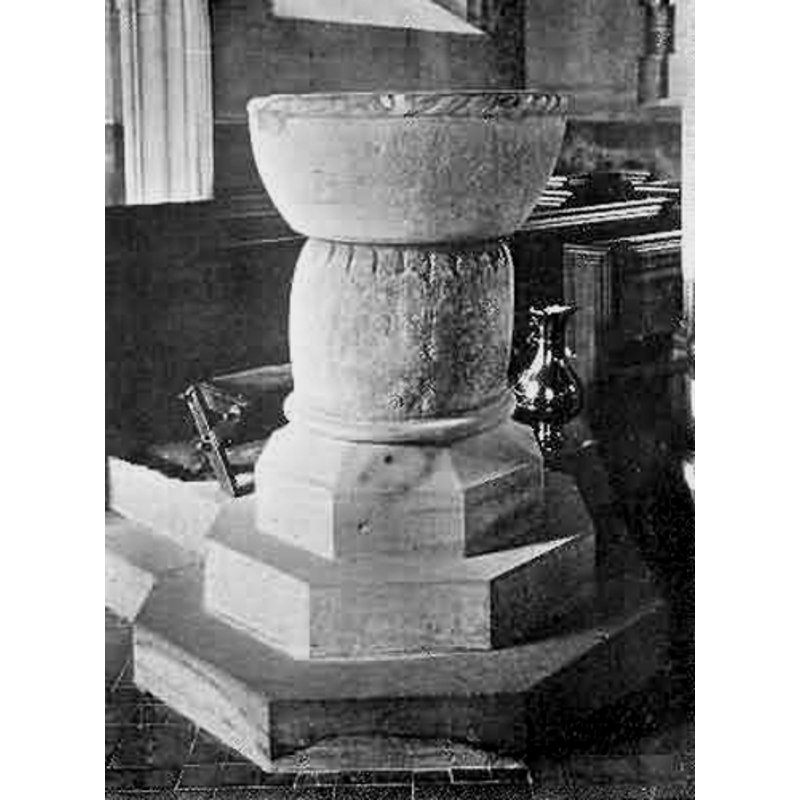
Image copyright © Roger Peters, 2005
Permission received (email of 9 January 2005)
Results: 5 records
BBU01: design element - motifs - braid
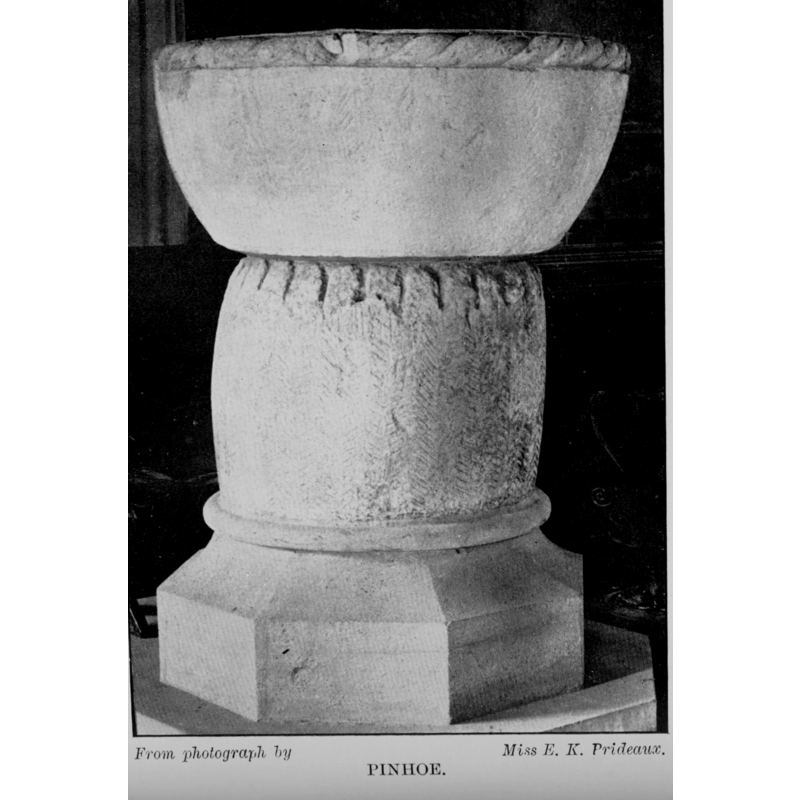
Copyright Statement: Image copyright © [in the public domain]
Image Source: digital image of an illustration by E.K. Prideaux, in Clarke (1913)
Copyright Instructions: PD
LB01: design element - motifs - scallop
Scene Description: a band of small scallop in place of the more common rope or roll moulding
Copyright Statement: Image copyright © [in the public domain]
Image Source: digital image of an illustration by E.K. Prideaux, in Clarke (1913)
Copyright Instructions: PD
LB02: design element - motifs - roll moulding
Scene Description: at the bottom of the stem
Copyright Statement: Image copyright © [in the public domain]
Image Source: digital image of an illustration by E.K. Prideaux, in Clarke (1913)
Copyright Instructions: PD
view of font
Copyright Statement: Image copyright © Roger Peters, 2005
Image Source: Roger Peters [www.wissensdrang.com]
Copyright Instructions: Permission received (email of 9 January 2005)
view of font
Copyright Statement: Image copyright © [in the public domain]
Image Source: digital image of an illustration by E.K. Prideaux, in Clarke (1913)
Copyright Instructions: PD
INFORMATION
Font ID: 05524PIN
Object Type: Baptismal Font1
Font Century and Period/Style: 11th - 12th century, Norman
Church / Chapel Name: Parish Church of St. Michael and All Angels
Font Location in Church: Inside the church
Church Patron Saint(s): St. Michael & All Angels
Site Location: Devon, South West, England, United Kingdom
Directions to Site: Located on the B3181, in the northern suburbs of Exeter
Font Notes:
Click to view
Among the many complaints Oliver (1840-1842) had about the vandalism exercised on the church interior and furnishings, there was one about the font: "The circular font, of very remote antiquity, is still imbedded in that everlasting whitewash." Listed in Bond (1908) simply as a baptismal font with a bowl-shaped basin. Stabb (1908) writes: "The font [...] is of the style which prevailed in the reign of Edward the Confessor (1042-1066), and is certainly much older than the church; it is a misshapen block of stone scooped out, its only ornament being a rudely carved cable twisted around it, and what seems like ferns, flags or bulrushes." Clarke (1913) describes this font as interesting but "not easy to classify [...] As far as I know, there is no other font in Devon constructed in this way. Round the rim of the bowl is a squared moulding partly covered by the lead lining; immediately below this is a bold cable twist. The rest of the bowl has hatched-work all over it; short lines of alternatively diagonal arranged in vertical rows, producing a herring-bone effect. The bowl is cemented to a barrel-shaped block; this block has a single row of scallop ornament just below the juntion with the bowl, taking the place of the usual cable [...] The rest of the block is covered with incised herring-bone similar to that on the bowl, but rather more regular, and with the vertical columns more accentuated." Clarke (ibid.) argues that there is Saxon work as well as Norman on this font. Noted in Pevsner (1952): "Plain Norman with just two bands of elementary decoration."
Credit and Acknowledgements: We are grateful to Dr. Roger Peters, of www.wissensdrang.com, for supplting us with the transcription of and images from Stabb (1908).
MEDIUM AND MEASUREMENTS
Material: stone
Font Shape: hemispheric, mounted
Basin Interior Shape: round
Basin Exterior Shape: round
Drainage Notes: lead lining
Rim Thickness: 6.5 cm [calculated]
Diameter (inside rim): 62.5 cm*
Diameter (includes rim): 75.62 cm*
Basin Depth: 21.25 cm*
Basin Total Height: 32.5 cm [calculated]
Height of Base: 41.25 cm*
Font Height (less Plinth): 73.75 cm*
Notes on Measurements: *[Measurements given in inches in Clarke (1913: 329)]
REFERENCES
- Bond, Francis, Fonts and Font Covers, London: Waterstone, 1985 c1908, p. 43
- Clarke, Kate M., "The baptismal fonts of Devon -- Part IX", 54, Report and Transactions of the Devonshire Association for the Advancement of Science, Literature and Art, 1922, pp. 216-223; p. 221
- Oliver, George, Ecclesiastical Antiquities in Devon: being Observations on Several Churches in Devonshire, with some Memoranda for the History of Cornwall, Exeter: W.C. Featherstone, 1840-1842, vol. 2: p. 126
- Pevsner, Nikolaus, South Devon, Harmondsworth: Penguin Books, 1952, p. 227
- Stabb, John, Some old Devon churches, their roods, pulpits, fonts, etc., London: Simkin, [et al.], 1908-1916, p. 182 and pl. 182b