Hastings No. 1
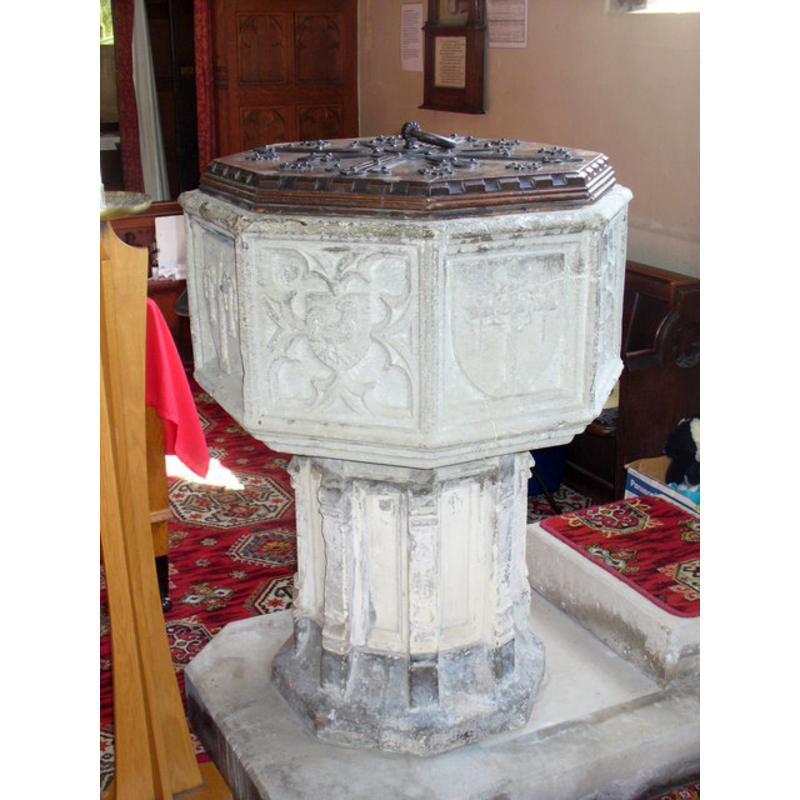
Image copyright © Colin Smith, 2010
Standing permission
Results: 6 records
view of font and cover
Copyright Statement: Image copyright © Colin Smith, 2010
Image Source: digital photograph taken 14 August 2010 by Colin Smith [www.geograph.org.uk/photo/2017308] [accessed 13 December 2012]
Copyright Instructions: Standing permission
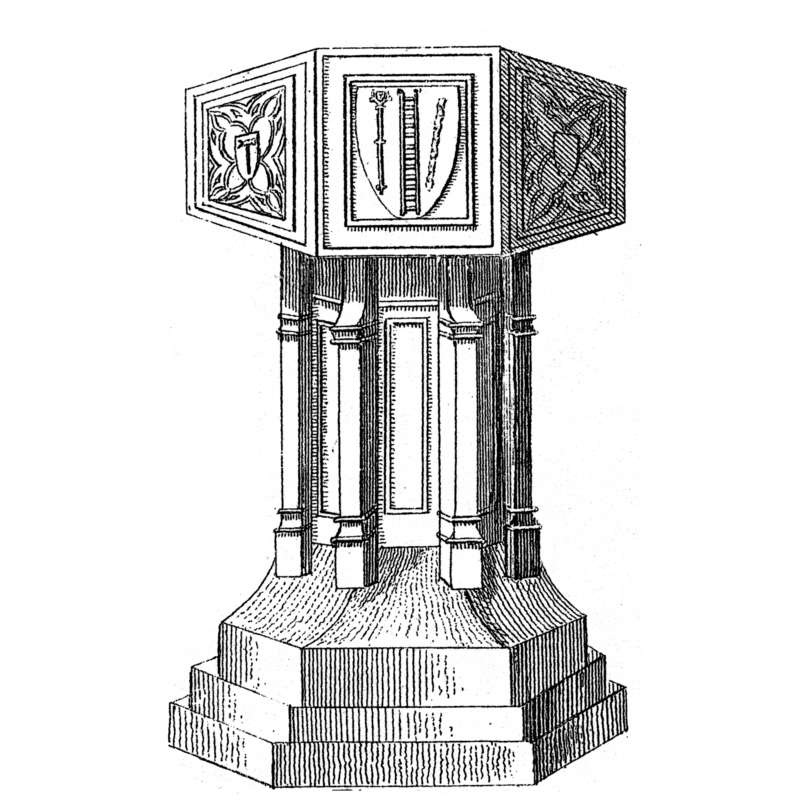
view of font
Copyright Statement: Image copyright © [in the public domain]
Image Source: detail of an engraving in The Gentleman's Magazine (Aug. 1786)
Copyright Instructions: PD
design element - motifs - tracery
Scene Description: on every other panel, framing the emblem
Copyright Statement: Image copyright © Colin Smith, 2010
Image Source: digital photograph taken 14 August 2010 by Colin Smith [www.geograph.org.uk/photo/2017308] [accessed 13 December 2012]
Copyright Instructions: Standing permission
symbol - Christ - the instruments of the Passion
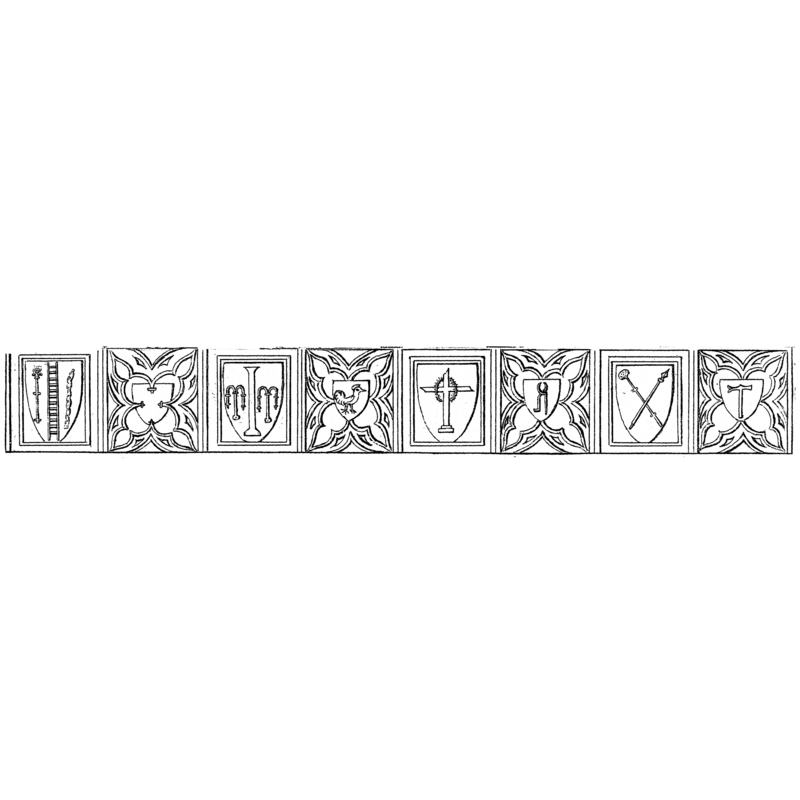
Scene Description: over all the panels of the basin
Copyright Statement: Image copyright © [in the public domain]
Image Source: detail of an engraving in The Gentleman's Magazine (Aug. 1786)
Copyright Instructions: PD
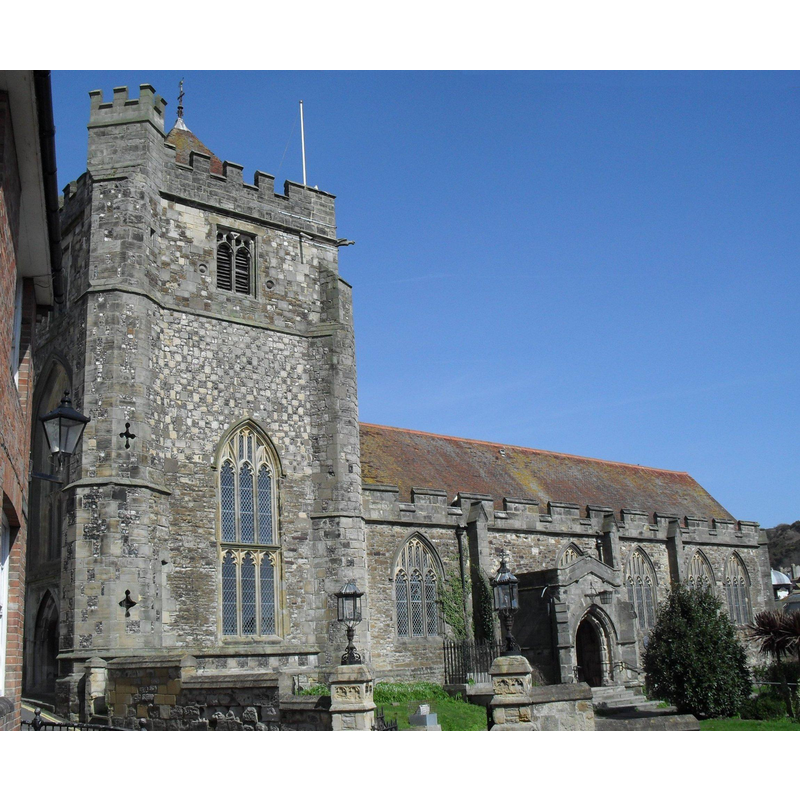
view of church exterior - southwest view
Copyright Statement: Image copyright © [in the public domain]
Image Source: digital photograph taken 5 April 2010 by The Voice of Hassocks [http://en.wikipedia.org/wiki/File:St_Clement%27s_Church,_Old_Town,_Hastings_%28IoE_Code_294078%29.jpg] [accessed 13 December 2012]
Copyright Instructions: Released by its author into the public domain
design element - architectural - buttress - 8
Scene Description: at the angles of the stem
Copyright Statement: Image copyright © Colin Smith, 2010
Image Source: digital photograph taken 14 August 2010 by Colin Smith [www.geograph.org.uk/photo/2017308] [accessed 13 December 2012]
Copyright Instructions: Standing permission
INFORMATION
Font ID: 05299HAS
Object Type: Baptismal Font1
Font Century and Period/Style: 15th century, Perpendicular
Workshop/Group/Artisan: heraldic font
Church / Chapel Name: Parish Church of St. Clement
Font Location in Church: Inside the church, at the W end
Church Patron Saint(s): St. Clement
Church Address: Swan Terrace/High St, Hastings, East Sussex, TN34 3ES. United Kingdom
Site Location: East Sussex, South East, England, United Kingdom
Directions to Site: Located on the southeast coast, 80-90 km S of London
Ecclesiastic Region: Diocese of Chichester
Historical Region: Rape and Honour of Hastings -- Sussex
Font Notes:
Click to view
A communication in The Gentleman's Magazine issue for August 1786 reads: "In St. Clement's church is a curious antique font [..] on the squares of which are carved, in relievo, the instruments of our Lord's passion"; an engraving of the font and iconographic program are included. Noted in Gough (1792), with reference to the Gentleman's Magazine entry above: "octagon, adorned with the instruments of the passion on shields in quatrefoils". Described and illustrated in Rouse (1825), who has little problem suggesting Norman pedigree to a Perpendicular font: "The Font as described in the drawing, is supposed to be of Norman workmanship, and is a curious specimen of antiquity. It is of an octagon form; on the squares of which are carved, in basso relievo, the instruments of our Saviour's passion. In the shield, on the left compartment, is seen the cross; in the left centre, are the pincers; in the light centre, the sponge and spear; and in the right is the hammer. The shields above are intended to describe those on the opposite side of the octagon; namely, that on the left, the cock; left centre, the pillar and scourges; right centre, blank; and that on the right, the beacon, as used by the Romans, --the ladder, and a spear which is defaced. It is regretted that the zeal which is every where manifested for improvement should sometimes disfigure some of the most curious remains of antiquity, by painting, white washing, &c., of the truth of which remark, this Font is a striking instance; the paint that now covers its surface having materially diminished its former beauty." Rouse (ibid.) further notes that some similarities of detail incline him to suggest that this font may have originally been at St. Dunstan's Palace, in Mayfield. Lewis' Dictionary of 1848 reports: "the font is ornamented on the sides with a sculptured representation of the Passion of the Saviour." Listed in Cox & Harvey (1907) as a baptismal font of the Perpendicular period. Described in Bond (1908) as one of those baptismal fonts in which "the Instruments of the Passion [...] occupy every panel of the bowl." Described in Harrison (1920): "splendid octagonal font (Perp.), sculptured with the Instruments of the Passion—on W., the Cross and Crown of Thorns ; N. scourging post and scourges ; E. lantern on a pole, ladder, and St. Peter's sword ; S. reed and spear crossed ; on the small shields, hammer, pincers, and cock." Described in Whiteman (1994): "The fine octagonal font is early 15th-century and has shields with the instruments of the Passion, including the cross and crown of thorns". [cf. Index entry for Hastings No. 3 for a rectored holy-water basin probably of the same date in this church]
COORDINATES
UTM: 31U 330447 5636733
Latitude & Longitude (Decimal): 50.8574, 0.5909
Latitude & Longitude (DMS): 50° 51′ 26.64″ N, 0° 35′ 27.24″ E
MEDIUM AND MEASUREMENTS
Material: stone
Font Shape: octagonal, mounted
Basin Interior Shape: round
Basin Exterior Shape: octagonal
LID INFORMATION
Date: 19th century?
Material: wood, oak?
Apparatus: no
Notes: octagonal and flat, with metal decoration and ting handle; appears Victorian
REFERENCES
- Bond, Francis, Fonts and Font Covers, London: Waterstone, 1985 c1908, p. 253
- Cox, John Charles, English Church Furniture, New York: E.P. Dutton & Co., 1907, p. 223
- Gough, Richard, "Description of the old font in the Church of East Meon, Hampshire, 1789: with some observations on fonts", X, Archaeologia, 1792, pp. 183-209; p. 192
- Harrison, Frederick, Notes on Sussex churches, Hove: Combridges, 1920, p. 41, 124
- Lewis, Samuel, A Topographical Dictionary of England, Comprising the Several Counties, Cities, Boroughs, Corporate and Market Towns, Parishes, Chapelries, and Townships, and the Islands of Guernsy, Jersey, and Man, with Historical and Statistical Descriptions [...], London: S. Lewis, 1831, [www.british-history.ac.uk/report.asp?compid=51013] [accessed 8 February 2007]
- Rouse, James, The Beauties and antiquities of the County of Sussex: forming a general illustration on one hundred and forty-nine spirited views from original drawings […], London: J.F. Setchel, 1825, vol. 1: 11, 12, 141 and pl. vi
- Skinner, Matt[ew]., "Topographical description of Hastings in Sussex", LVI 2nd pt., August 1786, The Gentleman's Magazine: or, Trader's monthly intelligencer, 1786, pp. 649-651; p. 650 and pl. I figs. 5, 6
- Whiteman, Ken, Ancient Churches of Suffolk, Seaford, East Sussex: S.B. Publications, 1998, p. 81