Plymstock
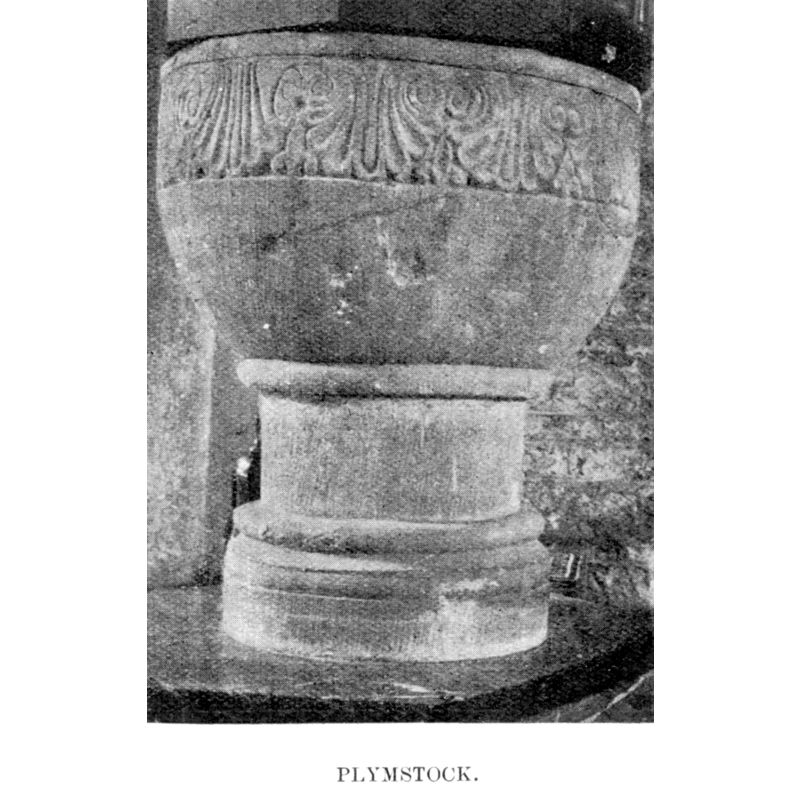
Image copyright © [in the public domain]
PD
Results: 5 records
B01: design element - motifs - foliage - honeysuckle or palmetto
Copyright Statement: Image copyright © [in the public domain]
Image Source: digital image from an illustration in Clarke (1916)
Copyright Instructions: PD
LB01: design element - motifs - roll moulding
Scene Description: several, on the base
Copyright Statement: Image copyright © [in the public domain]
Image Source: digital image from an illustration in Clarke (1916)
Copyright Instructions: PD
view of font
Copyright Statement: Image copyright © [in the public domain]
Image Source: digital image from an illustration in Clarke (1916)
Copyright Instructions: PD
view of font and cover
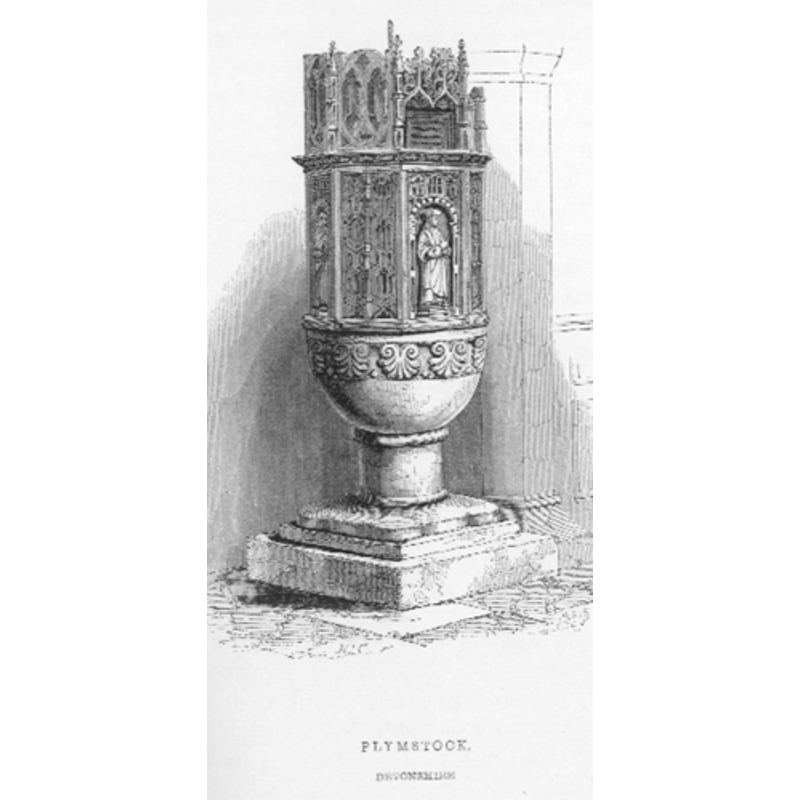
Copyright Statement: Image copyright © [in the public domain]
Image Source: engraving in Paley (1844: unpaged)
Copyright Instructions: PD
view of font and cover in context
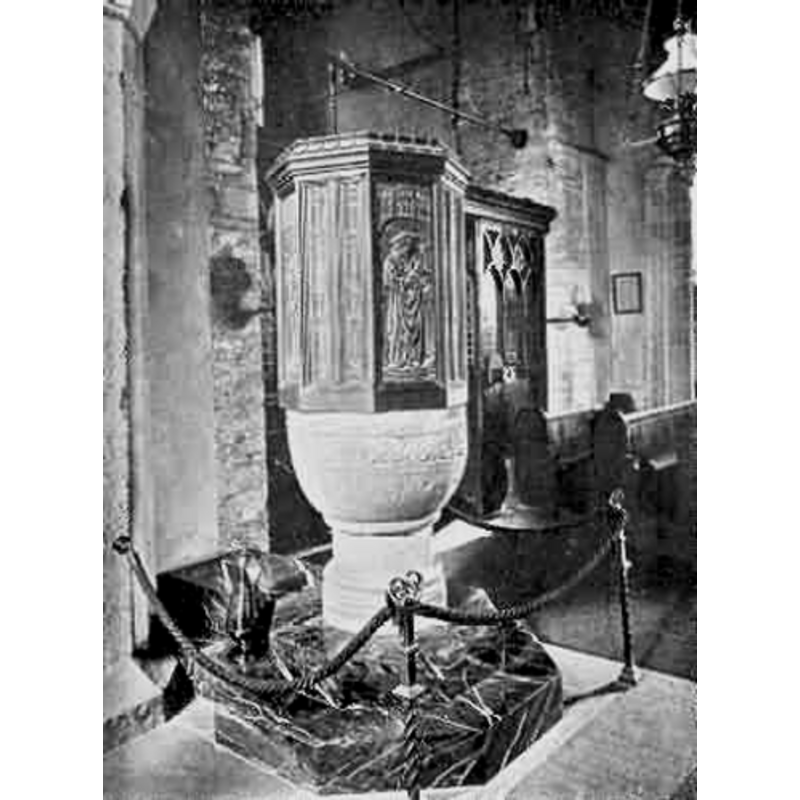
Copyright Statement: Image copyright © Roger Peters, 2005
Image Source: Roger Peters [www.wissensdrang.com]
Copyright Instructions: Permission received (email of 9 January 2005)
INFORMATION
Font ID: 03426PLY
Object Type: Baptismal Font1
Font Century and Period/Style: 12th - 13th century, Norman
Cognate Fonts: Fonts of this type at: Ashprington, Blackauton, Buckfastleigh, Denbury, Cornworthy, Dartmouth St. Petrock's, Paignton St Andrew's, Plymstock, South Brent, Thurlestone, Ugborough and Wolbororugh, all in Devon
Church / Chapel Name: Parish Church of St. Mary and All Saints
Font Location in Church: Inside the church, in the W end of the nave, S aisle
Church Patron Saint(s): St. Mary the Virgin & All Saints
Church Address: Holland Rd, Plymstock, Plymouth PL9 9BL, United Kingdom -- Tel.: +44 1752 941844
Site Location: Devon, South West, England, United Kingdom
Directions to Site: Located off (S) the A38, 4-5 km SW of Plymouth
Ecclesiastic Region: Diocese of Plymouth
Additional Comments: recycled font: whitewashed; then the whitewash removed; damaged; altered -- Stabb [cf. FontNotes] says it's probably from another church originally
Font Notes:
Click to view
Paley (1844) describes it as one in a group of fonts in which "the under side of the bowl is bevilled away or rounded off to meet the stem [...] and this hemispherical form is extremely common in Norman fonts as at Cuxwold, Lincolnshire; Clipsham, Rutland; Heydon, Norfolk; Laxton, Northamptonshire; Plymstock, Devonshire." Paley (ibid.) reports this font as being of red sandstone and having suffered much damage in the early 1800s during attempts to remove the "many coats of wash", and later repaired with cement. The basin is hemispheric "having a broad ornamented band of Grecian character" around the upper part of the basin side. The base is cylindrical and plain; the whole stands on three roughly square steps. Paley reports it as having been moved from its original position near the westermost pillar to its present [i.e., ca. 1844] position at the west end of the south side, north-west angle. The font cover, dated -in part- to the 17th cent. by Paley, is close to 6 feet tall; the lower part, which he dates much later than the upper, is octagonal with a saint figure painted in colours in each alternate side; the upper part "is better designed and executed than the lower portion [...] a text of scripture runs on six sides of it". Bond (1908) mentions only the font cover as being a notable example of the Post-Reformation period. [NB: the reference to the font "Plympton" in Cox & Harvey (1907) as being illustrated in Paley is obviously a typographical error and it should read "Plymstock"]. Font and font cover are noted and illustrated in Stabb (1908): "This church has an old font [...], cup-shape in form, with a broad band of carving of Grecian character: it is mounted on a circular shaft. It is of dark red sandstone, its source unknown, probably it was brought from some other church. There is a good cover, but it was evidently not made for this font, as the font is circular and the cover octagonal: each alternate side is ornamented with a carved figure. It is probably of German workmanship, and dates from the 17th century." Described and illustrated in Clarke (1916) as one of twelve Devon fonts of about the same period [Norman/Late Norman] decorated with a prominent band of honeysuckle or palmetto motif all around the basin [the twelve are: Ashprington, Blackauton, Buckfastleigh, Denbury, Cornworthy, Dartmouth St. Petrock's, Paignton St Andrew's, Plymstock, South Brent, Thurlestone, Ugborough and Wolbororugh, all in Devon]. Clarke (ibid.) writes that "this font has the same characteristics as Denbury, with the curious difference that the honeysuckle which hitherto has been unvarying in arrangement is reversed, and the containing stems are absent. The work is shallow and flat; the flatness is no doubt due in part to modern restoration, which appears to have been much overdone. The mouldings, including the base moulding of the shaft, are the same as at Denbury, but the circular base, which is either modern or modernised, is not so satisfactory as the sloping one at Denbury. The font is overweighted by its accessories: a polished marble plinth and a towering octagonal cover of carved panels." Noted in Pevsner (1952): "Norman, red sandstone, circular with a palmette frieze, the motif upside down as compared with the usual Devon practice. Fine font cover. Probably German, c. 1530, octagonal like a pulpit."
Credit and Acknowledgements: We are grateful to Dr. Roger Peters, of www.wissensdrang.com, for his permission to use the transcription of and images from Stabb (1908).
COORDINATES
UTM: 30U 422736 5579030
Latitude & Longitude (Decimal): 50.35827, -4.0862
Latitude & Longitude (DMS): 50° 21′ 29.77″ N, 4° 5′ 10.32″ W
MEDIUM AND MEASUREMENTS
Material: stone, sandstone (red)
Font Shape: hemispheric, mounted
Basin Interior Shape: round
Basin Exterior Shape: round
Rim Thickness: 10 cm
Diameter (inside rim): 52.5 cm *[51.25 cm]
Diameter (includes rim): 72.5 cm
Basin Depth: 31 cm *[30 cm]
Basin Total Height: *[45 - 47.5 cm]
Height of Central Column: *[17.5 cm]
Font Height (less Plinth): 96 cm *[88.7 cm]
Notes on Measurements: Paley (1844, unpaged) *[measurements given in inches in Clarke (1916: 319)]
INSCRIPTION
Inscription Location: On the sides of the font cover
Inscription Text: [transcription of the inscription not available]
Inscription Notes: Paley writes just "text of scripture"
Inscription Source: Paley (1844, unpaged)
LID INFORMATION
Date: 17th century (in part)? / ca. 1530? [composite]
Material: wood
Apparatus: no
Notes: [German workmanship? cf. FontNotes]
REFERENCES
- Bond, Francis, Fonts and Font Covers, London: Waterstone, 1985 c1908, p. 291
- Clarke, Kate M., "The baptismal fonts of Devon -- Part IV", 48, Report and Transactions of the Devonshire Association for the Advancement of Science, Literature and Art, 1916, pp. 302-319; p. 318, 319 and pl. XI (opp. p. 318)
- Cox, John Charles, English Church Furniture, New York: E.P. Dutton & Co., 1907, p. 195 [error]
- Paley, Frederick Apthorp, Illustrations of Baptismal Fonts, London, UK: John van Voorst, 1844, p. 19, 21, 26 et al.
- Pevsner, Nikolaus, South Devon, Harmondsworth: Penguin Books, 1952, p. 245-246
- Stabb, John, Some old Devon churches, their roods, pulpits, fonts, etc., London: Simkin, [et al.], 1908-1916, p. 186