Ringmore / Rinmore
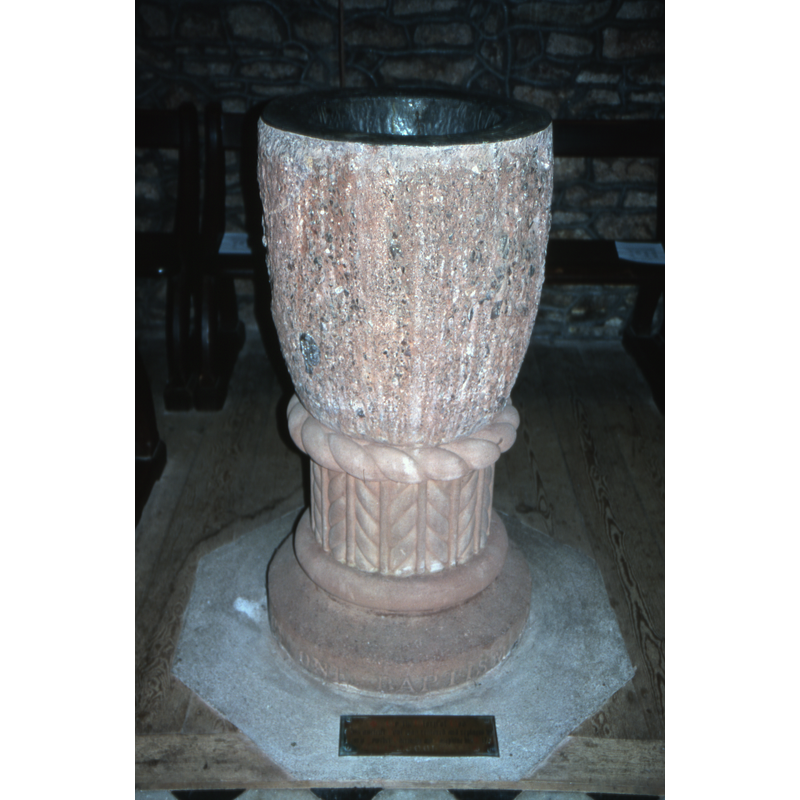
Image copyright © Baptisteria Sacra Index, 2023
CC-BY-NC-ND-4.0
Results: 3 records
view of font
Copyright Statement: Image copyright © Baptisteria Sacra Index, 2023
Image Source: digital image of a photograph taken 24 July 2000 by BSI
Copyright Instructions: CC-BY-NC-ND-4.0
view of font
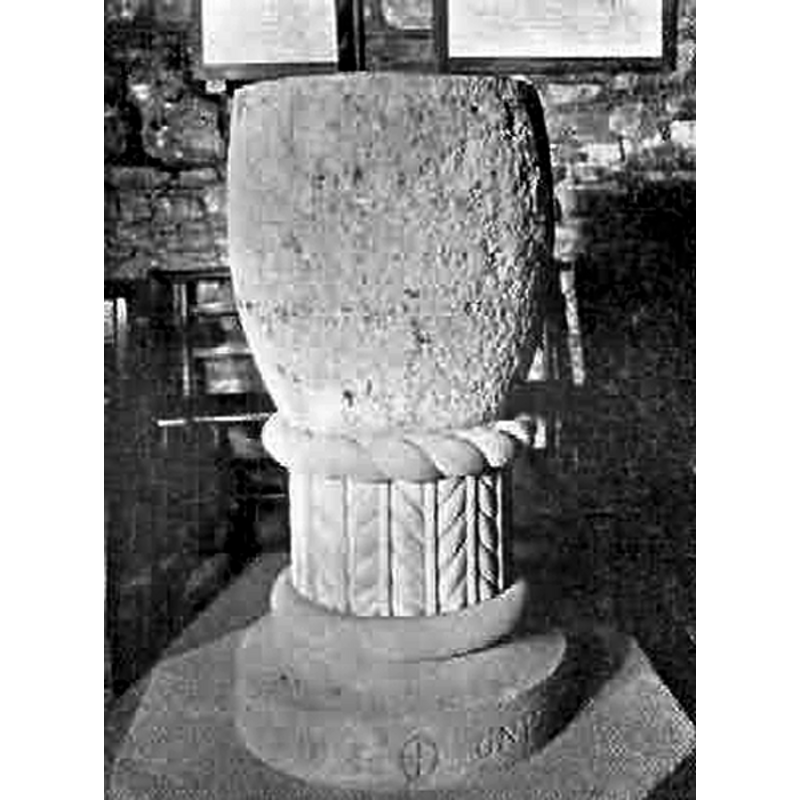
Copyright Statement: Image copyright © Roger Peters, 2005
Image Source: digital image by Roder Peters in www.wissensdrang.com [accessed 1 January 2005]
Copyright Instructions: Permission received from the author (e-mail of 9 January 2005)
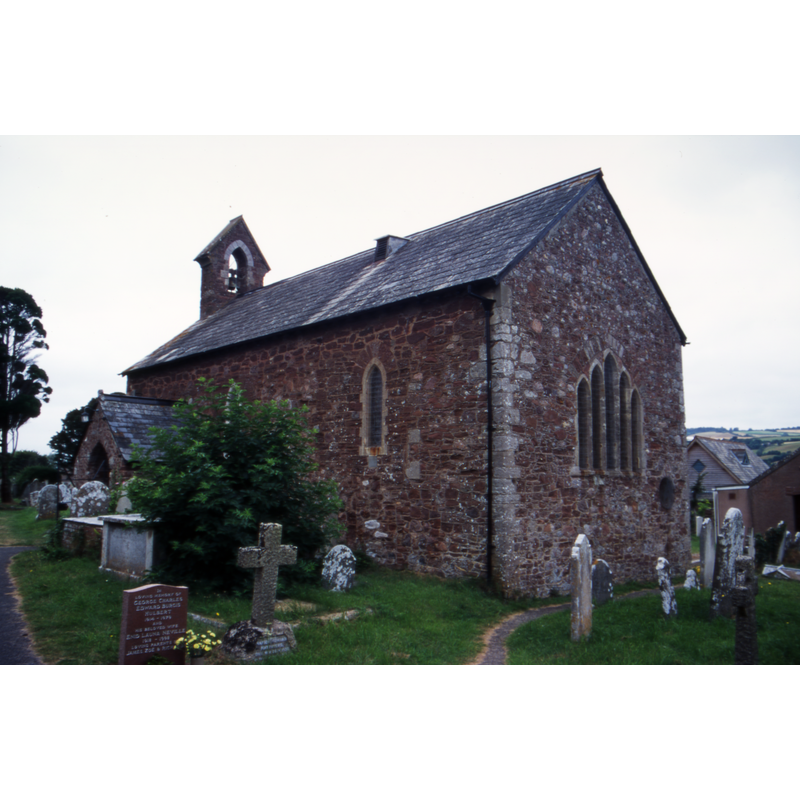
view of church exterior - southeast view
Copyright Statement: Image copyright © Baptisteria Sacra Index, 2023
Image Source: digital image of a photograph taken 24 July 2000 by BSI
Copyright Instructions: CC-BY-NC-ND-4.0
INFORMATION
Font ID: 03418RIN
Object Type: Baptismal Font1
Date Visited: 2000-07-24
Font Century and Period/Style: 11th - 12th century [basin only] [altered], Medieval / composite
Cognate Fonts: Fonts of this tyoe at Kenchester, Shaldon
Church / Chapel Name: St. Nicholas' church/chapel
Font Location in Church: Inside the church
Church Patron Saint(s): St. Nicholas of Myra
Church Notes: The little church now hidden behind a road-side dwelling just up the road from the Bay appears 13th century as it is claimed by the church guide pamphlet, and it is said to have been built as a chantry chapel by the lord of the manor of Haccombe upon his return from the Crusades. The same source informs that it served as the town's parish church until 1902 when a new church was built near Shaldon.
Church Address: Ringmore Rd, Shaldon, Teignmouth TQ14 0ET, United Kingdom -- Tel.: +44 1626 873173
Site Location: Devon, South West, England, United Kingdom
Directions to Site: Located off Ringmored Rd, W of Shaldon and Teignmouth, about 10 km N of Torquay
Historical Region: Hundred of Wonford
Additional Comments: recycled font? re-tooled?
Font Notes:
Click to view
Described and illustrated in Stabb (1908): "the font [...] is of red sandstone, oval shaped, and very old; it has been claimed as Saxon, but there is nothing to show to what period it belongs. For many years it had been in the churchyard, and was restored by Henry Lowther Chermside and Josephine his wife in 1881." Described in Clarke (1913) as a tub-shaped basin of a Norman font, even though, as it appears now, mounted on its modern pedestal, it may not look it. Clarke (ibid.) describes it as: "perfectly plain, of barrel shape, hewn from course red conglomerate [cf. the basin at Ringmore No. 2 in this Index, for example]. It is very small, and possibly was a holy-water stoup. It may be of pre-Norman date. For a long time it stood in the churchyard, near the porch. It was replaced in the church in 1881, and was then raised on a shaft and base of fine red sandstone [...]" [NB: Stabb (1908) also reported a font that "consists of a figure of St. John the Baptist with staff and banner holding a shell for the baptismal water", in the Parish Church of St Peter, also in Shaldon / Ringmore. That font is dated between 1899 and 1902 and is therefore not included in this Index]. The entry for this church in Historic England [Listing NGR: SX9238972316] notes: "FITTINGS: include the bowl of a Saxon or early Norman font
reclaimed from the churchyard when the font of 1620 was disposed of in 1881." [NB: the nearby parish church of Shaldon, dedicated to St Peter, is modern as is its font]
On-site notes: the basin of the font in Ringmore St. Nicholas' is a strange artefact: goblet-shaped and raised on a modern base, its reddish colour and the course stone of the basin provide an undeserved shock to the weary visitor, considering how awkward it is to gain access to this site. The friendly and helpful warden could not provide information on it. The church guide reads: "The original font had been disposed of and replaced by the present Saxon [!] or early Norman one." The basin of the present font could be Saxon or Norman, or it could have been carved only a month ago by the local grave-stone mason. If ancient, it could be associated with the type at Bridgerule, more probably re-tooled. It is certainly not Bond's barrel-shaped Norman font. [cf. Index entry for Kenchester for a somewhat similar basin]
reclaimed from the churchyard when the font of 1620 was disposed of in 1881." [NB: the nearby parish church of Shaldon, dedicated to St Peter, is modern as is its font]
On-site notes: the basin of the font in Ringmore St. Nicholas' is a strange artefact: goblet-shaped and raised on a modern base, its reddish colour and the course stone of the basin provide an undeserved shock to the weary visitor, considering how awkward it is to gain access to this site. The friendly and helpful warden could not provide information on it. The church guide reads: "The original font had been disposed of and replaced by the present Saxon [!] or early Norman one." The basin of the present font could be Saxon or Norman, or it could have been carved only a month ago by the local grave-stone mason. If ancient, it could be associated with the type at Bridgerule, more probably re-tooled. It is certainly not Bond's barrel-shaped Norman font. [cf. Index entry for Kenchester for a somewhat similar basin]
Credit and Acknowledgements: We are grateful to Dr. Roger Peters, of www.wissensdrang.com, for his permission to use the transcription of and image from Stabb (1908).
COORDINATES
UTM: 30U 463123 5598878
Latitude & Longitude (Decimal): 50.54068, -3.520426
Latitude & Longitude (DMS): 50° 32′ 26.45″ N, 3° 31′ 13.54″ W
MEDIUM AND MEASUREMENTS
Material: stone, composite or course granite
Font Shape: round, mounted [egg-cup shaped]
Basin Interior Shape: round
Basin Exterior Shape: round
Drainage System: centre hole in basin
Drainage Notes: lead lining
Rim Thickness: 10 cm
Diameter (inside rim): 34-36 cm
Diameter (includes rim): 53-54 cm
Basin Depth: 18.5 cm (lining depth)
Basin Total Height: 58 cm
Notes on Measurements: BSI. [NB: the measurements of this font do not match any of the early font patterns (modern font?)]
REFERENCES
- Bond, Francis, Fonts and Font Covers, London: Waterstone, 1985 c1908, p. 37
- Clarke, Kate M., "The baptismal fonts of Devon -- Part I", 45, Report and Transactions of the Devonshire Association for the Advancement of Science, Literature and Art, 1913, pp. 314-329; 320-321, 329
- Stabb, John, Some old Devon churches, their roods, pulpits, fonts, etc., London: Simkin, [et al.], 1908-1916, p. 200 and pl. 200