Canterbury No. 5 / Cantuaria
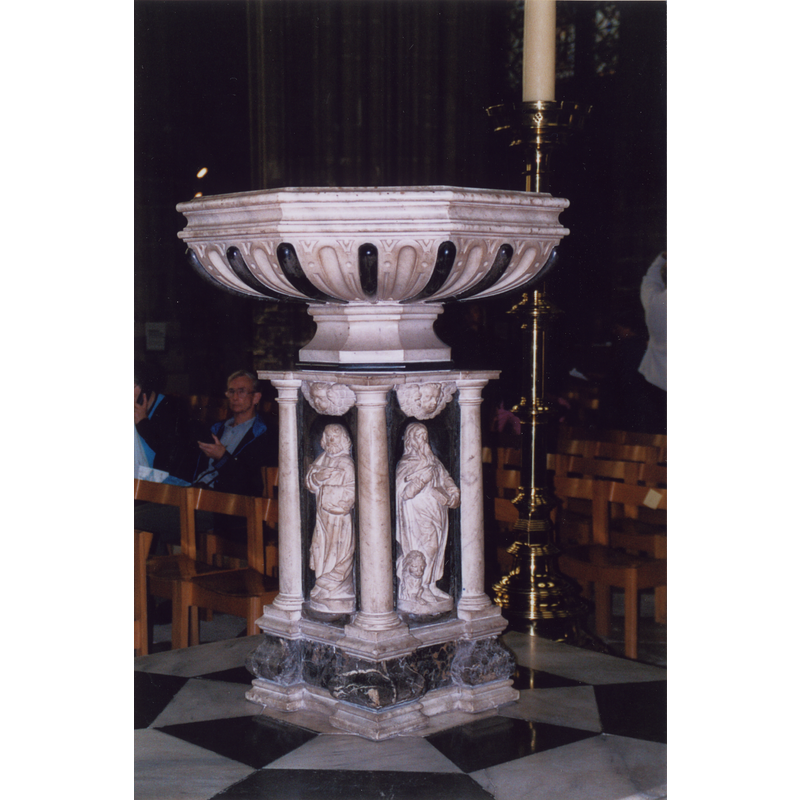
Image copyright © Baptisteria Sacra Index, 2023
CC-BY-NC-ND-4.0
Results: 8 records
BBU01: design element - motifs - torus-scotia-torus
Copyright Statement: Image copyright © Baptisteria Sacra Index, 2023
Image Source: BSI - Photographed July 2000
Copyright Instructions: CC-BY-NC-ND-4.0
BU01: design element - patterns - ribbed
Scene Description: all around the underbowl in coloured marble
Copyright Statement: Image copyright © Baptisteria Sacra Index, 2023
Image Source: BSI - Photographed July 2000
Copyright Instructions: CC-BY-NC-ND-4.0
LB01: design element - architectural - column - 4
Copyright Statement: Image copyright © Baptisteria Sacra Index, 2023
Image Source: BSI - Photographed July 2000
Copyright Instructions: CC-BY-NC-ND-4.0
LBF01: Apostle or saint - Evangelists - 4 - one per niche
Copyright Statement: Image copyright © Baptisteria Sacra Index, 2023
Image Source: BSI - Photographed July 2000
Copyright Instructions: CC-BY-NC-ND-4.0
LBF02: angel - cherub - 4
Scene Description: above the heads of the Evangelists
Copyright Statement: Image copyright © Baptisteria Sacra Index, 2023
Image Source: BSI - Photographed July 2000
Copyright Instructions: CC-BY-NC-ND-4.0
view of font
Copyright Statement: Image copyright © Baptisteria Sacra Index, 2023
Image Source: BSI - Photographed July 2000
Copyright Instructions: CC-BY-NC-ND-4.0
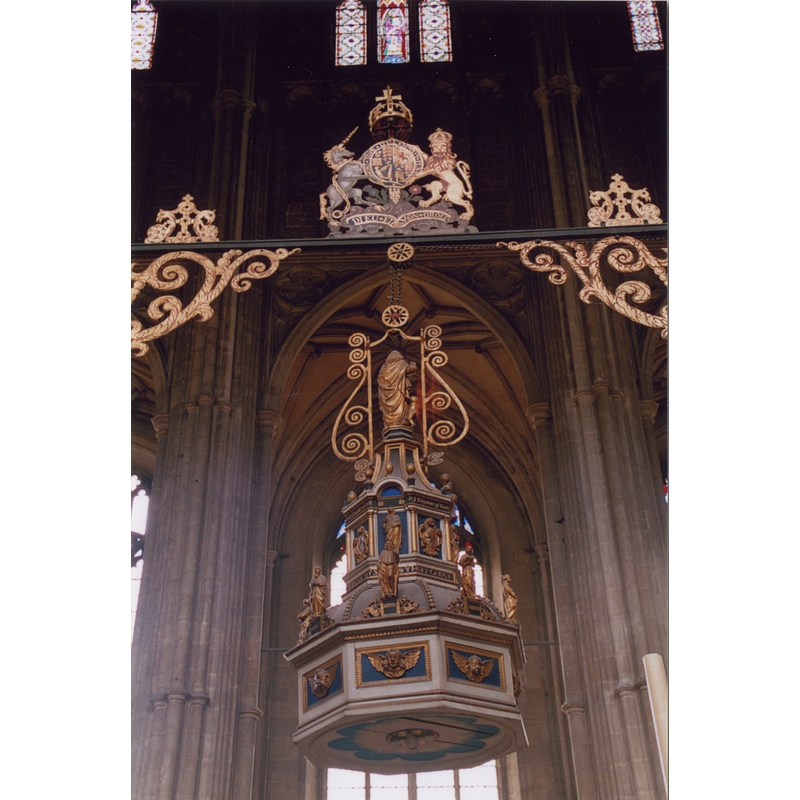
view of font cover
Copyright Statement: Image copyright © Baptisteria Sacra Index, 2023
Image Source: BSI - Photographed July 2000
Copyright Instructions: CC-BY-NC-ND-4.0
view of font and cover

Copyright Statement: Image copyright © [s.n., s.d.]
Image Source: drawing of unknown or not-recorded source
Copyright Instructions: PERMISSION NOT AVAILABLE -- IMAGE NOT FOR PUBLIC USE
INFORMATION
Font ID: 03415CAN
Object Type: Baptismal Font1
Date Visited: 2000-07-06
Font Date: 1640? / 1636?
Font Century and Period/Style: 17th century
Church / Chapel Name: Canterbury Cathedral
Font Location in Church: Inside the church, in the W end, N side [moved: cf. FontNotes]
Church Patron Saint(s): Our Saviour
Church Address: Cathedral House, 11 The Precincts, Canterbury CT1 2EH, United Kingdom -- Tel.: +44 1227 762862
Site Location: Kent, South East, England, United Kingdom
Ecclesiastic Region: Diocese of Canterbury
Historical Region: Hundred of Canterbury [in Domesday]
Additional Comments: recycled font lid: The large ornate font lid is apparently not the original but a replacement made ca. 1660. The original is said to have been destroyed by the Puritans ca. 1640. -- -- price of a font in 1639: the new font at Canterbury Cathedral cost £400 at the time
Font Notes:
Click to view
There are seven entries for Canterbury [variant spelling] in the Domesday survey [https://opendomesday.org/place/TR1557/canterbury/] [accessed 2 April 2025], one of which, in the lordship of Ranulf of Colombières in 1086, reports a church in it. Gough (1792) refers [after Somner] to the font that Bishop Warner gave the Cathedral in 1636, before which time there was none in that church. Lewis' Dictionary of 1848 has: "A passage from the north transept of the cathedral to the library leads to a circular room, called 'Bell Jesus', the lower part of which is of Norman character; it is lighted by a dome in the centre, under which is placed the font, removed from the nave of the cathedral." In Poole (1848) [with reference to "Dean and Chapter News from Canterbury, by Richard Culmer, quoted from Archaeologia Vol. XI"] notes that on 22nd August 1642: "The font also in the same Cathedral was broken to pieces". Noted and illustrated in Cox (1905), who notes the repairs made to it and the restoration to its original position. Noted in Newman (1976): "An outstanding piece of Laudian display given in 1639 by Bishop Werner of Rochester, torn down by Puritans, and reassembled with new sculptures in 1662." Foyle (2013) notes: "In 1639 Canterbury received the gift of a font from John Warner, Bishop of Rochester, to replace a simple brass basin [...] It cost the huge sum of £400 [...] Archbishop William Laud (1633-45) must have been instrumental in this commission, for he was busy fitting out the cathedral in line with the High Church ideals of the court of Charles I". On-site notes: a multicoloured marble font dating to ca. 1640; octagonal shallow basin of light colour marble with large ribs on the underbowl, alternating dark and light colours; a squat upper base is also octagonal; the lower base is square, with colonnettes at the corners; in between the colonnettes, the statues of the four Evangelists and their symbols; above these, angel heads; the statues and the colonnettes are in white marble, the background and the lower part are green; large ornate font lid is apparently not the original but a replacement made ca. 1660 [cf. Newman supra], the original cover said to have been destroyed by the Puritans ca. 1640. Newman (ibid.) adds that the finial represents Christ, and that the metal pulley bracket has "the Royal Arms of Charles II" [i.e., 1660+] A full description of the cover is given in Cox (1905): "The octagon base of the cover has a cherub's head on each face. Over them are the small upstanding figures of eight of the apostles. On the tier above this are the four other apostles, St. Peter, St. John, St. James, minor,' and St. Bartholomew. Between them are the arms of England and France, and of the diocese and chapter of Canterbury. Below these arms and four figures is the verse, 'Goe therefore & teach all nations baptizing them in ye name of ye Father & ye Sonne & ye Holy Ghost.' Above, in smaller text, is the verse, ' Suffer little
Children to come unto Me, and forbid [the]m not : for of such is ye Kingdome of God.' The whole is crowned with the figure of our Saviour with the right hand raised in blessing, and holding a little child to His breast with the left hand ; two other children are at His feet. The left hand must be a clumsy restoration, it is out of proportion." In Knox (2006), with some details of the font's history, and an illustration of a drawing in the Victoria and Albert Museum of London.
Children to come unto Me, and forbid [the]m not : for of such is ye Kingdome of God.' The whole is crowned with the figure of our Saviour with the right hand raised in blessing, and holding a little child to His breast with the left hand ; two other children are at His feet. The left hand must be a clumsy restoration, it is out of proportion." In Knox (2006), with some details of the font's history, and an illustration of a drawing in the Victoria and Albert Museum of London.
COORDINATES
UTM: 31U 366308 5682674
Latitude & Longitude (Decimal): 51.2797, 1.0831
Latitude & Longitude (DMS): 51° 16′ 46.92″ N, 1° 4′ 59.16″ E
MEDIUM AND MEASUREMENTS
Material: stone, marble
Font Shape: octagonal, mounted
Basin Interior Shape: round
Basin Exterior Shape: octagonal
Notes on Measurements: BSI
INSCRIPTION
Inscription Location: on the cover
Inscription Text: [texts unavailable]
Inscription Notes: Reported in Cox & Harvey (1907: 179) as "a series of texts, etc." on the 17th-century cover -- C&H (ibid.) refer to Cox' Canterbury (p. 187-188) for the text
LID INFORMATION
Date: 17th century (ca. 1660)
Material: wood
Apparatus: pulley system
Notes: Very large and ornate font cover suspended from a pulley system. The lower part is octagonal and has angel heads and wings; the other levels above have figures and an inscription.
REFERENCES
- Cox, John Charles, Canterbury, a historical and topographical account of the city, London: Methuen, 1905, p. 124, 187-188 and ill. on p. 187
- Cox, John Charles, English Church Furniture, New York: E.P. Dutton & Co., 1907, p. 178
- Foyle, Jonathan, Architecture of Canterbury Cathedral, London: Scala, 2013, p. 155, 156, 157
- Gough, Richard, "Description of the old font in the Church of East Meon, Hampshire, 1789: with some observations on fonts", X, Archaeologia, 1792, pp. 183-209; p. 201 and fn
- Lewis, Samuel, A Topographical Dictionary of England, Comprising the Several Counties, Cities, Boroughs, Corporate and Market Towns, Parishes, Chapelries, and Townships, and the Islands of Guernsy, Jersey, and Man, with Historical and Statistical Descriptions [...], London: S. Lewis, 1831, [www.british-history.ac.uk/report.asp?compid=50856] [accessed 22 January 2007]
- Longstaffe-Gowan, Todd, "One rare piece of novelty", 164, 533 (July 2006), Apollo, 2006, pp. 9 p.; p. 49-57
- Newman, John, North East and East Kent, Harmondsworth: Penguin Books, 1976, p. 209
- Poole, George Ayliffe, A History of Ecclesiastical Architecture in England, London: Printed by Joseph Masters, 1848, p. 397 / [http://books.google.com/books?id=vxkEAAAAQAAJ&pg=PA66&lpg=PA66&dq=george+ayliffe+poole+1848+a+history+of+ecclesiastical+architecture+in+england&source=web&ots=MxN7ostq7i&sig=Rc5Z3xTsdqVhwZWhddPnaAUrxt4#PPA253,M1] [accessed 9 October 2007]