Dura Europos / Doura Europos / Dura Europus / Δούρα Ευρωπός / nr. Salahiyeh

Image copyright © Wolfgang Sauber, 2006
GFDL / CC-BY-SA-3.0,2.5,2.0,1.0
Results: 2 records
view of font
Scene Description: Source caption: "Bible open air museum in Nijmegen [Netherlands]. Christian house: Reconstruction of a baptismal font in Dura Europos ( Syria )"
Copyright Statement: Image copyright © Wolfgang Sauber, 2006
Image Source: digital photograph taken 17 August 2006 by Wolfgang Sauber [https://commons.wikimedia.org/wiki/File:Bible_Museum_-_Christliches_Taufbecken_Dura_Europos.jpg] [accessed 5 February 2016]
Copyright Instructions: GFDL / CC-BY-SA-3.0,2.5,2.0,1.0
view of font
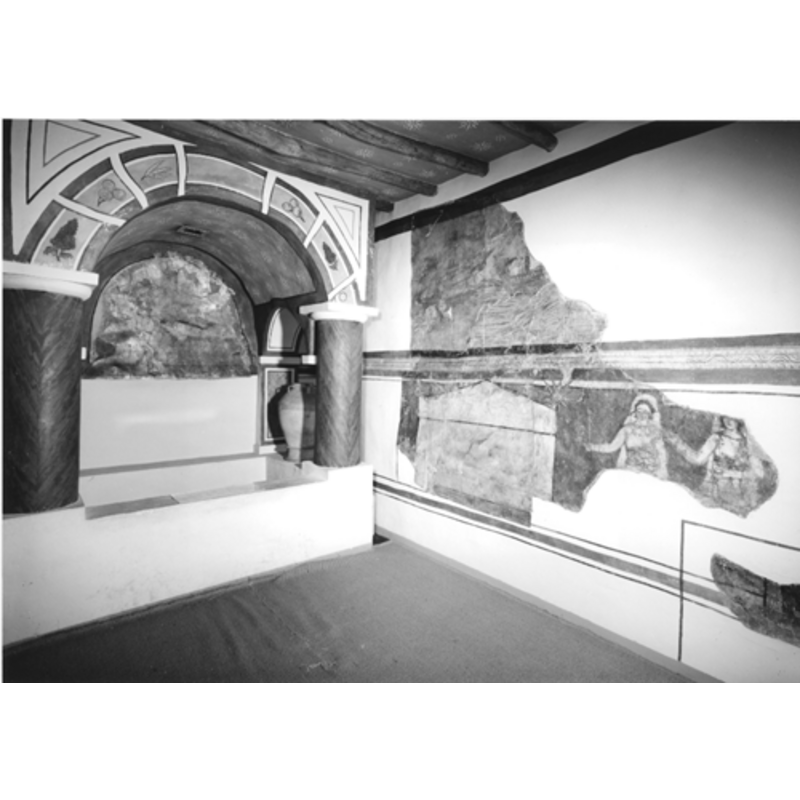
Scene Description: The baptistery as reconstructed at the Yale Unversity Art Gallery
Copyright Statement: Image copyright © Yale University Art Gallery, Dura-Europos Collection, 2008
Image Source: Yale University Art Gallery, Dura-Europos Collection
Copyright Instructions: Permission received
INFORMATION
Font ID: 02657DUR
Object Type: Baptismal Font2
Font Date: ca. 230?
Font Century and Period/Style: 3rd century (early?), Early Christian
Church / Chapel Name: House-church at Dura-Europos
Font Location in Church: In the NW room, at the W end
Church Address: PPWH+657, Gharanij, Syria
Site Location: Dayr az-Zawr, Syria, Middle East
Directions to Site: The original Early Christian house-church is located near Al-Salihiyah, in the same Syrian location as the eponymous synagogue reknown for its magnificent frescoes.
Font Notes:
Click to view
This earliest example of baptistery, from ca. 230, "was found at Dura Europos, and is rectangular in shape" (Encyclopedic Dictionary of Religion). Described and illustrated in Bowerstock (1999). In Ferguson (2009) with measurements of the font. A reconstruction of this baptistery and font exists at the Yale University Art Gallery [who kindly provided the image presented here]: a photograph of the reproduction of this font shows a rectangular tub about two feet tall and 8-10 feet long on the outside; the inner basin is also rectangular and appears to be about 6-8 feet long by 2-3 feet wide. Built against the wall, it has a canopy-like cover all the way to the ceilling; in the front it is arched and rests on two plain pillars, one at each side of the length of the tub; the arch itself is divided in seven sections, five of which have a motif painted on it (fruit or foliage); the spandrels to the left and right of the upper arch have a double-triangle motif as ornament. The visible side has a smaller arch. The wall on the right of the room shows partially restored frescoes which include two human figures and a tomb-like monument. One of the sources, Bowerstock (1999) mentions "a representation of the Good Shepherd over the baptismal font", which Ferguson (2009) locates "on the west wall behind the baptismal font".
Credit and Acknowledgements: We are grateful to Yale University Art Gallery for their permission to reproduce their photograph of the church and font
COORDINATES
UTM: 37S 658358 3846350
Latitude & Longitude (Decimal): 34.745605, 40.727821
Latitude & Longitude (DMS): 34° 44′ 49.2″ N, 40° 43′ 48″ E
MEDIUM AND MEASUREMENTS
Material: stone, type unknown
Font Shape: rectangular
Basin Interior Shape: rectangular
Basin Exterior Shape: rectangular
Basin Depth: 95 cm*
Height of Basin Side: [2-3 feet tall?]
Basin Total Height: [2-3 feet tall?]
Trapezoidal Basin: 163 x 94.8 cm*
Notes on Measurements: * [a/p Ferguson (2009)]
REFERENCES
- Encyclopedic Dictionary of Religion, Washington D.C.: Corpus Publications, 1979, vol. 1, p. 361
- Bowersock, G. W., Late Antiquity: a Guide to the Postclassical World, Cambridge, Massachusetts: Belknap Press of Harvard University Press, 1999, p. 332 with ill.
- Ferguson, Everett, Baptism in the Early Church: history, theology, and liturgy in the first five centuries, Grand Rapids, MI: William B. Eerdmans, 2009, p. 440-443
- Partner, Peter, Two Thousand Years: the First Millennium: the Brith of Christianity to the Crusades, London: Granada Media, 1999, ill. on p. 32