Bradfield St. George
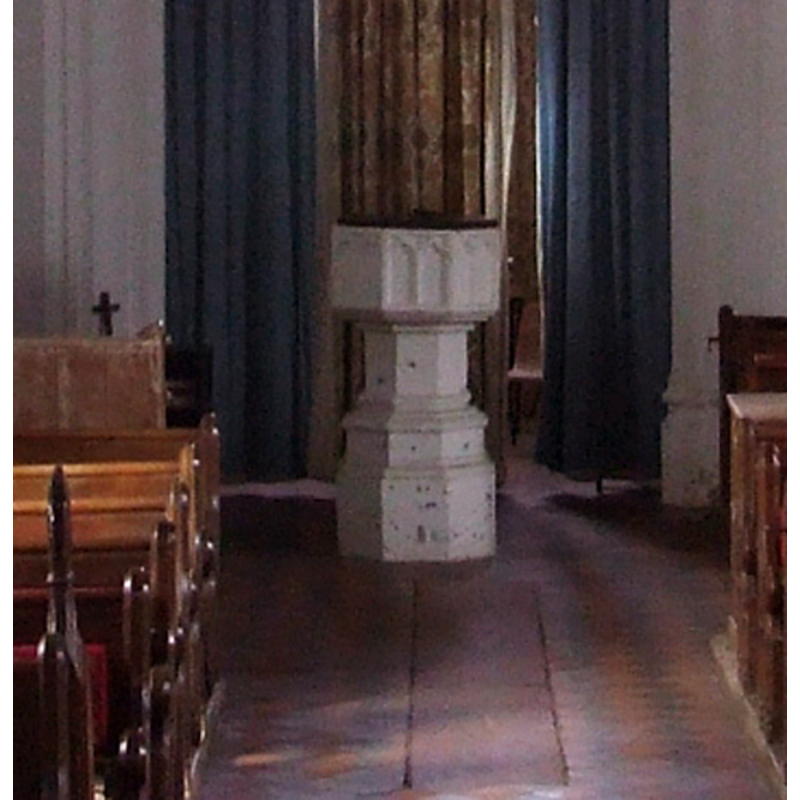
Image copyright © Simon Knott, 2008
Standing permission
Results: 9 records
view of font
Scene Description: the font as documented in Knott [cf. Font notes]
Copyright Statement: Image copyright © Simon Knott, 2008
Image Source: detail of a digital photograph taken 14 April 2008 by Simon Knott [http://www.suffolkchurches.co.uk/bradgeorge.html] [accessed 10 November 2009]
Copyright Instructions: Standing permission
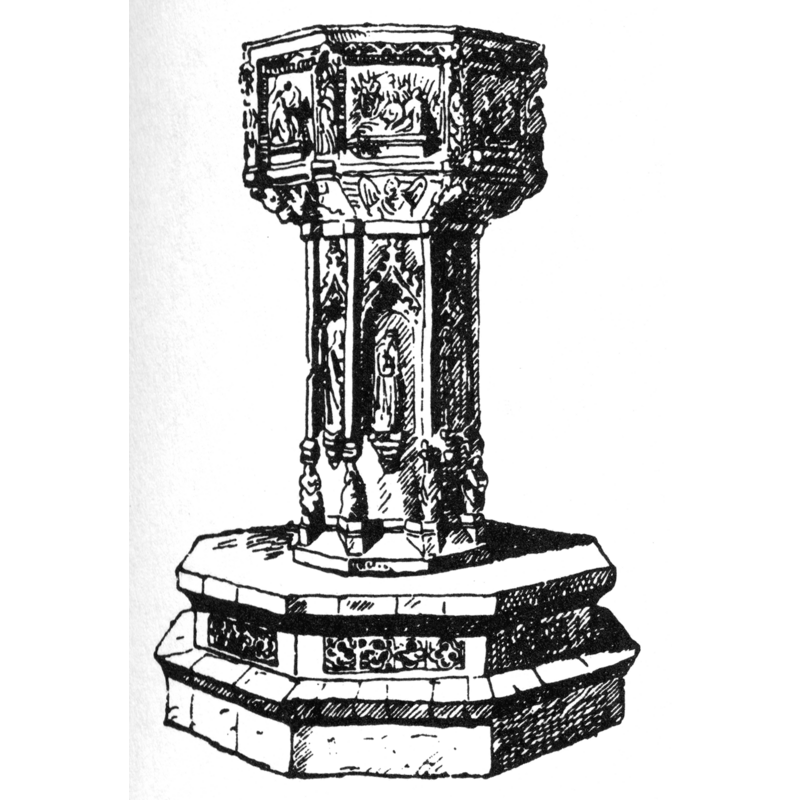
view of font
Copyright Statement: Image copyright © [in the public domain]
Image Source: Speltz (1994 c1910: 263 pl. 153 fig. 4)
Copyright Instructions: PD
scene [unidentified] - 8
Scene Description: One on each side of the octagonal basin
Copyright Statement: Image copyright © [in the public domain]
Image Source: Speltz (1994 c1910: 263 pl. 153 fig. 4)
Copyright Instructions: PD
angel - showing wings
Scene Description: one on each of the eight panels of the underbowl
Copyright Statement: Image copyright © [in the public domain]
Image Source: Speltz (1994 c1910: 263 pl. 153 fig. 4)
Copyright Instructions: PD
view of church interior - nave - looking west
![the font at the west end, as documented in Knott [cf. Font notes]](/static-50478a99ec6f36a15d6234548c59f63da52304e5/compressed/1091110003_compressed.png)
Scene Description: the font at the west end, as documented in Knott [cf. Font notes]
Copyright Statement: Image copyright © Simon Knott, 2008
Image Source: digital photograph taken 14 April 2008 by Simon Knott [http://www.suffolkchurches.co.uk/bradgeorge.html] [accessed 10 November 2009]
Copyright Instructions: Standing permission
design element - architectural - arch - Gothic - crocketed arch - 8
Scene Description: one on each side of the stem, with a human fugure in each
Copyright Statement: Image copyright © [in the public domain]
Image Source: Speltz (1994 c1910: 263 pl. 153 fig. 4)
Copyright Instructions: PD
human figure - standing - 8
Scene Description: one in each arch of the stem
Copyright Statement: Image copyright © [in the public domain]
Image Source: Speltz (1994 c1910: 263 pl. 153 fig. 4)
Copyright Instructions: PD
design element - motifs - quatrefoil - 32
Scene Description: four per side of the upper step of the plinth
Copyright Statement: Image copyright © [in the public domain]
Image Source: Speltz (1994 c1910: 263 pl. 153 fig. 4)
Copyright Instructions: PD
design element - architectural - buttress - 8
Scene Description: separating the sides of the stem
Copyright Statement: Image copyright © [in the public domain]
Image Source: Speltz (1994 c1910: 263 pl. 153 fig. 4)
Copyright Instructions: PD
INFORMATION
Font ID: 01864BRA
Object Type: Baptismal Font1
Font Century and Period/Style: 14th - 15th century, Medieval
Church / Chapel Name: Parish Church of St. George
Font Location in Church: Inside the church, at the W end of the nave
Church Patron Saint(s): St. George
Church Address: 34 Church Road, Bradfield St George, Suffolk IP30 0BG
Site Location: Suffolk, East Anglia, England, United Kingdom
Directions to Site: Located 9 km S of Bury St. Edmunds
Ecclesiastic Region: Diocese of Ely
Historical Region: Hundred of Thedwastre [in Domesday] -- Hundred of Thedwestry
Font Notes:
Click to view
There are three entries for Bradfield [St George, St Clare and Combust] in the Domesday survey [http://domesdaymap.co.uk/place/] [accessed 14 September 2016], one of which reports a church and church lands in it. Parker (1855) reports a Perpendicular font in Bradfield St. George; no font mentioned in his entry for St. Clare's. Listed in Cox & Harvey (1907) as a baptismal font of the 15th century; later in the same source (ibid.: 220) it is listed in the Decorated period [1250-1350]. [NB: it is unclear whether this is Bradfield St. Clare or St. George. Cox-Harvey do not specify, nor does Speltz (1910) whose drawing shows an octagonal East Anglian font of the Decorated or Perpendicular period with scenes (?) on the basin sides and the underbowl decorated with angels; the narrower octagonal pedestal has figures inside niches on it; the upper of the two plinths has quatrefoil motifs carved on its sides, four per side. The entry for this church in English Heritage [Listing NGR: TL9072159932] (1955) notes: "Mid C14 octagonal font with moulded base and traceried facets to bowl." Knott (2008) does not mention a font at St. Clare's [formerly dedicated to All Saints], but includes an interior view of the west end of the nave at St. George's including the font there; the font is not the one described and illustrated in Speltz, but a plainer type: the octagonal basin has pairs of trefoiled arches or windows all around; the octagonal stem has mouldings at the ends, and the lower base is octagonal and moulded as well. The wooden cover is octagonal, flat and plain; appears modern. [discrepancy with Speltz to be resolved]
Credit and Acknowledgements: We are grateful to Simon Knott, of www.suffolkchurches.co.uk, for his photograph of this font
COORDINATES
UTM: 31U 349669 5786120
MEDIUM AND MEASUREMENTS
Material: stone, type unknown
Font Shape: octagonal, mounted
Basin Interior Shape: round
Basin Exterior Shape: octagonal
REFERENCES
- Cox, John Charles, English Church Furniture, New York: E.P. Dutton & Co., 1907, p. 165, 220
- Knott, Simon, The Suffolk Churches Site, Simon Knott, 1999-. [standing permission to reproduce images received from Simon [February 2005]. URL: www.suffolkchurches.co.uk.
- Parker, John Henry, The Ecclesiastical and architectural topography of England [...] Suffolk, 1855, [unpaged]
- Speltz, Alexander, Styles of Ornament: a Pictorial Survey of Six Thousand Years of Ornamental Design, New York: Gramercy Books, 1994(c1910), p. 263 pl. 153 fig. 4