Lackford / Lachford
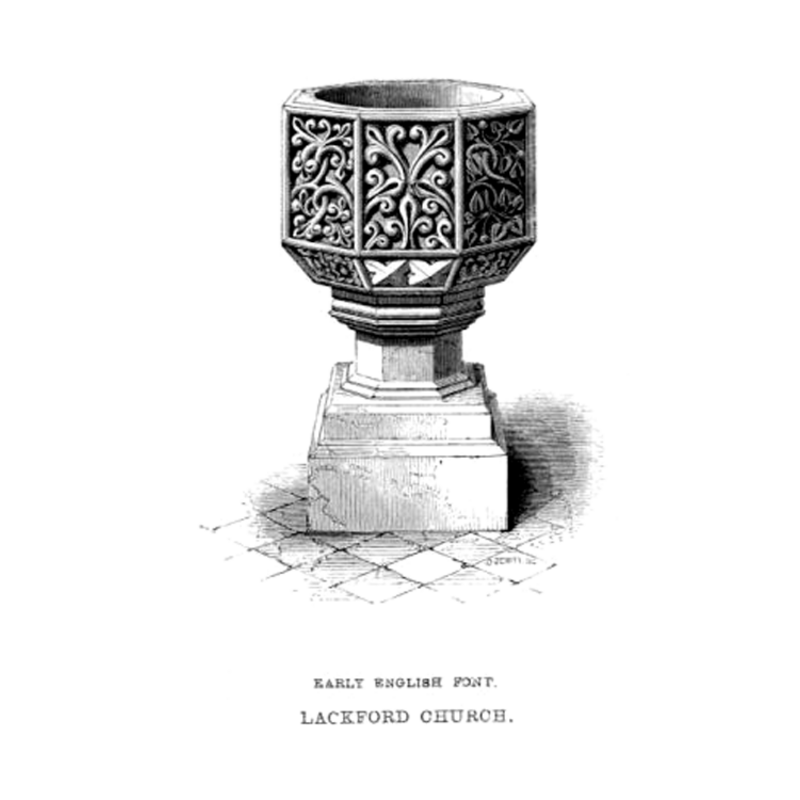
Image copyright © [in the public domain]
PD
Results: 3 records
B01: design element - motifs - foliage
Copyright Statement: Image copyright © [in the public domain]
Image Source: engraving of a drawing by Orlando Jewitt reproduced in Parker (1855)
Copyright Instructions: PD
BU01: design element - motifs - floral or foliage
Scene Description: [cf. Font notes]
Copyright Statement: Image copyright © [in the public domain]
Image Source: engraving of a drawing by Orlando Jewitt reproduced in Parker (1855)
Copyright Instructions: PD
view of font
Copyright Statement: Image copyright © [in the public domain]
Image Source: engraving of a drawing by Orlando Jewitt reproduced in Parker (1855)
Copyright Instructions: PD
INFORMATION
Font ID: 01850LAC
Object Type: Baptismal Font1
Font Century and Period/Style: 13th century (late?), Decorated
Church / Chapel Name: Parish Church of St. Lawrence
Font Location in Church: Inside the church
Church Patron Saint(s): St. Lawrence [aka Laurence]
Church Address: 20 Holden Rd, Lackford, Bury Saint Edmunds IP28 6HZ, United Kingdom
Site Location: Suffolk, East Anglia, England, United Kingdom
Directions to Site: Located on the A1101, 10 km NW of Bury St Edmunds
Additional Comments: the engraving looks like one of Jewitt's [Thomas Orlando Jewitt (1799-1869), born in Derbs but moved to Oxon in the 1830s, then to London in the 1850s -- some of his children became also engravers or printers] -- entry in Knott not yet ready [Nov. 2009]
Font Notes:
Click to view
Noted and illustrated in Parker (1855): "The font is very beautiful, of Decorated date, c. Edward I [i.e., 1272-1307]; it has erroneously been described as E[arly] E[nglish] period [NB: Parker (ibid.) remarks that the font "is engraved in Rickman's Architecture and Gage's History of Suffolk" and reproduces an engraving captioned "Early English font". The illustration in Parker is signed by the well-known Orlando Jewitt.]. Listed in Cox & Harvey (1907) as an octagonal font labelled "Early English"; Cox & Harvey put it without a doubt in the reign of Edward I, 1272-1307. Noted in James (1930): "late thirteenth-century font of very fine design carved with foliage." [NB: James (ibid.) uses 'Lackford' in the text but his index entry under 'Fonts' has 'Lachford']. The font has deeply-carved foliage panels on the vertical sides; the upper level of the underbowl chamfer appears decorated with pairs of leaf and floral motifs, whereas the lower is decorated with graded mouldings; short octagonal stem; moulded lower base at the top, the rest square and plain. Cautley (1982) notes the recent [at the time of Cautley's first edition, most likely, ca. 1938] removal of the plaster that covered it.
COORDINATES
UTM: 31U 338699 5797149
Latitude & Longitude (Decimal): 52.300964, 0.634341
Latitude & Longitude (DMS): 52° 18′ 3.47″ N, 0° 38′ 3.63″ E
MEDIUM AND MEASUREMENTS
Material: stone, type unknown
Font Shape: octagonal, mounted
Basin Interior Shape: round
Basin Exterior Shape: octagonal
REFERENCES
- Cautley, Henry Munro, Suffolk churches and their treasures, Woodbridge: The Boydell Press, 1982, p. 66
- Cox, John Charles, English Church Furniture, New York: E.P. Dutton & Co., 1907, p. 218, 220
- James, M. R., Suffolk and Norfolk, London, Toronto: Dent & Sons, 1930, p. 63
- Parker, John Henry, The Ecclesiastical and architectural topography of England [...] Suffolk, 1855, [unpaged] and pl. 530