Wirksworth No. 2 / Werchesuorde / Werchesuuorde / Werchesvorde
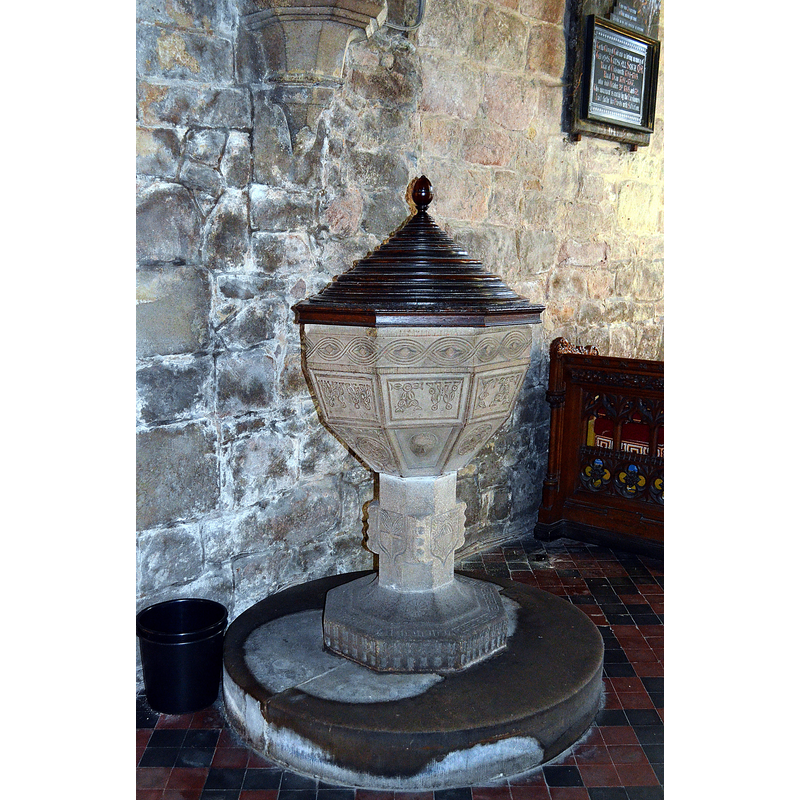
Image copyright © Timothy Marlow, 2015
Image and permission received (letter of 26 October 2013)
Results: 13 records
view of font and cover
Copyright Statement: Image copyright © Timothy Marlow, 2015
Image Source: digital photograph taken 27 February 2013 by Timothy Marlow
Copyright Instructions: Image and permission received (letter of 26 October 2013)
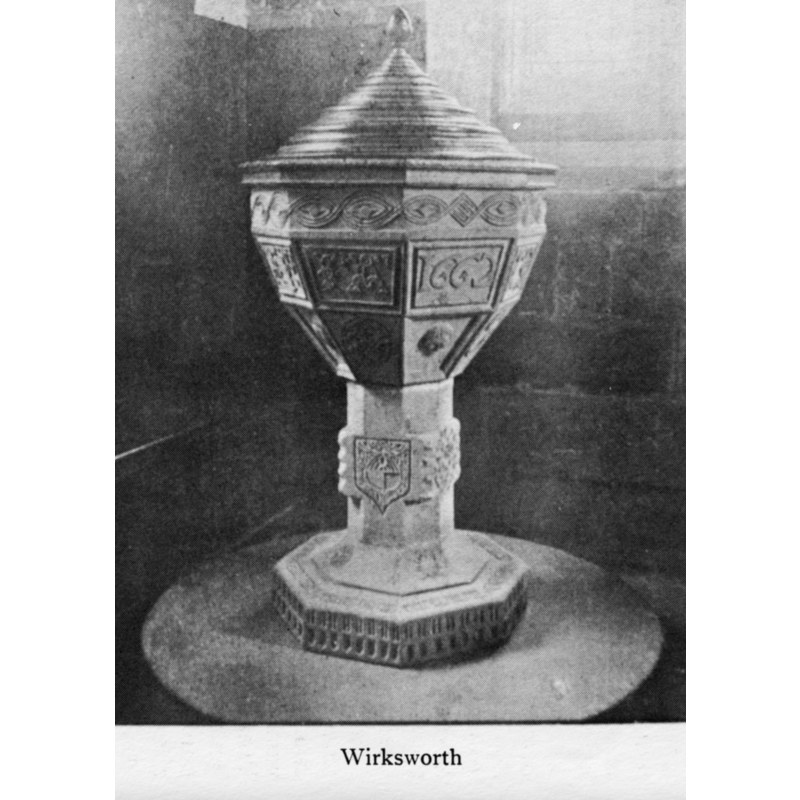
view of font and cover
Copyright Statement: Image copyright © [in the public domain]
Image Source: B&W photograph in Bond (1908)
Copyright Instructions: PD
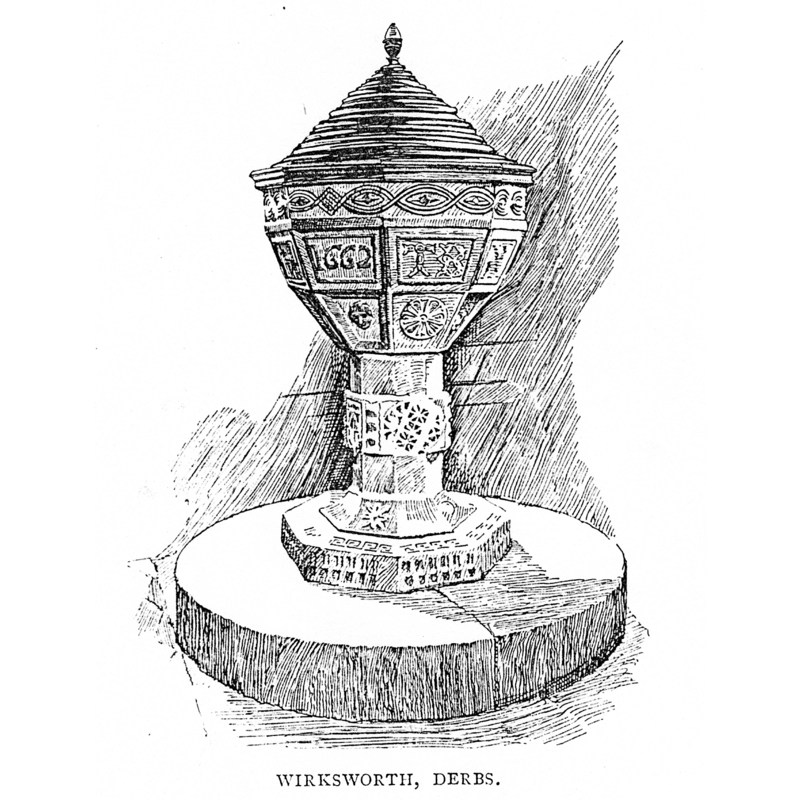
view of font and cover
Copyright Statement: Image copyright © [in the public domain]
Image Source: Cox & Harvey (1907)
Copyright Instructions: PD
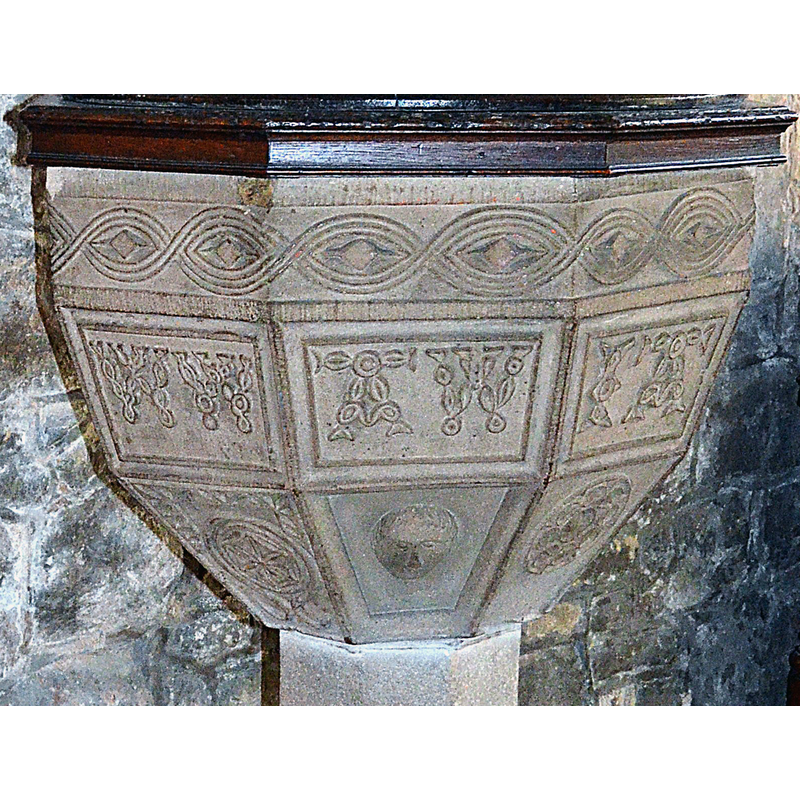
design element - motifs - interlace - 3-strand
Copyright Statement: Image copyright © Timothy Marlow, 2015
Image Source: detail of a digital photograph taken 27 February 2013 by Timothy Marlow
Copyright Instructions: Image and permission received (letter of 26 October 2013)
inscription
Scene Description: three sets of 'flowery' initials on these three sides
Copyright Statement: Image copyright © Timothy Marlow, 2015
Image Source: detail of a digital photograph taken 27 February 2013 by Timothy Marlow
Copyright Instructions: Image and permission received (letter of 26 October 2013)
human figure - head
Copyright Statement: Image copyright © Timothy Marlow, 2015
Image Source: detail of a digital photograph taken 27 February 2013 by Timothy Marlow
Copyright Instructions: Image and permission received (letter of 26 October 2013)
design element - motifs - floral - flower - in a circle
Copyright Statement: Image copyright © Timothy Marlow, 2015
Image Source: detail of a digital photograph taken 27 February 2013 by Timothy Marlow
Copyright Instructions: Image and permission received (letter of 26 October 2013)
inscription
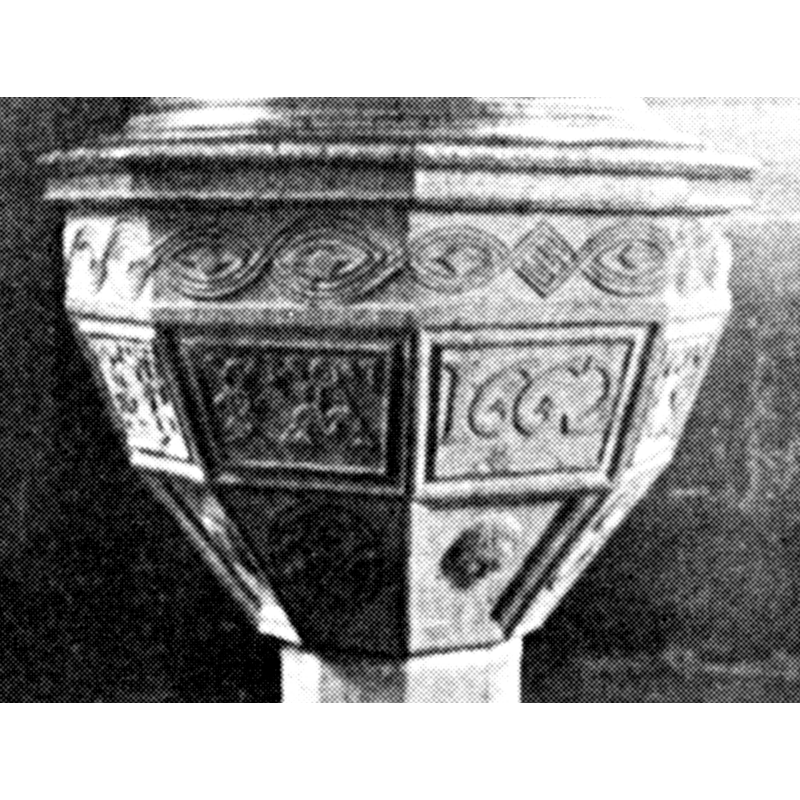
Scene Description: on one of the sides: "1662"
Copyright Statement: Image copyright © [in the public domain]
Image Source: detail of a B&W photograph in Bond (1908)
Copyright Instructions: PD
design element - motifs - floral or foliage
Scene Description: making up the initials of the churchwardens on the other panels of the basin
Copyright Statement: Image copyright © [in the public domain]
Image Source: detail of a B&W photograph in Bond (1908)
Copyright Instructions: PD
symbol - shield - coat of arms - 4
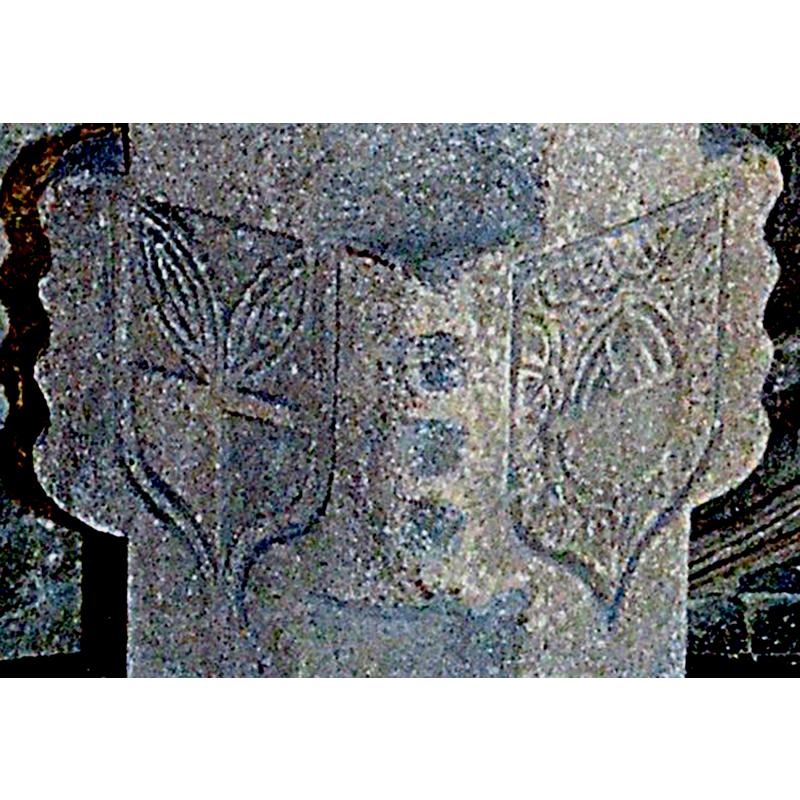
Copyright Statement: Image copyright © Timothy Marlow, 2015
Image Source: detail of a digital photograph taken 27 February 2013 by Timothy Marlow
Copyright Instructions: Image and permission received (letter of 26 October 2013)
design element - patterns - honeycomb
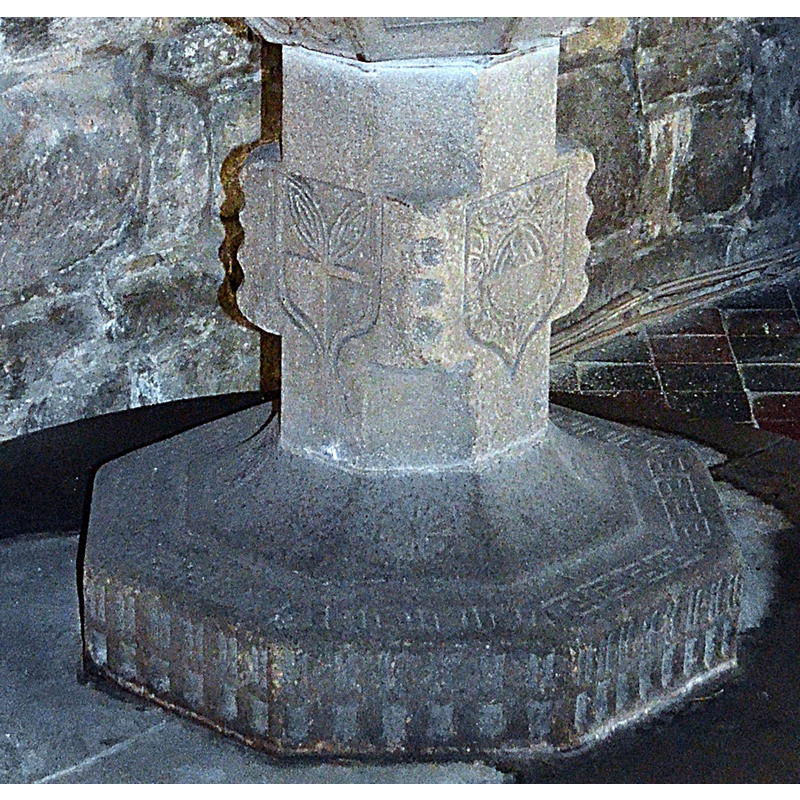
Scene Description: all around the wide lower basin side; on two rows (up and down)
Copyright Statement: Image copyright © Timothy Marlow, 2015
Image Source: detail of a digital photograph taken 27 February 2013 by Timothy Marlow
Copyright Instructions: Image and permission received (letter of 26 October 2013)
design element - motifs - floral
Scene Description: multi-petal in a circle on the upper surface of the lower base
Copyright Statement: Image copyright © Timothy Marlow, 2015
Image Source: detail of a digital photograph taken 27 February 2013 by Timothy Marlow
Copyright Instructions: Image and permission received (letter of 26 October 2013)
design element - patterns - fretwork - Grecian / Greek
Scene Description: all around the upper surface of the lower base
Copyright Statement: Image copyright © Timothy Marlow, 2015
Image Source: detail of a digital photograph taken 27 February 2013 by Timothy Marlow
Copyright Instructions: Image and permission received (letter of 26 October 2013)
INFORMATION
Font ID: 01545WIR
Object Type: Baptismal Font1
Font Date: 1662
Font Century and Period/Style: 17th century(mid), Post-Reformation
Workshop/Group/Artisan: John Ashmore
Church / Chapel Name: Parish Church of St. Mary
Font Location in Church: Inside the church
Church Patron Saint(s): St. Mary the Virgin
Church Address: Church Close, Wirksworth, Derbyshire, DE4 4DP
Site Location: Derbyshire, East Midlands, England, United Kingdom
Directions to Site: Located 20-25 km WNW of Derby up the B5023
Ecclesiastic Region: Diocese of Derby
Historical Region: Hundred of Hamston [in Domesday]
Additional Comments: price of a font: price of setting up a font in 1662, painting, hanging the cover, etc
Font Notes:
Click to view
There are two entries for Wirksworth [variant spelling] in the Domesday survey [http://domesdaymap.co.uk/place/SK2854/wirksworth/] [accessed 23 February 2015], one of which, in the lordship and tenancy of King William, mentions both a cleric and a church in it. Cox (1875-1877) notes the earlier font in this church, and adds: "Its successor, in the Restoration, stands in the opposite transept, and is of octagon design, and ornamented with patterns of unusual style, having more resemblance to Egyptian art, than anything that pertains to either Gothic or Renaissance. On one face is the date 1662, and on the remainder are the initials T.B., I.B., I.A., A.W., W.W., E.T., and T.B." Cox (ibid.) includes four entries relative to "the setting up of this font, in the Churchwardens' accounts for 1662:--
Pd ye Joyner for ye cover of ye funt ... £1 s.15 d.0
Pd John Ashmore And ye Carrier and Ashmore's man for settinge up ye funt and other worke ... £4 s.7 d.0
Pd Wm. Greene for painting ye funt ... £0 s.11 d.0
Pd Christopher Wall for dressinge the Church yard 6d. And for Ale at the hanginge up of ye funt cover 6d. ... £0 s.1 d.0
"A footnote in Cox (ibid.) adds: "The churchwardens for 1662, were, Thomas Bradshaw, John Ballerhous, William Wall, and Edward Toplis. Anthony Weston was also sidesman for the township of Cromford, in the same year, and the churchwardens' accounts also mention John Ashmore and Thomas Blackwall as office-bearers about that time." Described and illustrated in Cox & Harvey (1907) as a Restoration baptismal font dated 1662: "in this case, although the true principles of design are set at defiance by a medley of varied ornaments, the result is not unpleasant, for it is quite obvious that the sculptor did the very best of which he was capable to adorn the House of God." In his introduction to the new designs of the Renaissance-type of fonts, Bond (1908) writes: "How clearly the new design was intended to point to the other great sacrament [i.e., the Eucharist] appears well in the font at Wirksworth, where even the knopp or knob in the middle of the stalk of a chalice is carefully reproduced on the pedestal of the font [...]. This font bears the date 1662, and therefore probably replaces one removed in Commonwealth days." Noted in Pevsner (1978) as a font "of 1662 by John Ashmore, octagonal, with the usual style of carving of the 1662 fonts, and a series of florid initials." [cf. Index entry for Wirksworth No. 1 for the earlier font]. The font is topped with a conical cover, itself ending in an acorn finial. The basin has a band of geometric ornamentation under the rim and then eight (?) rectangular/ trapezoidal frames, one of which contains the 1662 date; the others contain foliage (?) motifs; the underbowl narrows down to meet the slender stem, in the middle of which is an ornamentation wich includes a heraldic shield; the lower base is octagonal and splayed; the whole is raised on a round plinth. Bunting (2001: 7) gives the following citation from the churchwarden's accounts for a new font in 1662: "'pd. John Ashmore And ye Carrier and Ashmore's man for settinge up ye funt... £4.70' to 'Ale at the hanginge up ye funt cover 6d'". [transcription in www.genuki.org.uk]
Pd ye Joyner for ye cover of ye funt ... £1 s.15 d.0
Pd John Ashmore And ye Carrier and Ashmore's man for settinge up ye funt and other worke ... £4 s.7 d.0
Pd Wm. Greene for painting ye funt ... £0 s.11 d.0
Pd Christopher Wall for dressinge the Church yard 6d. And for Ale at the hanginge up of ye funt cover 6d. ... £0 s.1 d.0
"A footnote in Cox (ibid.) adds: "The churchwardens for 1662, were, Thomas Bradshaw, John Ballerhous, William Wall, and Edward Toplis. Anthony Weston was also sidesman for the township of Cromford, in the same year, and the churchwardens' accounts also mention John Ashmore and Thomas Blackwall as office-bearers about that time." Described and illustrated in Cox & Harvey (1907) as a Restoration baptismal font dated 1662: "in this case, although the true principles of design are set at defiance by a medley of varied ornaments, the result is not unpleasant, for it is quite obvious that the sculptor did the very best of which he was capable to adorn the House of God." In his introduction to the new designs of the Renaissance-type of fonts, Bond (1908) writes: "How clearly the new design was intended to point to the other great sacrament [i.e., the Eucharist] appears well in the font at Wirksworth, where even the knopp or knob in the middle of the stalk of a chalice is carefully reproduced on the pedestal of the font [...]. This font bears the date 1662, and therefore probably replaces one removed in Commonwealth days." Noted in Pevsner (1978) as a font "of 1662 by John Ashmore, octagonal, with the usual style of carving of the 1662 fonts, and a series of florid initials." [cf. Index entry for Wirksworth No. 1 for the earlier font]. The font is topped with a conical cover, itself ending in an acorn finial. The basin has a band of geometric ornamentation under the rim and then eight (?) rectangular/ trapezoidal frames, one of which contains the 1662 date; the others contain foliage (?) motifs; the underbowl narrows down to meet the slender stem, in the middle of which is an ornamentation wich includes a heraldic shield; the lower base is octagonal and splayed; the whole is raised on a round plinth. Bunting (2001: 7) gives the following citation from the churchwarden's accounts for a new font in 1662: "'pd. John Ashmore And ye Carrier and Ashmore's man for settinge up ye funt... £4.70' to 'Ale at the hanginge up ye funt cover 6d'". [transcription in www.genuki.org.uk]
Credit and Acknowledgements: We are grateful to Timothy Marlow for his photograph of this font
COORDINATES
UTM: 30U 595653 5882316
Latitude & Longitude (Decimal): 53.081733, -1.571955
Latitude & Longitude (DMS): 53° 4′ 54.24″ N, 1° 34′ 19.04″ W
MEDIUM AND MEASUREMENTS
Material: stone, type unknown
Font Shape: octagonal, mounted -- chalice shaped
Basin Interior Shape: round
Basin Exterior Shape: octagonal
INSCRIPTION
Inscription Language: letters and numbers
Inscription Location: on the sides of the basin
Inscription Text: "1662 / T.B. / I.B. / I.A. / A.W. / W.W. / E.T. / T.B"
Inscription Notes: the letters are made up of floral or foliage designs
Inscription Source: Cox & Harvey (ill. on p. 176); Bond (1908: 268)
LID INFORMATION
Date: 17th cent.?
Material: wood?
Apparatus: no
Notes: [cf. FontNotes]
REFERENCES
- Betjeman, John, An American's Guide to English Parish Churches (including the Isle of Man), New York: McDowell, Obolensky, 1958, p. 135
- Bond, Francis, Fonts and Font Covers, London: Waterstone, 1985 c1908, p. 33 and ill. on p. 268
- Bunting, Julie, "Take a a look at: fonts", 14 May 2001, The Peak Advertiser, 2001, pp. pl. & p. 7; p. 7
- Cox, John Charles, 1875-1877
- Cox, John Charles, English Church Furniture, New York: E.P. Dutton & Co., 1907, p. 174, 175 and ill. on p. 176
- Pevsner, Nikolaus, Derbyshire, Harmondsworth: Penguin Books, 1978, p. 358