Landewednack
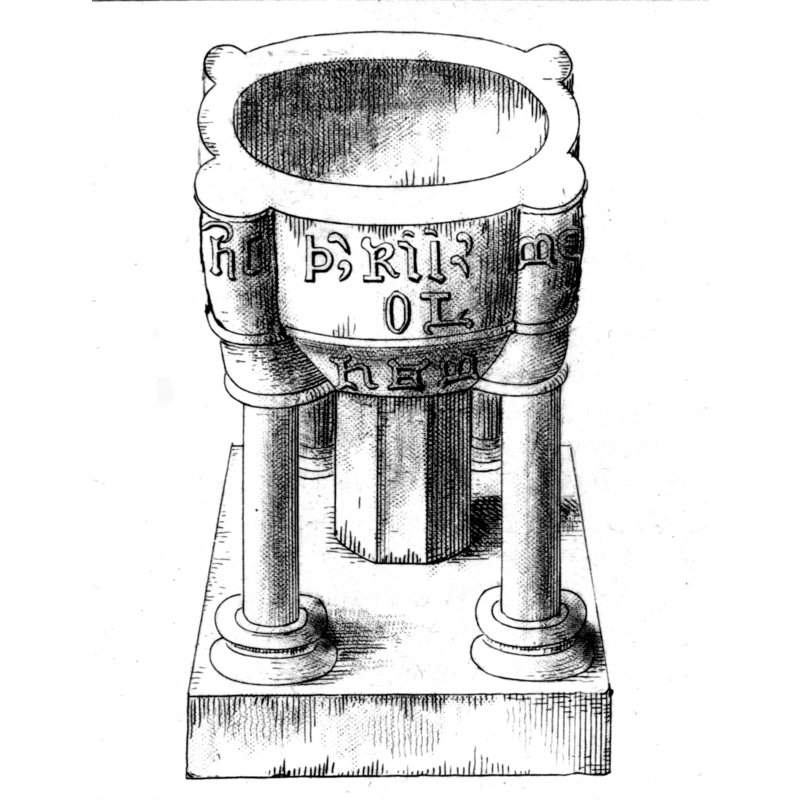
Image copyright © [in the public domain]
PD
Results: 8 records
B01: inscription
Scene Description: records the name of the donor of the font: Ric. Bolham, former rector of the parish
Copyright Statement: Image copyright © [in the public domain]
Image Source: Lysons (1806-1833)
Copyright Instructions: PD
B01: symbol - varied
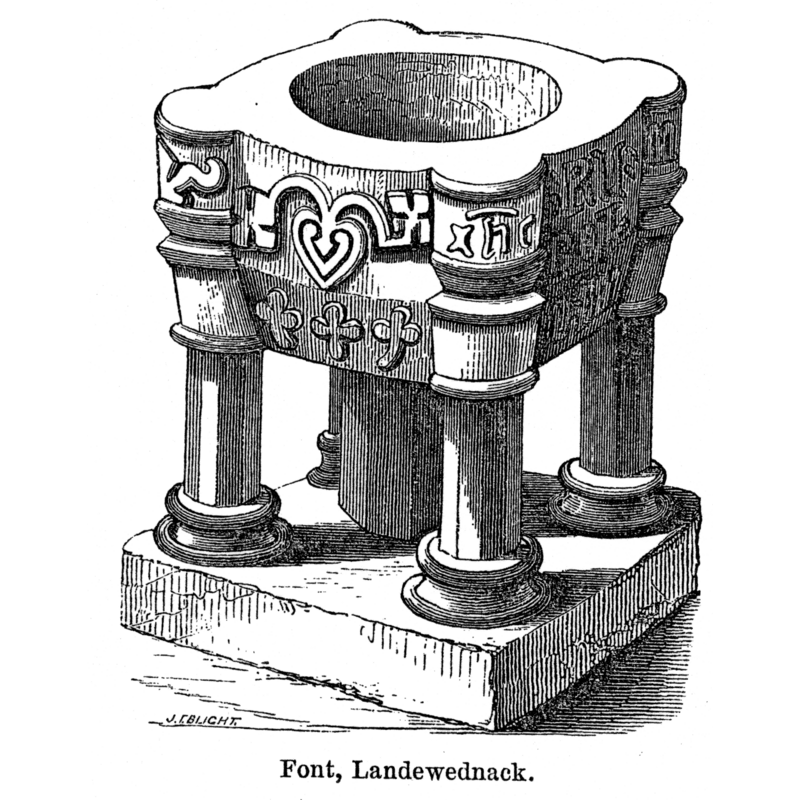
Scene Description: heart, leaves, anagram, etc.
Copyright Statement: Image copyright © [in the public domain]
Image Source: Sketch by Blight in the original 1862 article in The Gentleman's Magazine
Copyright Instructions: PD
view of font
Copyright Statement: Image copyright © [in the public domain]
Image Source: Lysons (1806-1833)
Copyright Instructions: PD
view of font
Copyright Statement: Image copyright © [in the public domain]
Image Source: Sketch by Blight in the original 1862 article in The Gentleman's Magazine
Copyright Instructions: PD
view of font
Copyright Statement: Image copyright © [in the public domain]
Image Source: digital image of an illustration in Bond (1908)
Copyright Instructions: PD
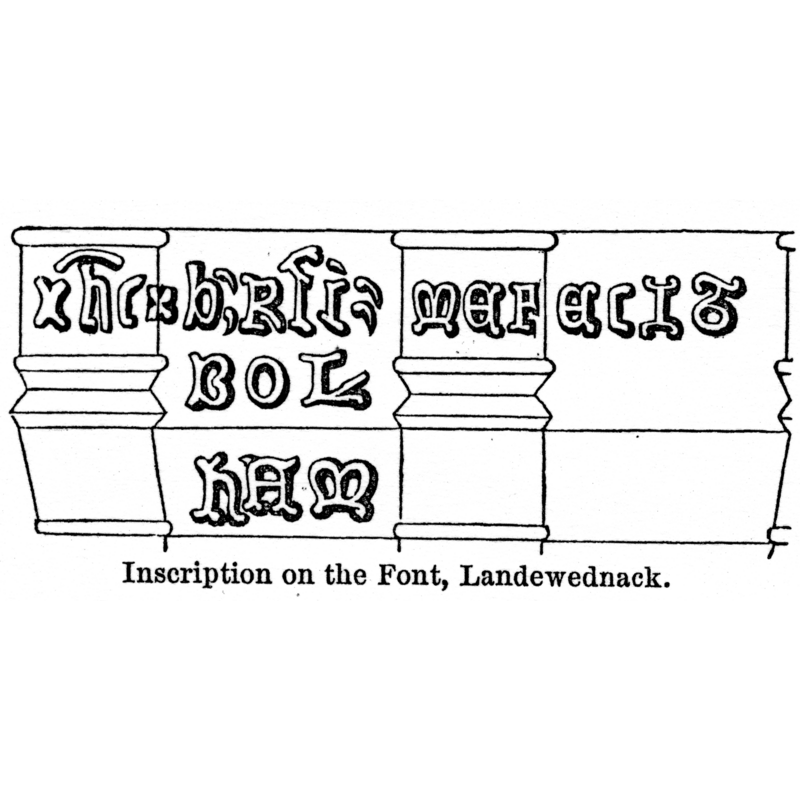
inscription
Copyright Statement: Image copyright © [in the public domain]
Image Source: Sketch by Blight in the original 1862 article in The Gentleman's Magazine
Copyright Instructions: PD
view of church exterior - south door
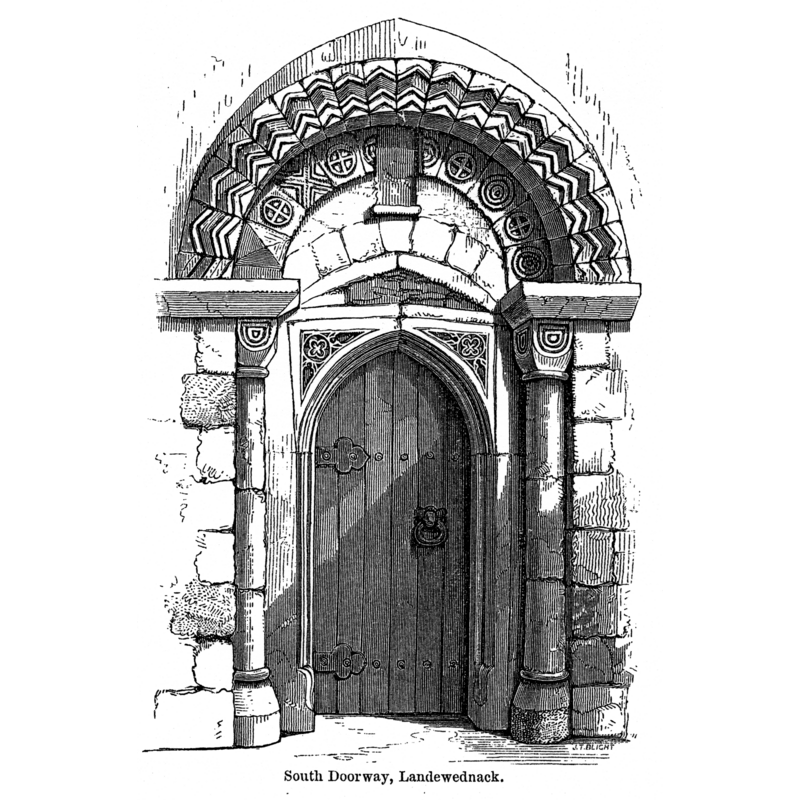
Copyright Statement: Image copyright © [in the public domain]
Image Source: Sketch by Blight in the original 1862 article in The Gentleman's Magazine
Copyright Instructions: PD
view of font and cover

Copyright Statement: Image copyright © Cornish Churches, [2005?]
Image Source: www.kerrierdeanery.co.uk
Copyright Instructions: Standing permission
INFORMATION
Font ID: 01227LAN
Object Type: Baptismal Font1
Font Date: ca. 1404-1415?
Font Century and Period/Style: 15th century (early?), Perpendicular
Workshop/Group/Artisan: Bodmin type (variant of later date)
Cognate Fonts: Similar in shape to the earlier Bodmin-group fonts, but of a later date as Boconnoc, Grade, etc.
Church / Chapel Name: Church of St. Wynwallow or St. Lanty
Font Location in Church: Inside the church
Church Patron Saint(s): St. Winwaloe [aka Guénolé de Landévennec, Grimolay, Guignolet, Gwenole, Guingalan, Guingalois, Guinglin, Guingualoeus, Guingaloué, Gwenole, Gwennole, Uuingualoeus, Walloy, Winnoc, Winwallus, Winwaloeus] / St. Lanty
Church Notes: "The most southerly church in England" (Blight (1862: 540))
Church Address: Church Cove Rd, Landewednack, Helston TR12 7PH, United Kingdom -- Tel.: +44 1326 280999
Phone: +44 1326 280999
Site Location: Cornwall, South West, England, United Kingdom
Directions to Site: Located at the southwesternmost tip of Cornwall, at Lizard's Point, about 20 km S of Helston, down the A3083
Font Notes:
Click to view
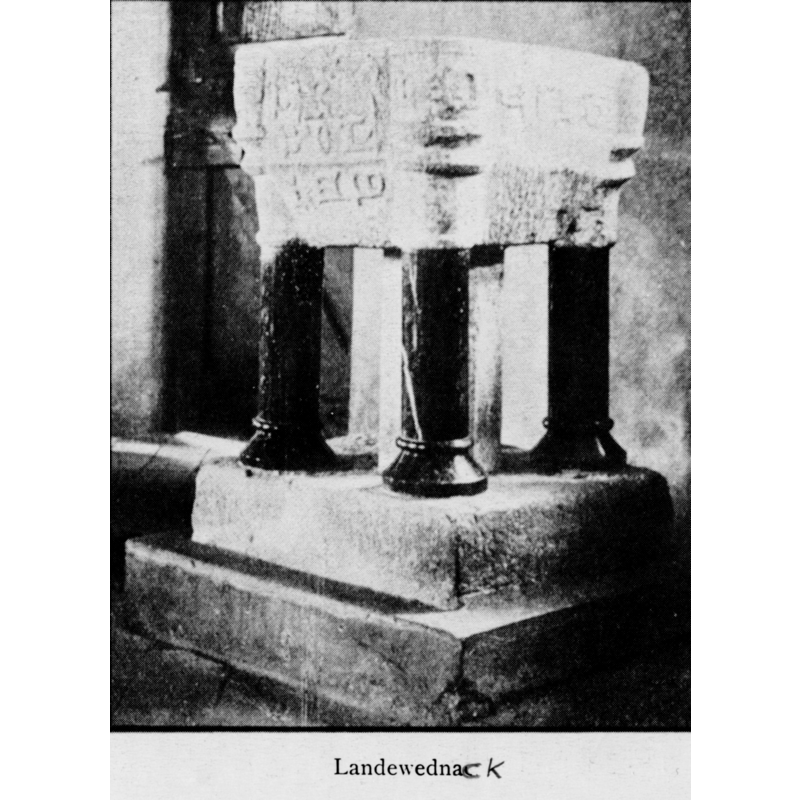
Noted in Lysons (1806-1833) as one of a group of Cornish fonts of similar shape as the original fonts of Bodmin, Roche, etc., “but evidently of a much later date [...]. On the Landewednack font is the following inscription, which, from the character of the letters, does not seem to be of a later date than the reign of King Edward the Fifth [1272-1307]: 'Ihc---D. Ric. Bolham me fecit.'" Lewis' Dictionary of 1848 notes "a curious font" in the church of St. Lanty [cf. ChurchName field above]. Noted and illustrated in Upcott (1818) [with reference to Lyson]. 'On the ancient stone fonts of Cornwall' (1851) suggests a date ca. 1280, in the Early English period [aka First Pointed] for this font." Blight (1862) writes: "The font [...], supported on a central pillar and four shafts, a form frequently met in Cornwall, is probably of the thirteenth century, and bears an inscription in early English characters, "I.H.C. D. Ric. (Dominus Ricardus) Bolham me fecit." Listed in Romilly Allen (1888) as one of several "later fonts with inscriptions of a religious nature". Described and illustrated in Bond (1908) as a square mounted baptismal font; the square basin with rounded, protruding corners rests on a central stem of the same stone and four darker columns at the angles; it has an inscription naming a former rector, Bolham, who commissioned it. The columns of the base rest on a double plinth, also square. Described also in Cox & Harvey (1907) as a noteworthy example ca. 1400, bearing the name of the donor, Ric. Bolham, a former rector of the parish [NB: C&H list the font erroneously in the Norman/Transitional period in their county listing on p. 193]. There are ornamentation motifs on the sides: four-leave plants or flowers and other heart- and leaf-shaped motifs. C&H identify the material as granite [cf. infra]. Cox (1912) gives the years of Bolham's rectory as 1414-1415. Tyrrell-Green (ibid.) identifies the material of the angle shafts on this font as "the dark green serpentine of the rocks of the Lizard district"; he further (ibid.) describes this font as "an example of adherence in later days to an early type of font, of the same general appearance as the famous Bodmin group", and records the text of the inscription. Noted in Pevsner (1970): "Font. With an inscription recording the name of a rector, no doubt the donor of the font. His dates at Landewednack are 1404-15; the type with the short corner columns is a simplified version of Bodmin."
Credit and Acknowledgements: We are grateful to the Thomas Fisher Rare Books Library for access to the copy of Lysons’ Magna Britannia, and to Jim Ingram, of the Preservation Services, Robarts Library, for the digital imaging of Lysons’ illustrations]
COORDINATES
UTM: 30U 342721 5537663
Latitude & Longitude (Decimal): 49.970556, -5.193333
Latitude & Longitude (DMS): 49° 58′ 14″ N, 5° 11′ 36″ W
MEDIUM AND MEASUREMENTS
Material: stone, granite [angle shafts made of Cornish Serpentine stone)
Font Shape: square, mounted
Basin Interior Shape: round
Basin Exterior Shape: square
INSCRIPTION
Inscription Language: Latin
Inscription Location: on the basin sides
Inscription Text: 1. "RIC. BOLHAM ME FECIT"
2. "D. RIC. BOLHAM ME FECIT"
3. "IHC[...] D. RIC. BOLHAM ME FECIT"
Inscription Notes: 1)Cox and Bond -- 2)Tyrrell-Green -- 3)Lysons [Richard Bolham was a rector of this parish from 1404 to 1442]
Inscription Source: Cox (1907: 182); Bond (1985 c1908: 115); Tyrrell-Green (1928: 152); Lysons (1806-1833); Blight (1862: 544)
LID INFORMATION
Date: modern?
Material: wood, oak
Apparatus: no
Notes: round and flat
REFERENCES
- "On the ancient stone fonts of Cornwall: a communication", 83 (April 1851) / New Series no. 47, Ecclesiologist, 1851, pp. 96-102; p. 100
- Allen, J. Romilly, "On the Antiquity of Fonts in Great Britain", XLIV, Journal of the British Archaeological Association, 1888, pp. 164-173; p. 169 fn3
- Bond, Francis, Fonts and Font Covers, London: Waterstone, 1985 c1908, p. 115, ill. on p. 116
- Cox, John Charles, Cornwall, London: George Allen & Company, 1912, p. 135
- Cox, John Charles, English Church Furniture, New York: E.P. Dutton & Co., 1907, p. 182, 191, 193
- Lewis, Samuel, A Topographical Dictionary of England, Comprising the Several Counties, Cities, Boroughs, Corporate and Market Towns, Parishes, Chapelries, and Townships, and the Islands of Guernsy, Jersey, and Man, with Historical and Statistical Descriptions [...], London: S. Lewis, 1831, [www.british-history.ac.uk/report.asp?compid=51090] [accessed 15 February 2007]
- Lysons, Daniel, Magna Britannia, being a concise topographical account of the several counties of Great Britain, London: Printed for T. Cadell and W. Davies, 1806-1822, vol. III: p. ccxxiii-ccxxiv and pl. on opp. p.
- Pevsner, Nikolaus, Cornwall, Harmondsworth: Penguin Books, 1970, p. 87
- Tyrrell-Green, E., Baptismal Fonts Classified and Illustrated, London: Society for Promoting Christian Knowledge: The Macmillan Co., 1928, p. 27, 135, 152
- Upcott, William, A bibliographical account of the principal works relating to English topography, London: Printed by Richard and Arthur Taylor, 1818, p. 95 and pl. xx / [http://books.google.com/books?id=gLwuAAAAMAAJ&pg=PA228&lpg=PA228&dq=upcott+1818&source=web&ots=lJwT-K00zU&sig=oVT6Kc6G03vqjYf4Synuk_Aek9w#PPP15,M1] [accessed 23 September 2007]