Haydon Bridge
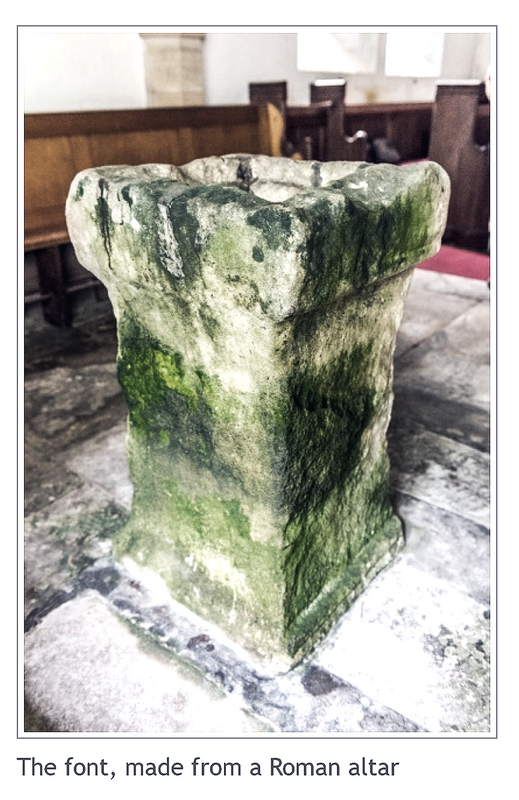
Image copyright © David Ross & Britain Express Ltd, 2026
Standing permission
Results: 3 records
view of font
Scene Description: [cf. FontNotes]
Copyright Statement: Image copyright © David Ross & Britain Express Ltd, 2026
Image Source: digital photograph in David Ross & Britain Express
Copyright Instructions: Standing permission
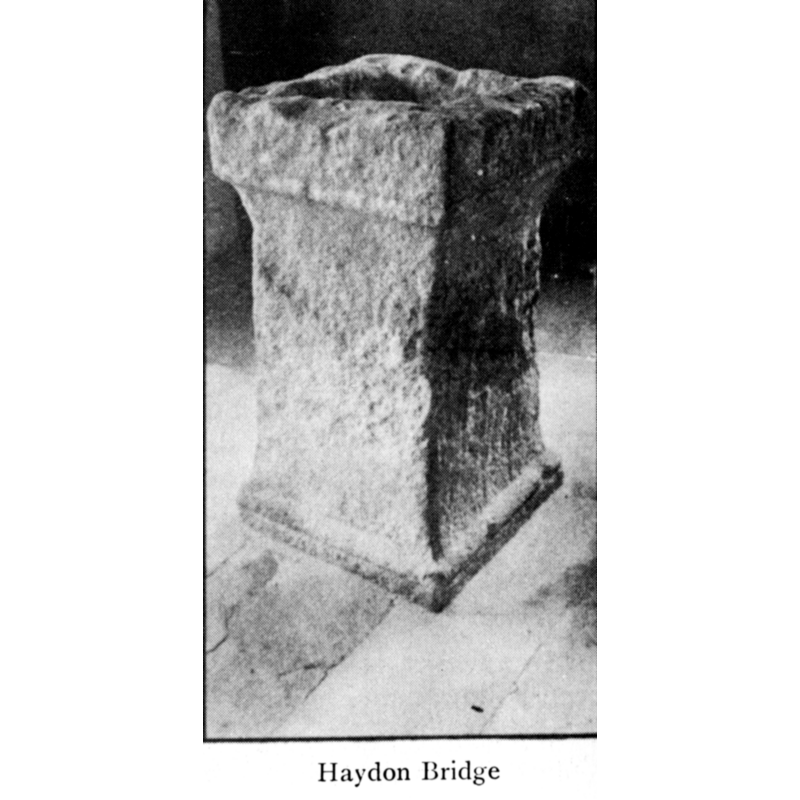
view of font
Copyright Statement: Image copyright © [in the public domain]
Image Source: Bond (1908: ill. on p. 98)
Copyright Instructions: PD
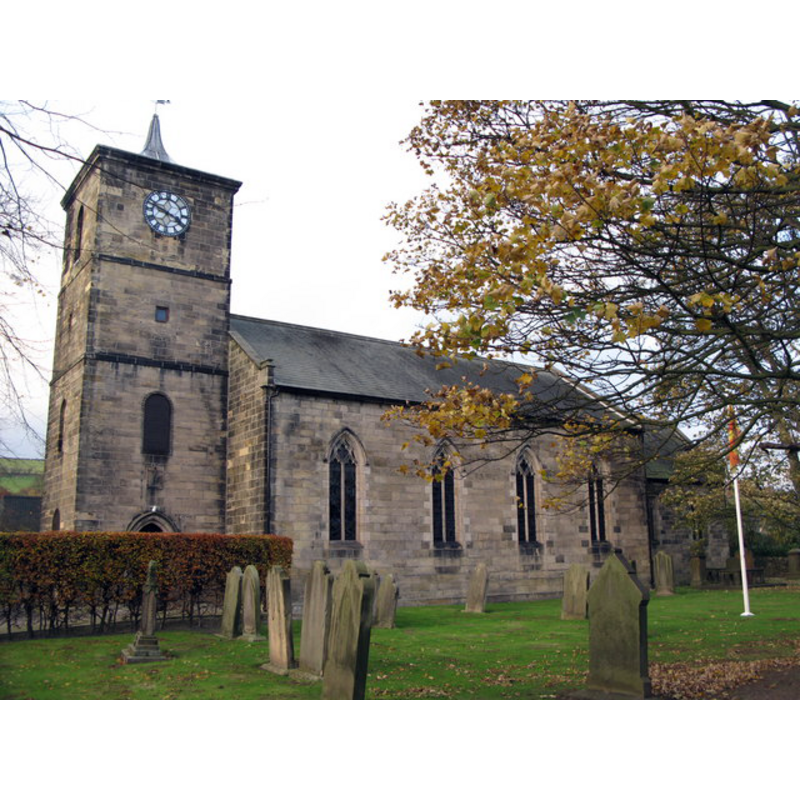
view of church exterior - south view
Copyright Statement: Image copyright © Mike Quinn, 2007
Image Source: digital photograph taken 2 November 2007 by Mike Quinn [www.geograph.org.uk/photo/601736] [accessed 8 February 2013]
Copyright Instructions: CC-BY-SA-3.0
INFORMATION
Font ID: 01143HAY
Object Type: Other
Object Details: altar, Roman
Font Century and Period/Style: 3th - 5th century [converted Roman altar], Anglo-Roman
Workshop/Group/Artisan: altar font
Cognate Fonts: The fonts at Chollerton and St. John Lee (Northumberland) are also hollowed out Roman altars, as is the one at Staunton [also cf. FontNotes]
Church / Chapel Name: Parish Church of St. Cuthbert [originally from the old chapel nearby]
Font Location in Church: Inside the church
Church Patron Saint(s): St. Cuthbert [aka Cubertus]
Church Notes: formerly a parochial chapelry -- "This chapel was built in 1797, in lieu of the old one, which is situated about 1 mile N. of the village, and is used at times for interments" [source: National Gazetteer (1868)]
Church Address: Haydon, Northumberland NE47 6LL
Site Location: Northumberland, North East, England, United Kingdom
Directions to Site: Located on the B6319, 14 km W of Hexham, 45 km W of Newcastle upon Tyne, (dir. Carlisle)
Ecclesiastic Region: Diocese of Newcastle [formerly Durham?]
Additional Comments: re-purposed Roman altar or cippus -- converted to a font; it had its original inscription chiselled off
Town/City Wikipedia: https://en.wikipedia.org/wiki/Haydon_Bridge
Font Notes:
Click to view
Ruprich-Robert (1855) mentions a noteworthy font at Haydon without further details. Romilly Allen (1888) includes Haydon's among a number of "fonts made out of Roman altars". Bond (1908) mentions three examples of "Roman altars [...] converted into fonts": this one, the font at Chollerton Bridge and another one at St. John Lee, all in Northumberland. Cox & Harvey (1907) describe it as a baptismal font believed to be a hollowed out Roman altar. Tyrrell-Green (1928) identifies it as a "Roman altar, from the ruins of Borcovicium, converted in like manner for the administration of the Christian sacrament." The modern, 19th-century, font in use in this church is made of marble. Noted and illustrated in BritainExpress [https://www.britainexpress.com/counties/northumbria/churches/haydon-bridge-old-church.htm] [accessed 6 March 2026]: "The most interesting historic feature in the church is the font, made from a Roman altar. If there was ever a Roman inscription it has long since been worn away." [NB: a number of other popular sources refer to this object as a converted Roman altar]. A communication to BSI from Pol Herman (e-mail of 4 March 2026) informs: "This was originally probably a roman cippus, comparable to the one preserved in the Saint Nicholas church of Strée-lez-Huy (20087STR), situated on the ancient Roman road between Atuatuca Tungrorum (Tongres) and Marca (Marche-en-Famenne). Cippi were installed along the roads as milestones, as boundary posts, as identification signs of sanctuaries and temples. The one at Strée (Latin name Strata) was hidden under the romanesque church altar and was discovered in 1967. The latin inscription says : "In honor of the Imperial House. To the goddess Virathethis. Superina, daughter of Suppo, has fulfilled her vow, gladly and with good reason".
https://balat.kikirpa.be/object/10121365 -- The use of Roman artifacts inside or under Christian altars and baptismal fonts is well documented in the Ardennes region. Virathetis was a Celtic goddess of the Belgian Tungri tribe. A votive stone was found in Scotland in 1772 at a Roman camp at Birrens (Blatobulgium), bearing the inscription: "Dedicated to the goddess Viradecthis, erected by the soldiers of the pagus Condroz serving in the second cohort of the Tungri under the command of Silvius Auspex."
https://balat.kikirpa.be/object/10121365 -- The use of Roman artifacts inside or under Christian altars and baptismal fonts is well documented in the Ardennes region. Virathetis was a Celtic goddess of the Belgian Tungri tribe. A votive stone was found in Scotland in 1772 at a Roman camp at Birrens (Blatobulgium), bearing the inscription: "Dedicated to the goddess Viradecthis, erected by the soldiers of the pagus Condroz serving in the second cohort of the Tungri under the command of Silvius Auspex."
Credit and Acknowledgements: We are grateful to Pol Herman for his help documenting this object, and to David Ross and Britain Express for their photograph of the font
COORDINATES
UTM: 30U 548212 6092154
Latitude & Longitude (Decimal): 54.973963, -2.246799
Latitude & Longitude (DMS): 54° 58′ 26.27″ N, 2° 14′ 48.47″ W
MEDIUM AND MEASUREMENTS
Material: stone, type unknown
Number of Pieces: one
Font Shape: square, mounted
Basin Interior Shape: round
Basin Exterior Shape: square
INSCRIPTION
Inscription Language: Latin?
Inscription Location: it was on the side
Inscription Text: [chiselled off]
Inscription Notes: the pagan inscription had been chiselled off when the Roman object was converted to use as font
Inscription Source: Bond (Ibid., p. 99)
REFERENCES
- Allen, J. Romilly, "On the Antiquity of Fonts in Great Britain", XLIV, Journal of the British Archaeological Association, 1888, pp. 164-173; p. 172-173
- Betjeman, John, An American's Guide to English Parish Churches (including the Isle of Man), New York: McDowell, Obolensky, 1958, p. 295
- Bond, Francis, Fonts and Font Covers, London: Waterstone, 1985 c1908, p. 99 and ill. on p. 98
- Cox, John Charles, English Church Furniture, New York: E.P. Dutton & Co., 1907, p. 167, 212
- Ruprich-Robert, V., "Bénitiers et fonts baptismaux du Moyen-âge et de la Renaissance", II (1855), Revue générale de l'architecture et des travaux publics, pp. 289-290, Pl. XXVI; p. 289
- Stocker, D.A., "Fons et origo: The Symbolic Death and Resurrection of English Font Stones", I (1997b), Church Archaeology, 1997, pp. 17-25; p. 25
- Tyrrell-Green, E., Baptismal Fonts Classified and Illustrated, London: Society for Promoting Christian Knowledge: The Macmillan Co., 1928, p. 21-22