Woolstone nr. Swindon / Olvricestone / Olvrichestone / Wlfricheston / Wluricheston / Wolierston / Wolstane / Wolston / Wolstone / Woolstone /Woulricheston / Wulevycheston / Wulwricheston
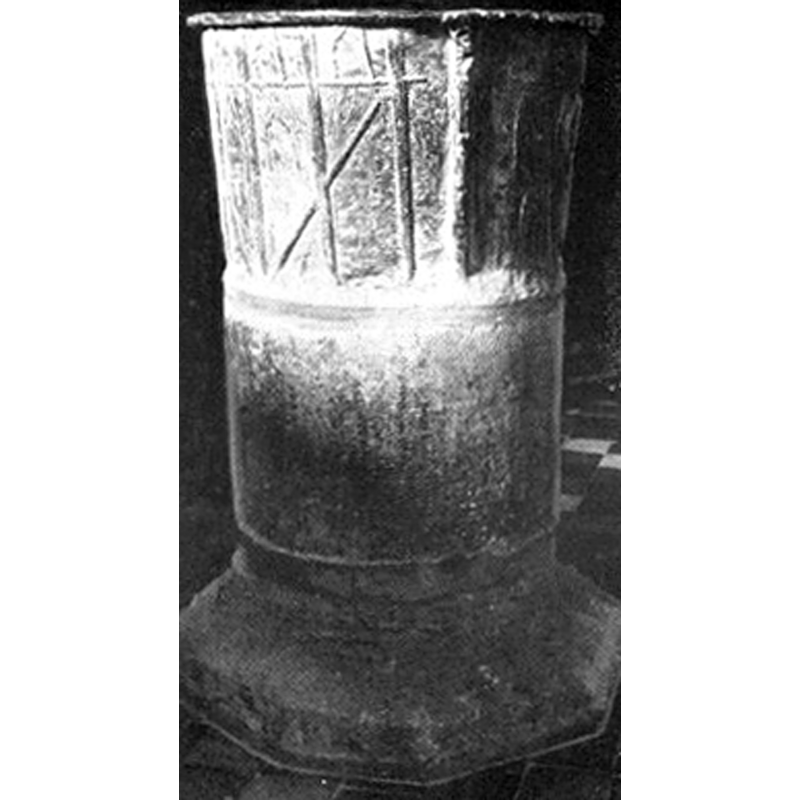
Image copyright © [in the public domain]
No known copyright restriction / Fair Dealing
Results: 6 records
view of font
Copyright Statement: Image copyright © [in the public domain]
Image Source: B&W photograph [original source unknown] provided by Peter Fairweather (Lincoln, England)
Copyright Instructions: No known copyright restriction / Fair Dealing
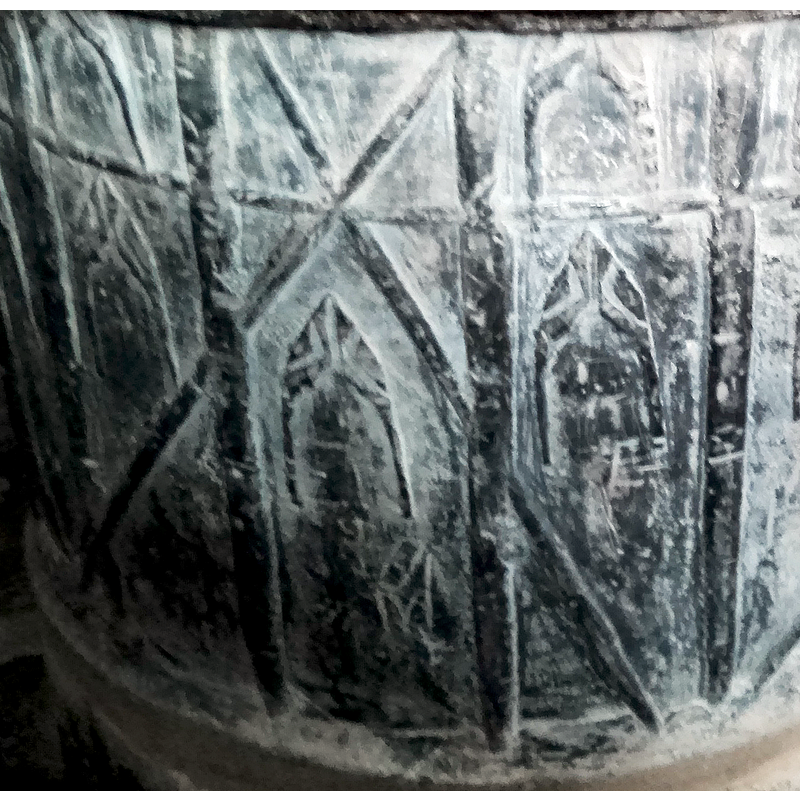
design element - patterns - lattice pattern
Copyright Statement: Image copyright © deadmanjones, 2013
Image Source: edited detail of a digital photograph taken 3 August 2013 by deadmanjones [www.flickr.com/photos/deadmanjones/9710986067/] [accessed 9 June 2015]
Copyright Instructions: CC-BY-SA-2.0
design element - patterns - tracery - window tracery
Copyright Statement: Image copyright © deadmanjones, 2013
Image Source: edited detail of a digital photograph taken 3 August 2013 by deadmanjones [www.flickr.com/photos/deadmanjones/9710986067/] [accessed 9 June 2015]
Copyright Instructions: CC-BY-SA-2.0
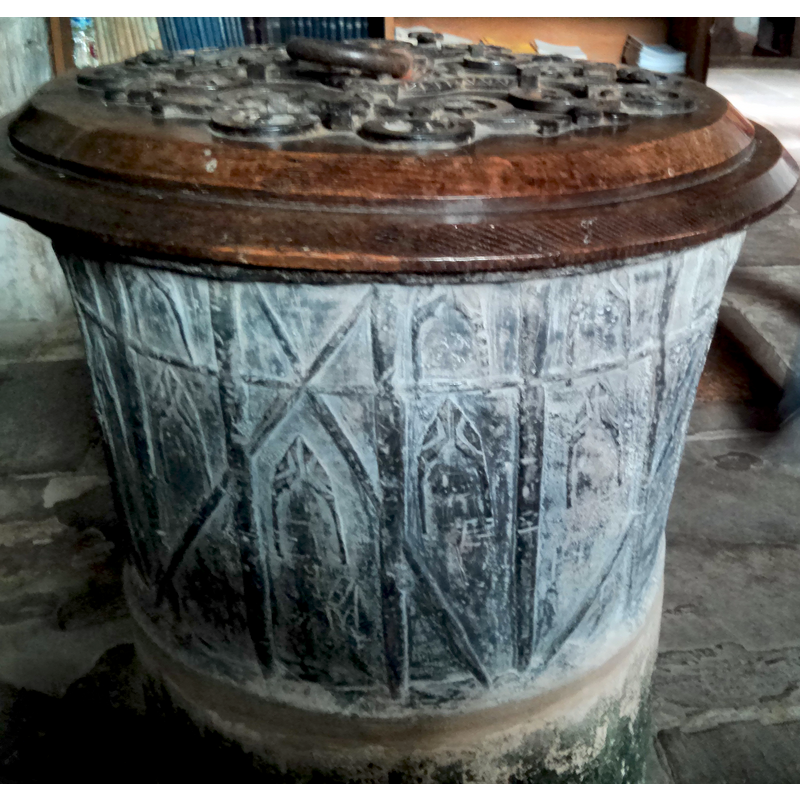
view of basin and cover
Copyright Statement: Image copyright © deadmanjones, 2013
Image Source: detail of a digital photograph taken 3 August 2013 by deadmanjones [www.flickr.com/photos/deadmanjones/9710986067/] [accessed 9 June 2015]
Copyright Instructions: CC-BY-SA-2.0
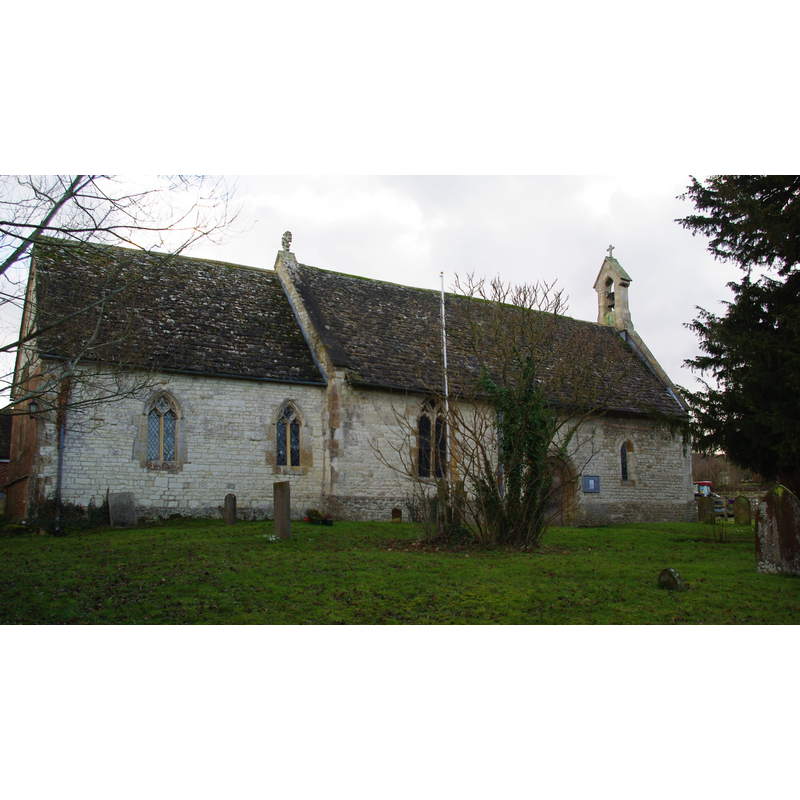
view of church exterior - north side
Copyright Statement: Image copyright © Andrew Mathewson, 2010
Image Source: digital photograph taken 5 February 2010 by Andrew Mathewson [www.geograph.org.uk/photo/1750432] [accessed 9 June 2015]
Copyright Instructions: CC-BY-SA-2.0
view of font and cover

Copyright Statement: Image copyright © Rex Harris, 2012
Image Source: digital photograph taken 2 April 2012 by Rex Harris [www.flickr.com/photos/sheepdog_rex/6896243466/] [accessed 9 June 2015]
Copyright Instructions: PERMISSION NOT AVAILABLE -- IMAGE NOT FOR PUBLIC USE
INFORMATION
Font ID: 01065WOO
Object Type: Baptismal Font1
Font Century and Period/Style: 13th - 14th century, Medieval
Workshop/Group/Artisan: lead font
Church / Chapel Name: Parish Church of All Saints
Font Location in Church: Inisde the church
Church Patron Saint(s): All Saints ["not known" (Crockford's)]
Church Address: Marsh Way, Woolstone, Oxfordshire, SN7 7QN
Site Location: Oxfordshire, South East, England, United Kingdom
Directions to Site: Located N of the B4507, 7 km S of Faringdon, 10 km EEN of Swindon, 35-40 km WSW of Oxford
Ecclesiastic Region: Diocese of Oxford
Historical Region: Hundred of Hildslow [in Domesday] -- formerly in Berkshire (until 1974) -- Hundred of Shrivenham
Additional Comments: disappeared font?
Font Notes:
Click to view
There is an entry for this Woolestone [variant spelling] in the Domesday survey [http://opendomesday.org/place/SU2987/woolstone/] [accessed 9 June 2015], but it mentions neither cleric nor church in it. The font here is listed in Paley (1844), in Batty (1844), in Cox (1875), in Andre (1882) and in Lethaby (1893) as a "leaden font" [NB: Lethaby (ibid.) dates it 'Norman']. Described in 'Church notes...' (1887) in the context of some "notes [that] were taken between 1835 and 1840": "The font has a cylindrical bowl of cast lead, upon a plain stone cylinder, with a scalloped base. The prints upon the lead resemble 'cancelli', or lattice work, with some rude representations of windows, with early Decorated tracery." Described in Cox & Harvey (1907) as a "small tub font [...] rudely marked. Dr. Fryer's suggestion that the designer was endeavouring to reproduce the form of an earlier timber Saxon church is ingenious but not probable". [NB: C&H's reference is to Alfred C. Fryer's article on Leaden Fonts, in vol. LVII (1900: 40ff) of the Archaeological Journal]. Listed in Bond (1908) as a lead font ornamented with "various decorations" [NB: Bond gives the county as Berkshire in the text of the original edition; the reprint edition shows in under "Oxon." in the index]. The Victoria County History (Berkshire, vol. 4, 1924) notes: "The building dates from about 1195 [...] The font is of great interest, and consists of a circular lead bowl 21 in. in diameter [...] by 14 in. high, on a circular stone stem and modern base. It is probably not earlier than the 14th century. The bowl is divided by raised vertical bands into a series of compartments, 'each containing a pair of leaves forming a pointed arch,' [...] across which a series of zigzag lines are carried. A narrow fillet runs round the top of the bowl between the vertical bands with a series of smaller pointed 'arches' in the spaces thus formed." The window tracery can have the effect of suggesting praying figures.
Credit and Acknowledgements: We are grateful to Peter Fairweather, of www.churchmouse.co.uk, for his image of this font.
COORDINATES
UTM: 30U 598583 5715908
Latitude & Longitude (Decimal): 51.585594, -1.577058
Latitude & Longitude (DMS): 51° 35′ 8.14″ N, 1° 34′ 37.41″ W
MEDIUM AND MEASUREMENTS
Material: metal, lead
Font Shape: bucket-shaped, mounted
Basin Interior Shape: round
Basin Exterior Shape: round
Diameter (includes rim): 52.5 cm*
Basin Total Height: 35 cm*
Notes on Measurements: * VCH [cf. FontNotes] [NB: not specified whether the diameter is external or internal]
REFERENCES
- "Church notes, chiefly in Berks, Wilts, and Oxford, with a few in Somerset and Gloucestershire", 44, Archaeological Journal, 1887, pp. 43-50; 185-193; 291-303; 397-402; p. 401
- Victoria County History [online], University of London, 1993-. URL: https://www.british-history.ac.uk.
- André, J. Lewis, "Leaden Fonts in Sussex", 32, Surrey Archaeological Collections, relating to the history and antiquities of the county, 1882
- Batty, Robert Eaton, Some particulars connected with the history of baptismal fonts: being a paper read at the quarterly general meeting of the Architectural and Archaeological Society for the County of Buckingham, London: F. & J. Rivington, 1848, p. 20
- Bond, Francis, Fonts and Font Covers, London: Waterstone, 1985 c1908, p. 87
- Cook, G.H., English Mediaeval Parish Church, London: Phoenix House, 1954
- Cox, John Charles, 1875-1877
- Cox, John Charles, English Church Furniture, New York: E.P. Dutton & Co., 1907, p. 164
- Fryer, Alfred C., "Leaden Fonts", LVII, Archaeological Journal, 1900, pp. 40ff; p. 40ff
- Lethaby, William Richard, Leadwork, old and ornamental, and for the most part English [...] with illustrations, London; New York: Macmillan & co., 1893, p. 62