Hollington / Halinton / Halyngtone / Holintun / Horintone / Horintune
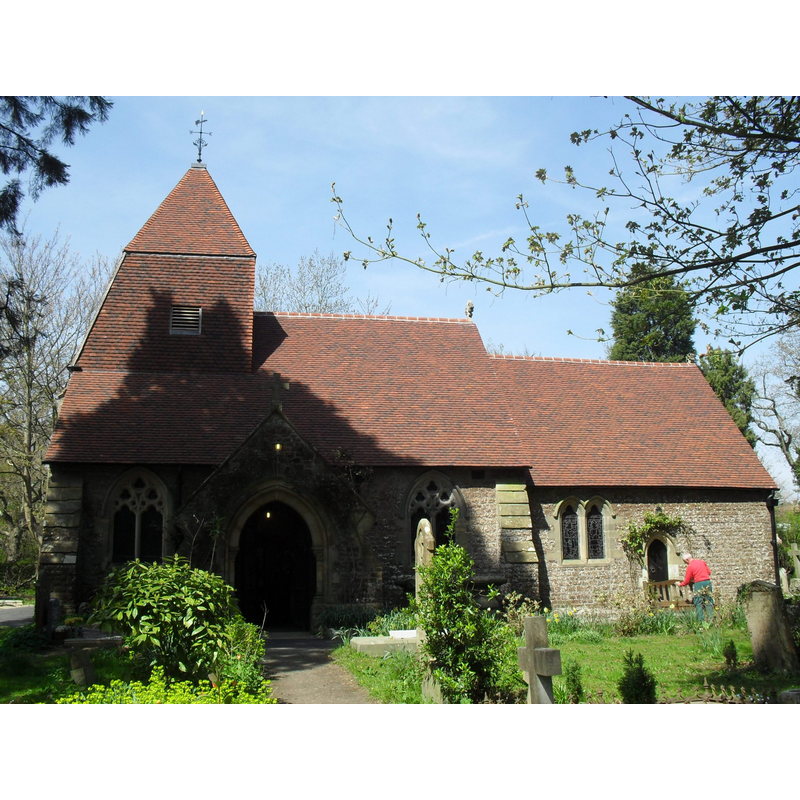
Image copyright © [in the public domain]
Released by its author into the public domain
Results: 1 records
view of church exterior - south view
Copyright Statement: Image copyright © [in the public domain]
Image Source: digital photograph taken 24 April 2010 by The Voice of Hassocks [http://en.wikipedia.org/wiki/File:Church-in-the-Wood,_Hollington,_Hastings_%28South_Side%29.jpg] [accessed 22 January 2013]
Copyright Instructions: Released by its author into the public domain
INFORMATION
Font ID: 01059HOL
Object Type: Baptismal Font1
Font Century and Period/Style: 13th century, Medieval
Cognate Fonts: Another pentagonal basin at Bletherston (Pembrokeshire)
Church / Chapel Name: Church of St. Leonard (Church in the Wood)
Font Location in Church: [disappeared?]
Church Patron Saint(s): St. Leonard [originally dedicated to St. Rumbold]
Site Location: East Sussex, South East, England, United Kingdom
Directions to Site: Located in the western outskirts of Hastings -- known as St Leonard's, the "Church in the Wood"
Ecclesiastic Region: Diocese of Chichester
Additional Comments: e-mailed churchwarden at St Leonard's for confirmation of the destruction of the font [7 Nov 2010] [no reply received]
Font Notes:
Click to view
Noted as a pentagonal in Pugin (1843) and in Paley (1844). [NB: yet Pugin (ibid.) writes in the same work: "A font of five sides I do not know to occur any where"]. In Geldart (1899) after Pugin. Described in Cox & Harvey (1907) as "the unique example of a pentagon font". Mentioned in Bond (1908) as a pentagonal font, "a solitary example". There is no mention of a font in Harrison's (1920) entry for this church. Tyrrel-Green (1928) corrects Bond, who "was doubtless unaware of the existence of a like example at the very obscure village of Bletherston (Pem)." The Parish web site [www.stleonardsandstannes.org.uk/history.htm] [accessed 7 November 2010] has a brief history of the church by Denis Baker, which notes: "The font replaced an earlier sandstone one from the old church, and at one time, shortly after the restoration, there were two fonts in the church. Unfortunately, the older font was subsequently removed and placed in the churchyard, where it was broken up and destroyed." The British Listed Buildings database [www.britishlistedbuildings.co.uk/en-293741-church-of-st-leonard-in-the-wood-hasting] [accessed 7 November 2010] reports: "There is a C19 octagonal stone font with wooden cover with decorative brasswork".
COORDINATES
UTM: 31U 326787 5638735
Latitude & Longitude (Decimal): 50.8743, 0.538
Latitude & Longitude (DMS): 50° 52′ 27.48″ N, 0° 32′ 16.8″ E
MEDIUM AND MEASUREMENTS
Material: stone, type unknown
Font Shape: pentagonal
Basin Exterior Shape: pentagonal
REFERENCES
- Bond, Francis, Fonts and Font Covers, London: Waterstone, 1985 c1908, p. 57
- Cox, John Charles, English Church Furniture, New York: E.P. Dutton & Co., 1907, p. 165
- Geldart, Ernest, A manual of church decoration and symbolism, containing directions and advice to those who desire worthily to deck the church at various seasons of the year: also, the explanation and the history of the symbols and emblems of religion, Oxford, London: A.R. Mobray & Co., 1899, p. 40fn
- Harrison, Frederick, Notes on Sussex churches, Hove: Combridges, 1920, p. 128
- Paley, Frederick Apthorp, Illustrations of Baptismal Fonts, London, UK: John van Voorst, 1844, p. 22
- Poole, George Ayliffe, The Appropriate Character of Church Architecture, Leeds; London: T.W. Green; Rivington, Burns, and Houlston and Stoneman, 1842, p. 68 and fn
- Pugin, Augustus Northmore Welby, The Present State of Ecclesiastical Architecture in England, London: Charles Dolman, 1843, p. 67, 70
- Tyrrell-Green, E., Baptismal Fonts Classified and Illustrated, London: Society for Promoting Christian Knowledge: The Macmillan Co., 1928, p. vi, 32