Lewes No. 1
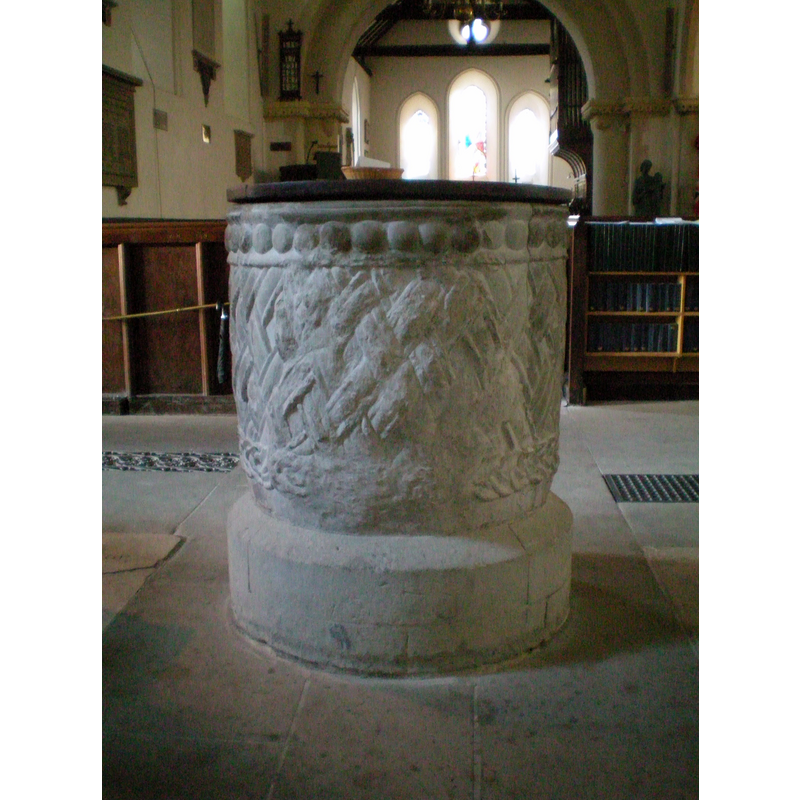
Image copyright © [in the public domain]
Released into the public domain
Results: 9 records
B01: design element - motifs - braid -diamond shape
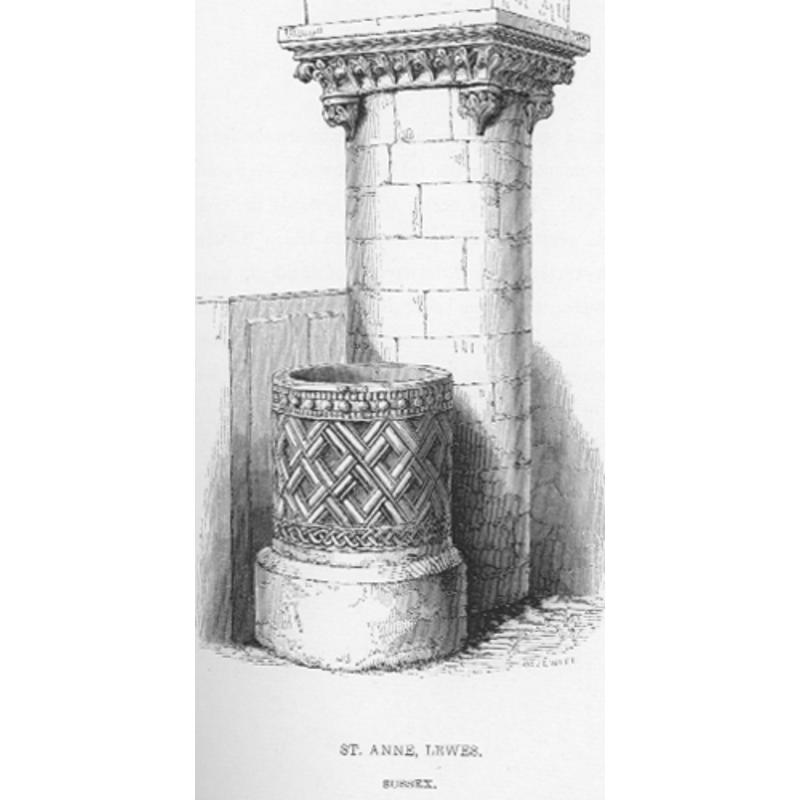
Scene Description: covering all the surface of the basin sides
Copyright Statement: Image copyright © [in the public domain]
Image Source: engraving in Paley (1844: unpaged)
Copyright Instructions: PD
BBL01: design element - motifs - braid
Scene Description: framing the lower part of the basin, all around
Copyright Statement: Image copyright © [in the public domain]
Image Source: engraving in Paley (1844: unpaged)
Copyright Instructions: PD
BBU01: design element - motifs - ball
Scene Description: band of ball motif all around the upper side of the basin side
Copyright Statement: Image copyright © [in the public domain]
Image Source: engraving in Paley (1844: unpaged)
Copyright Instructions: PD
view of font and cover
Scene Description: the damaged west side [cf. Font notes]
Copyright Statement: Image copyright © [in the public domain]
Image Source: digital photograph taken 19 September 2009 by Charlesdrakew [http://commons.wikimedia.org/wiki/File:Lewes_St._Anne%27s_Church_6.JPG]
Copyright Instructions: Released into the public domain
view of font and cover
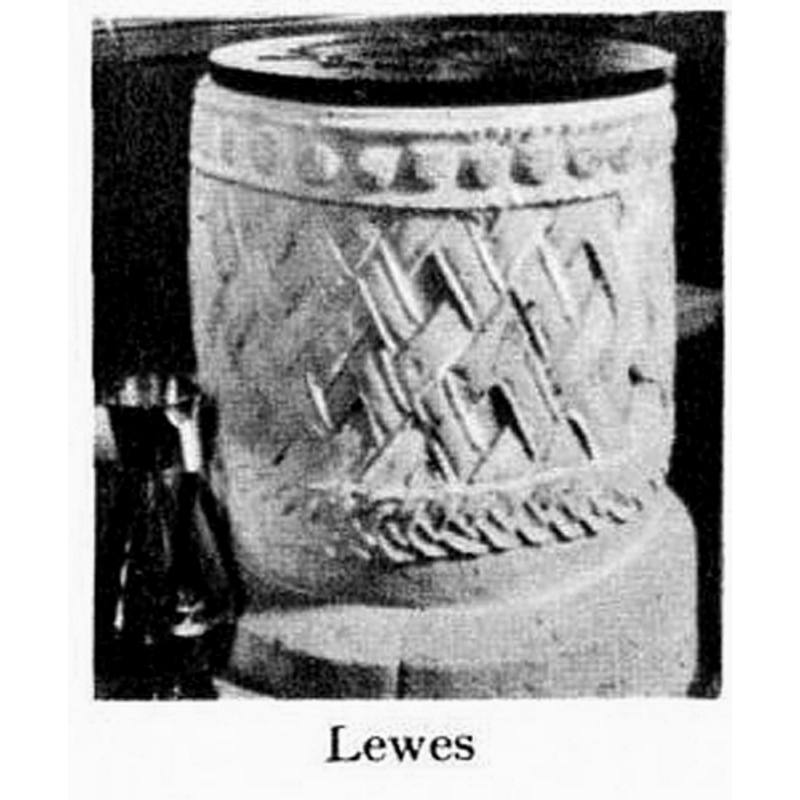
Copyright Statement: Image copyright © Arthur Mee, 1937
Image Source: Paul Zwierzanski [www.yeoldesussexpages.co.uk]
Copyright Instructions: PD
view of font
Copyright Statement: Image copyright © [in the public domain]
Image Source: engraving in Paley (1844: unpaged)
Copyright Instructions: PD
view of font

Scene Description: west side
Copyright Statement: Image copyright © The British Academy & Kathryn A. Morrison, 2008
Image Source: B&W photograph in the CRSBI
Copyright Instructions: PERMISSION NOT AVAILABLE -- IMAGE NOT FOR PUBLIC USE
view of font
Scene Description: east side
Copyright Statement: Image copyright © The British Academy & Kathryn A. Morrison, 2008
Image Source: B&W photograph in the CRSBI
Copyright Instructions: PERMISSION NOT AVAILABLE -- IMAGE NOT FOR PUBLIC USE
view of font
Scene Description: east side
Copyright Statement: Image copyright © The British Academy & Kathryn A. Morrison, 2008
Image Source: B&W photograph in the CRSBI
Copyright Instructions: PERMISSION NOT AVAILABLE -- IMAGE NOT FOR PUBLIC USE
INFORMATION
Font ID: 01045LEW
Object Type: Baptismal Font1
Object Details: capital
Font Century and Period/Style: 12th century, Norman
Cognate Fonts: Ornamentation work similar to the one on the font at Denton, also in East Sussex
Church / Chapel Name: Parish Church of St. Anne
Font Location in Church: Inside the church, in the W end, by the N door [cf. FontNotes for moves of the font within the church]
Church Patron Saint(s): St. Anne [formerly St. Mary?]
Church Address: St Anne's Hill, Western Rd., Lewes, East Sussex, BN7
Site Location: East Sussex, South East, England, United Kingdom
Directions to Site: Located about 10 km ENE of Brighton
Ecclesiastic Region: Diocese of Chichester
Historical Region: Rape of Lewes -- Sussex
Additional Comments: altered / restored/ repaired / re-cycled (from a former capital?] CRSBI notes: "A tub font is situated by the N doorway of the nave. It has a central band carved with basketwork, an upper border of pellets, and a lower border of plait, beneath which is a plain chamfer. It sits on a modern, cylindrical plinth inscribed: 'restored 1925'. The W side of the font is extremely worn. It had been cut off when the font was positioned against a wall, and when the font was moved once again to a free-standing position a new section had to be made. Later the eroded original section was discovered under the floor and restored to its former position, with stone inserts on either side as it did not fit properly. Its surface consists largely of plaster" probably in reference to the west side
Font Notes:
Click to view
There are two entries for Lewes in the Domesday survey [http://domesdaymap.co.uk/place/TQ4110/lewes/] [accessed 26 September 2014], but neither mentions a church or cleric in it. Baptismal font noted in Gough (1792): "shaped like a barrel, the body adorned with fretwork, and an upper and lower band or fascia of rounds and quatrefoils, and set against a pillar." Paley (1844) describes it as a "cylindrical Norman Font, ornamented with the interlaced work so frequent in that style" and dates it toward the end of the 12th century; he identifies the stone as being "Eastbourne sand-stone" and notes the previous existence of iron staples for the cover. Noted in Lewis' Dictionary of 1848. Hussey (1852) writes: "The font of this church is peculiar. The form is cylindrical without a stem, and the pattera round the centre bears some resemblance to wicker-work. The upper border, consisting of pellets or studs, is an example of the neglect of measurement and calculation, which I imagine to have been common, in ancient times previous to commencing operations on the ornamental carving; for the pellets are not all of the same size, as if the consequence of there not being space to complete the last-worked like the others." Described in Cox & Harvey (1907) as a "handsomely carved" baptismal font of the Norman period ornamented with "interwaven basket-work pattern". Noted in Harrison (1920) as Norman. Described in Tyrrell-Green (1928) as the finest specimen of a "small group of tub-shaped fonts with [...] ornament of interlacing diagonal strands, resembling basketwork", of the Norman period in Sussex (the group includes: Lewes St. Anne's, Denton and East Dean). Illustrated in Needham (1944). Described and illustrated in Whiteman (1994) as having a similar pattern of decoration to that on the font at Denton. Described and illustrated in The Corpus of Romanesque Sulpture in Britain and Ireland (2008) with some valuable comments on the eventful life of this object: it notes the 1925 restoration (as stated on the modern plinth); it further notes that "it had been cut off when the font was positioned against a wall [it was set against a pillar ca. 1792 -- cf. Gough supra] and when the font was moved once again to a free-standing position a new section had to be made. Later the eroded original section was discovered under the floor and restored to its former position, with stone inderts on either side as it did not fit properly." Lastly the CRSBI (ibid.) refers to a communication from Dr. Freda Anderson [to the author of the CRSBI entry, K.A. Morrison] in which Anderson claims that this object "was not a font at all originally, but a capital from Lewes Priory which was later hollowed out to produce a font".
COORDINATES
UTM: 31U 289006 5639934
Latitude & Longitude (Decimal): 50.872516, 0.001022
Latitude & Longitude (DMS): 50° 52′ 21.06″ N, 0° 0′ 3.68″ E
MEDIUM AND MEASUREMENTS
Material: stone, sandstone (Eastbourne sandstone)
Number of Pieces: one
Font Shape: tub-shaped
Basin Interior Shape: round
Basin Exterior Shape: round
Drainage System: centre hole in basin
Drainage Notes: lead lining
Rim Thickness: 12 cm**
Diameter (inside rim): 54 cm**
Diameter (includes rim): 77.5 cm* [78 cm**]
Basin Depth: 38-39 cm*
Font Height (less Plinth): 65 cm* [67 cm**]
Notes on Measurements: * [Paley (1844: unpaged)] -- ** [CRSBI (2008)]
LID INFORMATION
Date: modern
Material: wood
Apparatus: no
Notes: flat wooden lid
REFERENCES
- Corpus of Romanesque Sculpture in Britain and Ireland, The Corpus of Romanesque Sculpture in Britain and Ireland, The Corpus of Romanesque Sculpture in Britain and Ireland. URL: http://www.crsbi.ac.uk.
- Cox, John Charles, English Church Furniture, New York: E.P. Dutton & Co., 1907, p. 222, 223
- Drummond-Roberts, Maud F., Some Sussex fonts, photographed and described, Brighton: Southern Publishing Co., 1935, p. 53
- Gough, Richard, "Description of the old font in the Church of East Meon, Hampshire, 1789: with some observations on fonts", X, Archaeologia, 1792, pp. 183-209; p. 188
- Harrison, Frederick, Notes on Sussex churches, Hove: Combridges, 1920, p. 143
- Hussey, Arthur, Notes on the churches in the counties of Kent, Sussex, and Surrey mentioned in Domesday Book and those of more recent date [...], London: John Russell Smith, 1852, p. 250
- Lewis, Samuel, A Topographical Dictionary of England, Comprising the Several Counties, Cities, Boroughs, Corporate and Market Towns, Parishes, Chapelries, and Townships, and the Islands of Guernsy, Jersey, and Man, with Historical and Statistical Descriptions [...], London: S. Lewis, 1831, [www.british-history.ac.uk/report.asp?compid=51105] [accessed 15 February 2007]
- Mee, Arthur, The King's England, Sussex, 1937
- Neeham, Albert, How to study an old church, London: Batsford, 1944, pl. X
- Paley, Frederick Apthorp, Illustrations of Baptismal Fonts, London, UK: John van Voorst, 1844, p. 19fn, 20-21 et al.
- Tyrrell-Green, E., Baptismal Fonts Classified and Illustrated, London: Society for Promoting Christian Knowledge: The Macmillan Co., 1928, p. 18, 85
- Whiteman, Ken, Ancient Churches of Suffolk, Seaford, East Sussex: S.B. Publications, 1998, p. 52, 96