Sandridge / Sandrage / Sandriche / Sandrige [Domesday] / Sandruge / Sandrugge / Sanruge / Santrugge / Santrugia
![Main image for Sandridge / Sandrage / Sandriche / Sandrige [Domesday] / Sandruge / Sandrugge / Sanruge / Santrugge / Santrugia](/static-50478a99ec6f36a15d6234548c59f63da52304e5/compressed/0011125028_compressed.png)
Image copyright © [in the public domain]
PD
Results: 14 records
view of font
Copyright Statement: Image copyright © [in the public domain]
Image Source: engraving in Paley (1844: unpaged)
Copyright Instructions: PD
design element - motifs - sawtooth
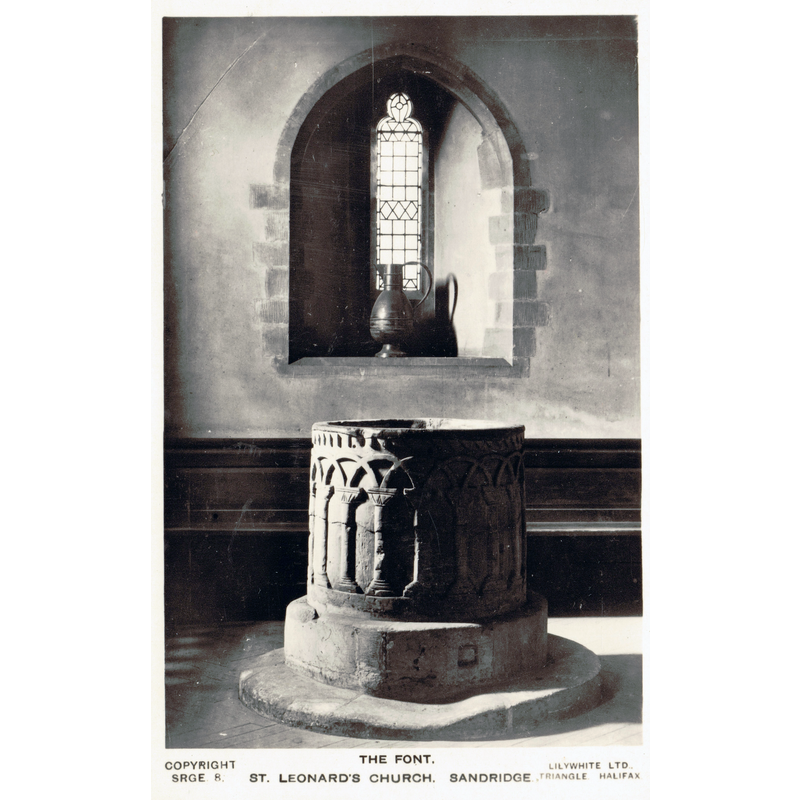
Scene Description: all around the upper basin side
Copyright Statement: Image copyright © Lilywhite SRGE.8, [n.d.]
Image Source: digital image taken 28 December 2013 of a B&W postcard by Andy Lawrence [www.flickr.com/photos/47716665@N02/11602012353] [accessed 28 September 2016]
Copyright Instructions: No known copyright restriction / Fair Dealing
design element - architectural - arcade - blind - round arches - intersecting arches
Scene Description: all around the basin sides
Copyright Statement: Image copyright © Lilywhite SRGE.8, [n.d.]
Image Source: digital image taken 28 December 2013 of a B&W postcard by Andy Lawrence [www.flickr.com/photos/47716665@N02/11602012353] [accessed 28 September 2016]
Copyright Instructions: No known copyright restriction / Fair Dealing
view of church exterior - southeast view
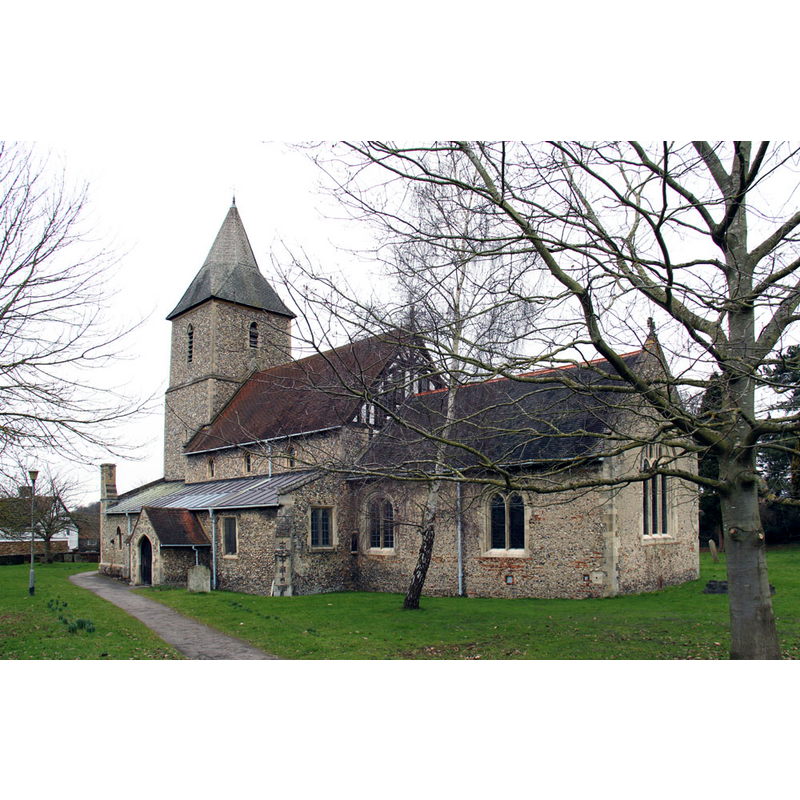
Copyright Statement: Image copyright © John Salmon, 2013
Image Source: digital photograph taken 1 March 2013 by John Salmon [www.geograph.org.uk/photo/3362980] [accessed 28 September 2016]
Copyright Instructions: CC-BY-SA-2.0
view of font in context
Copyright Statement: Image copyright © Lilywhite SRGE.8, [n.d.]
Image Source: digital image taken 28 December 2013 of a B&W postcard by Andy Lawrence [www.flickr.com/photos/47716665@N02/11602012353] [accessed 28 September 2016]
Copyright Instructions: No known copyright restriction / Fair Dealing
view of font - west side

view of font - east side
Copyright Statement: Image copyright © The Corpus of Romanesque Sculpture in Britain and Ireland, 2016
Image Source: digital image of a photograph taken by Hazel Gardiner, in the CRSBI [www.crsbi.ac.uk/site/171/] [accessed 28 September 2016]
Copyright Instructions: PERMISSION NOT AVAILABLE -- IMAGE NOT FOR PUBLIC USE
view of font
Copyright Statement: Image copyright © greentool2002, 2009
Image Source: digital photograph taken 24 May 2009 by greentool2002 [http://www.flickr.com/photos/66929259@N00/3563843237/] [accessed 5 February 2010]
Copyright Instructions: PERMISSION NOT AVAILABLE -- IMAGE NOT FOR PUBLIC USE
view of basin - detail
Scene Description: the large horizontal crack and many of the drilled holes are visible on the side here
view of basin - detail
view of basin - detail
view of basin - detail
Scene Description: details of the various patterns of decoration on the capitals are visible here; also, some of the graffiti between the columns below
view of basin - detail
Scene Description: a Latin cross, two birds (?) and other details incised on the sides are visible here
view of basin - detail
INFORMATION
Font ID: 01035SAN
Object Type: Baptismal Font1
Font Century and Period/Style: 12th century (late?), Late Norman
Cognate Fonts: The font at Screveton (Nottinghamshire) [cf. FontNotes]
Church / Chapel Name: Parish Church of St. Leonard
Font Location in Church: Inside the church, at the W end of the nave
Church Patron Saint(s): St. Leonard
Church Address: 23 Church End, Sandridge, Hertfordshire AL4 9DL
Site Location: Hertfordshire, East, England, United Kingdom
Directions to Site: Located just outside St. Albans, to the NE
Ecclesiastic Region: Diocese of St. Albans
Historical Region: Hundred of St. Albans [in Domesday] -- Hundred of Cashio
Additional Comments: damaged font: the basin is split horizontaly around its middle
Font Notes:
Click to view
There is an entry for Sandridge [variant spelling] in the Domesday survey [http://opendomesday.org/place/TL1710/sandridge/] [accessed 28 September 2016], but it mentions neither cleric nor church in it. Described and illustrated in Paley (1844) as a tub-shaped baptismal font of the Norman period ornamented with saw-tooth motif at the upper rim, and a tall blind arcade of intersecting round arches. Described in Cox & Harvey (1907) as "a good example of a Norman cylindrical font". The Victoria County History (Hertfordshire, vol. 2, 1908) notes: "The church of Sandridge belonged to the abbey of St. Albans, and was originally a chapel annexed to the church of St. Peter. […] The church is said to have been given to St. Alban's Abbey by Ecgfrid son of Offa, and there is a record of a consecration of the 'capella de Sandrage' (fn. 86) by Herbert Losinga, bishop of Norwich (1094–1119). The oldest parts of the existing building are the eastern angles of an aisleless nave, and part of a chancel arch of Roman brick. The angles have brick quoins, the walling being of flint rubble, and what is left of the arch shows it to have been of a single square order, and approximately semicircular. The building to which these features belonged consisted probably of a nave of the same length and breadth as that now existing, with a chancel shorter than at present, but perhaps of the same width. The plain character of the work and the use of Roman material suggest a pre-Conquest date, but may equally well belong to the chapel consecrated by Losinga at the beginning of the twelfth century. About 1160–70 north and south aisles were added to the nave, and towards the close of the twelfth century a west tower was built […] The font belongs to the second half of the twelfth century, and is circular, with an interlacing arcade of round arches, with scalloped capitals and moulded bases running round the bowl. Above the arches is a line of saw-tooth ornament." Noted in the Royal Commission on Historical Monuments, Hertfordshire (1911): "Font: cylindrical, carved with an arcade of small intersecting arches and shafts, late 12th-century." In Tompkins (1922) as a Norman font. Described in Tyrrell-Green (1928) as one in a group of Norman fonts the basins of which are decorated with an arcade of intersecting arches [T-G's list includes: Purley (Berks.), Llanfihangel Abercywyn (Carmarthen), Tidmarsh (Berks.), East Horndon (Essex), Sandridge (Herts), St. Ives (Hunts.), Oakham (Rutland), Great Durnford (Wilts.)]. Noted in Pevsner & Cherry (1977): "Font. Circular, Norman, with intersecting blank arches on colonnades." Described and illustrated in the CRSBI (2016) [www.crsbi.ac.uk/site/171/] [accessed 28 September 2016]: "Located at the W end of the nave in front of the tower. The font is tub-shaped and decorated with shallow blank arcading, with some variation in the design of bases and capitals. All piera have square plinths, necking below the capitals and a roll on the impost. The font has been completely broken in half (horizontally) and repaired at some point in its history. It is lead-lined and of Totternhoe stone. The supports are modern. ".
COORDINATES
UTM: 30U 685972 5740211
Latitude & Longitude (Decimal): 51.78182, -0.303894
Latitude & Longitude (DMS): 51° 46′ 54.55″ N, 0° 18′ 14.02″ W
MEDIUM AND MEASUREMENTS
Material: stone, limestone Totternhoe stone)
Font Shape: tub-shaped
Basin Interior Shape: round
Basin Exterior Shape: round
Drainage Notes: lead-lined
Diameter (inside rim): 60 cm*
Diameter (includes rim): 76 cm**
Basin Depth: 39 cm* / 41 cm**
Basin Total Height: 66 cm**
Font Height (less Plinth): 65 cm* / 66 cm**
Font Height (with Plinth): 96 cm**
Notes on Measurements: * Paley (1844: unpaged) / ** CRSBI (2016)
REFERENCES
- Victoria County History [online], University of London, 1993-. URL: https://www.british-history.ac.uk.
- Corpus of Romanesque Sculpture in Britain and Ireland, The Corpus of Romanesque Sculpture in Britain and Ireland, The Corpus of Romanesque Sculpture in Britain and Ireland. URL: http://www.crsbi.ac.uk.
- Cox, John Charles, English Church Furniture, New York: E.P. Dutton & Co., 1907, p. 202
- Great Britain. Royal Commission on Historical Monuments (England), An Inventory of the Historical Monuments in Hertfordshire, London: Printed for His Majesty's Stationary Office by J. Truscott, 1911, p. 200
- Paley, Frederick Apthorp, Illustrations of Baptismal Fonts, London, UK: John van Voorst, 1844, p. 11, 19-20 et al.
- Pevsner, Nikolaus, Hertfordshire, Harmondsworth: Penguin Books, 1977, p. 332
- Tompkins, Herbert Winckworth, Hertfordshire, London: Methuen & Co., 1922, [www.guttenberg.org/files/18252/18252-8.txt]
- Tyrrell-Green, E., Baptismal Fonts Classified and Illustrated, London: Society for Promoting Christian Knowledge: The Macmillan Co., 1928, p. 18, 77