Pyecombe / Piccumbe / Picumba / Piecombe / Pingeden / Pycombe / Pykecombe
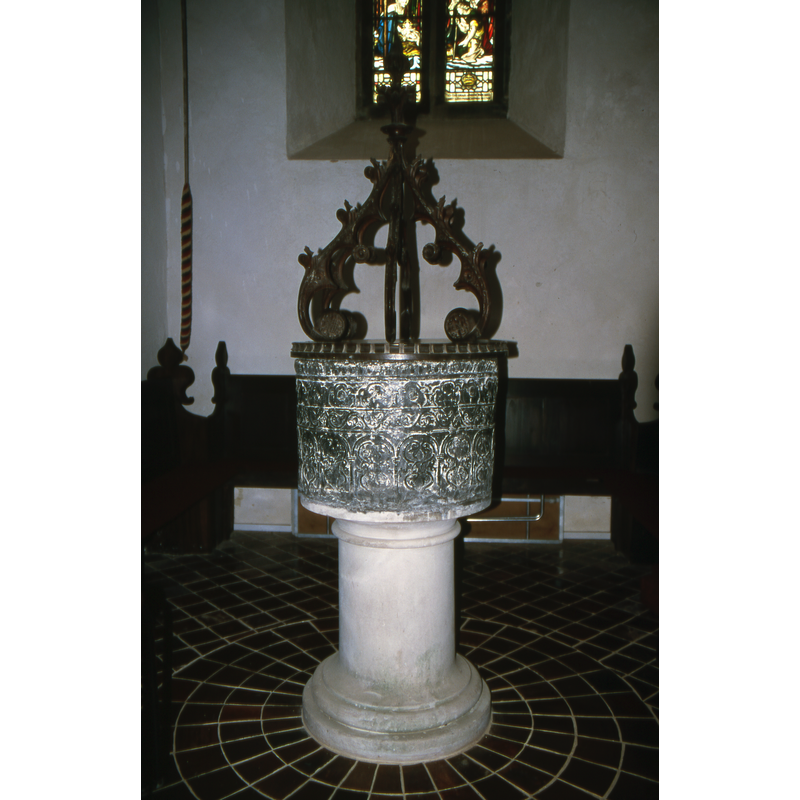
Image copyright © Baptisteria Sacra Index, 2023
CC-BY-NC-ND-4.0
Results: 7 records
view of font and cover
Copyright Statement: Image copyright © Baptisteria Sacra Index, 2023
Image Source: digital image of a photograph taken 25 July 2000 by BSI
Copyright Instructions: CC-BY-NC-ND-4.0
design element - motifs - foliage
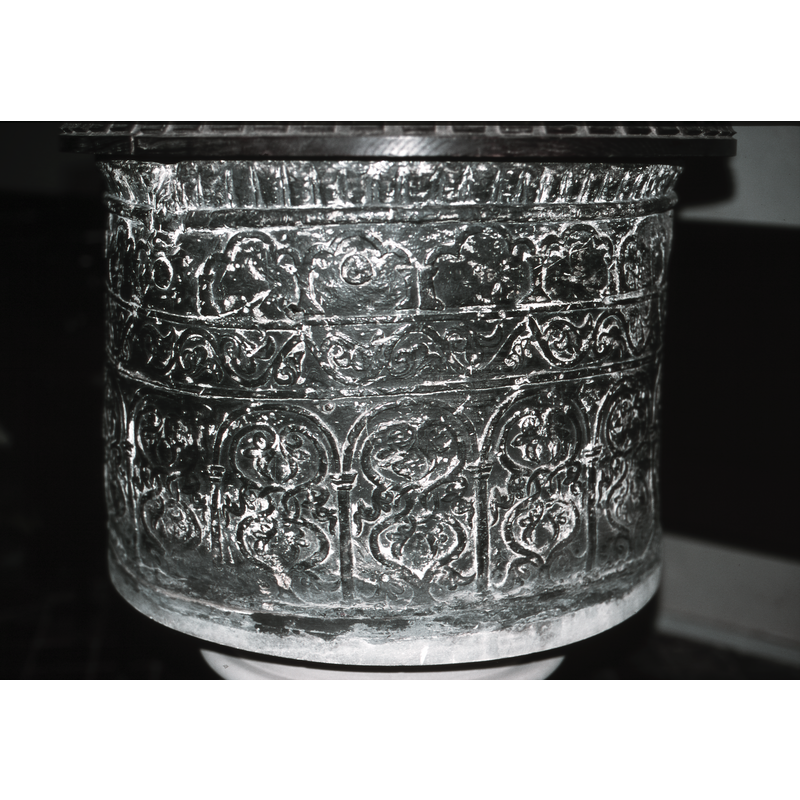
Scene Description: around the upper half of the basin side
Copyright Statement: Image copyright © Baptisteria Sacra Index, 2023
Image Source: digital image of a photograph taken 25 July 2000 by BSI
Copyright Instructions: CC-BY-NC-ND-4.0
design element - architectural - arcade - round arches - foliage
Scene Description: around the lower half of the basin sides
Copyright Statement: Image copyright © Baptisteria Sacra Index, 2023
Image Source: digital image of a photograph taken 25 July 2000 by BSI
Copyright Instructions: CC-BY-NC-ND-4.0
design element - motifs - groove - vertical
Scene Description: all around the upper rim side
Copyright Statement: Image copyright © Baptisteria Sacra Index, 2023
Image Source: digital image of a photograph taken 25 July 2000 by BSI
Copyright Instructions: CC-BY-NC-ND-4.0
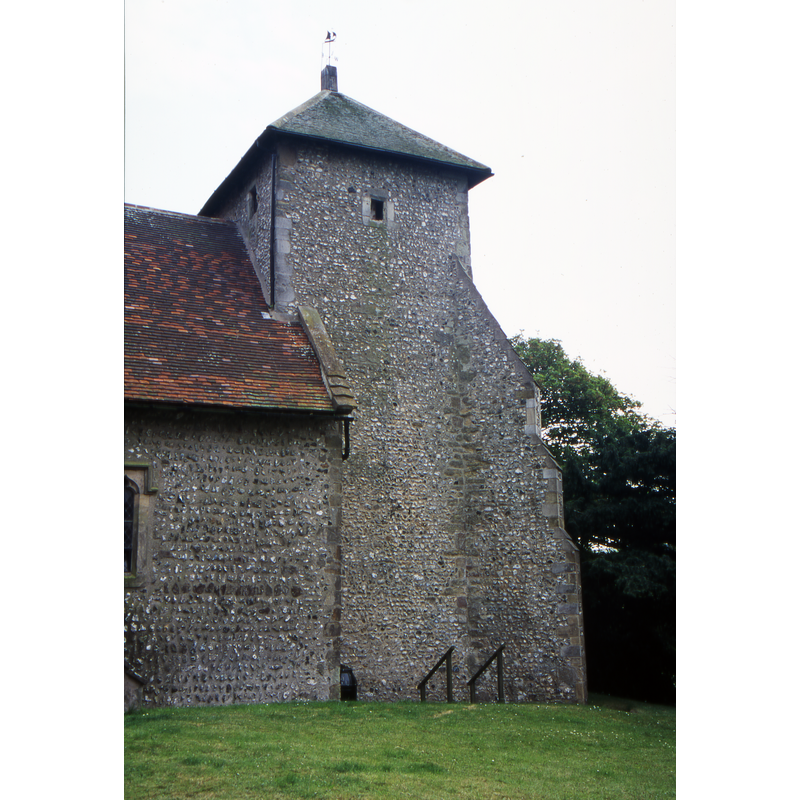
view of church exterior - tower - northwest view
Copyright Statement: Image copyright © Baptisteria Sacra Index, 2023
Image Source: digital image of a photograph taken 25 July 2000 by BSI
Copyright Instructions: CC-BY-NC-ND-4.0
view of font and cover in context
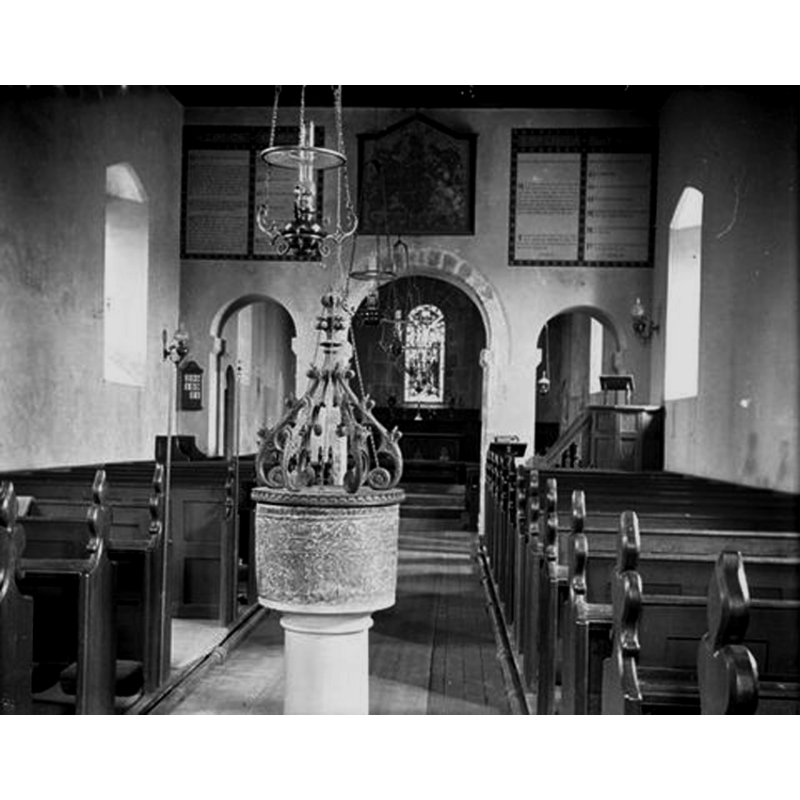
Scene Description: in 1906
Copyright Statement: Image copyright © University of Kent, 2012
Image Source: "Black and white negative of the interior of the "Church of the Transfiguration" in Pyecombe, Sussex taken on 19th June 1906" [ref. UKC-CHR-MUG-BW.F213377 -- Accession number: F213377], taken by William Burrell Muggeridge on 19 June 1906, now in the Muggeridge Collections, University of Kent at Canterbury [www.kent.ac.uk/library/specialcollections/all/r.php/23023/show.html] [accessed 14 November 2012]
Copyright Instructions: CC-BY-SA-3.0
view of font and cover
![[original source unknown ]](/static-50478a99ec6f36a15d6234548c59f63da52304e5/others/permission_not_available.jpg)
Scene Description: [original source unknown ]
Copyright Statement: Image copyright © [s.n., s.d.]
Image Source: received from Christopher Maidment [original source unknown]
Copyright Instructions: PERMISSION NOT AVAILABLE -- IMAGE NOT FOR PUBLIC USE
INFORMATION
Font ID: 00782PYE
Object Type: Baptismal Font1
Date Visited: 2000-07-25
Font Date: ca. 1200? [Zarnecki]
Font Century and Period/Style: 12th - 13th century [basin only], Medieval [composite]
Workshop/Group/Artisan: lead font
Cognate Fonts: A similar font at Edburton (West Sussex)
Church / Chapel Name: Parish Church of the Transfiguration of Our Lord [earlier advocation unknown]
Font Location in Church: Inside the church, in the W end, central nave
Church Patron Saint(s): The Transfiguration of Christ
Church Address: Church Hill, Pyecombe, Brighton BN45 7FR, United Kingdom
Site Location: West Sussex, South East, England, United Kingdom
Directions to Site: Located off (E) the A23, just N of Brighton
Ecclesiastic Region: Diocese of Chichester
Historical Region: Hundred pf Poynings -- Rape of Lewes -- Sussex
Additional Comments: e-mailed source of "old picture" (March 2004) -- cf. BSI file for p-o of emails -- update image area if/when source identified (never confirmed)
Font Notes:
Click to view
No entry found for Pyecombe in the Domesday survey. Baptismal font noted in Hussey (1852) without mentioning the material it is made of: "The font is round, upon a modern stem, with carving in very slight relief. It is curious, and may be of Norm[an] date, or even earlier." Listed in Cox (1875). Studied in Andre (1882), who describes it, together with the font at Edburton, "of late Norman date", although he notes that "in the handbook of English Ecclesiology (p. 130)" it is assigned a post-Reformation date [NB: Andre lists two 'Piecombe' lead fonts: one in Sussex and another such in Somersetshire -- it must have been a printing error]. Noted in Lethaby (1893) as Early English. The University of Kent, Library Services, Special Collections [www.kent.ac.uk/library/specialcollections/all/r.php/23023/show.html] [accessed 14 November 2012] has a "Black and white negative of the interior of the "Church of the Transfiguration" in Pyecombe, Sussex taken on 19th June 1906" [ref. UKC-CHR-MUG-BW.F213377 -- Accession number: F213377], taken by William Burrell Muggeridge on 19 June 1906, now in the Muggeridge Collections, University of Kent at Canterbury. The font is shown in the centre of the aisle, topped by its cover and mounted on a round pedestal made of stone. Noted in Cox & Harvey (1907) as a lead baptismal font with ornamentation of "the close of the Norman style", like the one at Edburton [cf. Index entry]. Described and illustrated in Bond (1908) as a cylindrical lead font: "the method employed in making these fonts was probably to cast them flat, afterwards bend them into the required circular form, and then solder them up. The edges which have been so joined are clearly seen at Edburton and Pyecombe, Sussex". Harrison (1920) writes: "The most interesting detail in this little church is the fine old leaden font (c. 1 1 70), there being only two others in the county, at Edburton and Parham". The Victoria County History (Sussex, vol. 7, 1940) notes: "The church of 'Pingeden' was granted to the Priory of St. Pancras at Lewes by Adam de Poynings and his wife Beatrice, and this grant was confirmed by successive Earls Warenne in about 1095 and 1140. [...] The whole [present] building is covered with rough-cast, and the stone-work of the windows is all modern. It is thus difficult to date the portions of the church with certainty, but from internal evidence it would appear that nave and chancel are 12th century and the western tower 13th century. [...] The font has a lead bowl, of late-12th-century date, with elaborate patterning of scroll-work. The base is modern." Illustrated in Needham (1944). Described and illustrated in Zarnecki (1957) as an example, together with the font at Ashover, of "the decline in the quality of lead fonts in the late twelfth century". Described and illustrated in Whiteman (1994). On-site notes: this cylindrical lead font has an edged upper rim; the upper register on the basin side, below the rim, has a pattern of vegetal ornamentation; the lower half of the basin side is covered in an arcade of round arches with vegetal ornamentation in them. There is a modern stone cylindrical base and a wooden Jacobean-style font cover.
COORDINATES
UTM: 30U 699388 5642349
Latitude & Longitude (Decimal): 50.898333, -0.164444
Latitude & Longitude (DMS): 50° 53′ 54″ N, 0° 9′ 52″ W
MEDIUM AND MEASUREMENTS
Material: metal (basin), lead
Font Shape: cylindrical, mounted
Basin Interior Shape: round
Basin Exterior Shape: round
Drainage System: no drainage system
Rim Thickness: 2 - 2.5 cm*
Diameter (inside rim): 53-56 cm* / 55 cm*
Diameter (includes rim): 58-60 cm* / 58.75 cm***
Basin Depth: 35 cm* / 34.37 cm**
Basin Total Height: 40 cm* / 37.5 cm**
Notes on Measurements: * BSI on-site / ** Andre (1882)
LID INFORMATION
Date: later period - Jacobean style (looks 19th cent.)
Material: wood
Apparatus: no
Notes: of the "open" Jacobean style
REFERENCES
- Victoria County History [online], University of London, 1993-. URL: https://www.british-history.ac.uk.
- André, J. Lewis, "Leaden Fonts in Sussex", 32, Surrey Archaeological Collections, relating to the history and antiquities of the county, 1882
- Bond, Francis, Fonts and Font Covers, London: Waterstone, 1985 c1908, p. 79, 87 and ill. on p. 85
- Cox, John Charles, 1875-1877
- Cox, John Charles, English Church Furniture, New York: E.P. Dutton & Co., 1907, p. 164, 222
- Harrison, Frederick, Notes on Sussex churches, Hove: Combridges, 1920, p. 106, 166
- Hussey, Arthur, Notes on the churches in the counties of Kent, Sussex, and Surrey mentioned in Domesday Book and those of more recent date [...], London: John Russell Smith, 1852, p. 268
- Lethaby, William Richard, Leadwork, old and ornamental, and for the most part English [...] with illustrations, London; New York: Macmillan & co., 1893, p. 51, 57, 63
- Neeham, Albert, How to study an old church, London: Batsford, 1944, pl. X
- Whiteman, Ken, Ancient Churches of Suffolk, Seaford, East Sussex: S.B. Publications, 1998, p. 127
- Zarnecki, George, English Romanesque Lead Sculpture: Lead Fonts of the Twelfth Century, London: A. Tiranti, 1957, p. 20, 21, 42 and fig. 77