Blythburgh No. 1 / Bladebure / Blythborough / Bliburgh
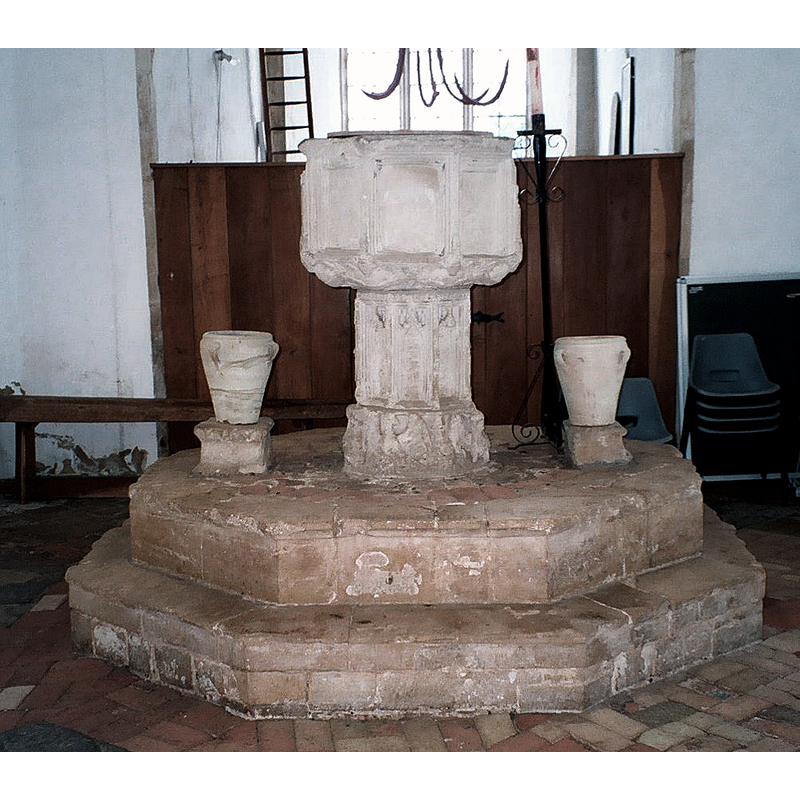
Image copyright © Simon Knott, 2005
Standing permission
Results: 7 records
view of font and cover
Scene Description: flat plain wooden cover
Copyright Statement: Image copyright © Simon Knott, 2005
Image Source: digital photograph in Simon Knott, 2005 [www.sufflokchurches.co.uk/Blythburgh.htm]
Copyright Instructions: Standing permission
angel - cherub - bust - holding scroll - 8
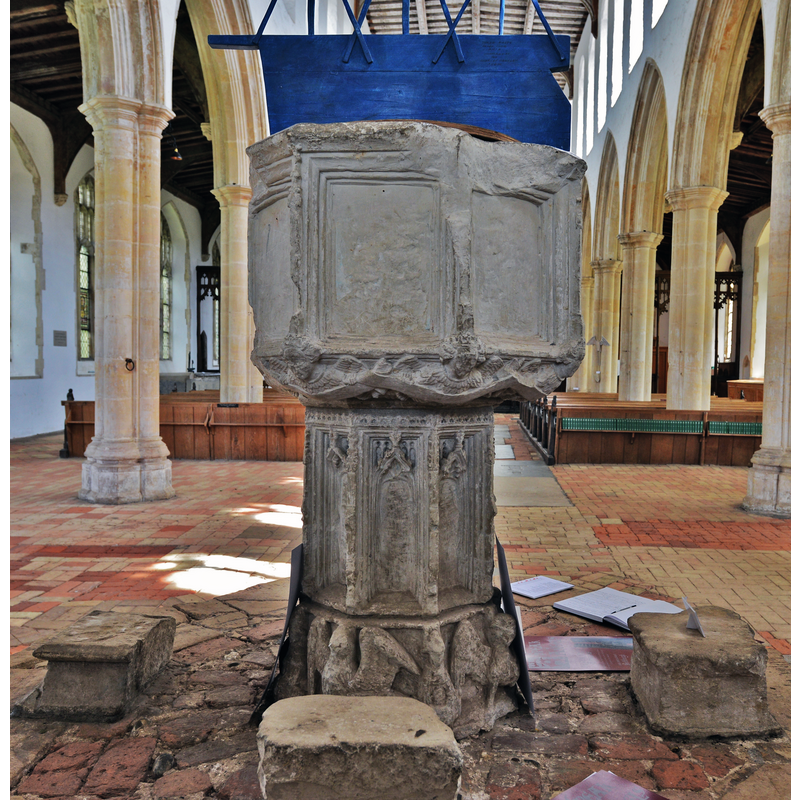
Scene Description: one on each angle of the chamfer
Copyright Statement: Image copyright © Michael Garlick, 2015
Image Source: digital photograph 26 May 2015 by Michael Garlick [https://www.geograph.org.uk/photo/4495912] [accessed 12 April 2023]
Copyright Instructions: CC-BY-SA-2.5
sacraments
Scene Description: Although totally obliterated now, it is generally accepted that the Seven-Sacraments were once inscribed in the basin panels [cf. FontNotes]
Copyright Statement: Image copyright © Michael Garlick, 2015
Image Source: digital photograph 26 May 2015 by Michael Garlick [https://www.geograph.org.uk/photo/4495912] [accessed 12 April 2023]
Copyright Instructions: CC-BY-SA-2.5
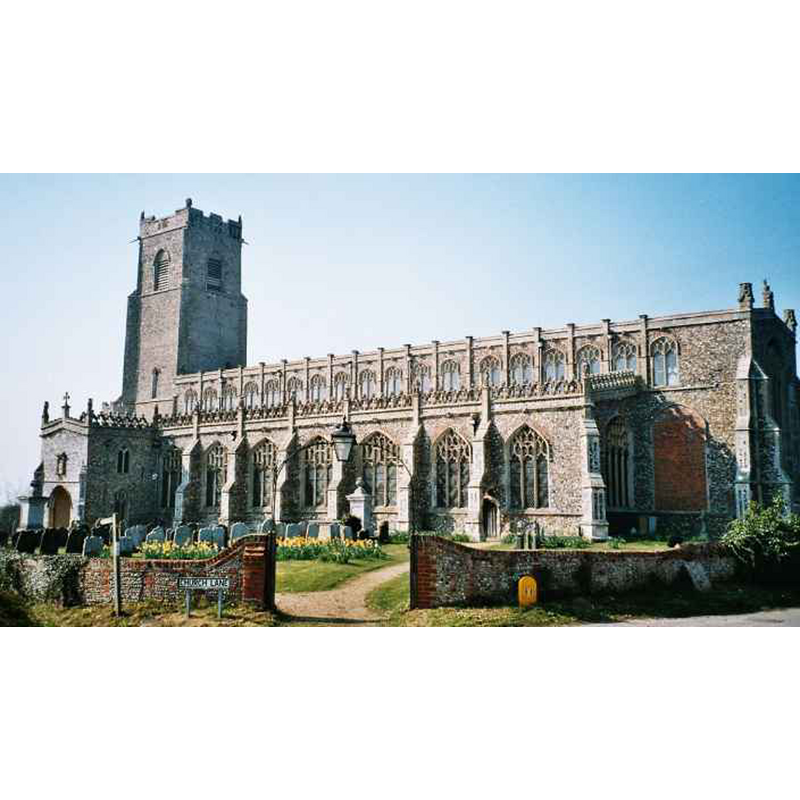
view of church exterior - southeast view
Copyright Statement: Image copyright © Simon Knott, 2005
Image Source: digital photograph in Simon Knott, 2005 [www.sufflokchurches.co.uk/Blythburgh.htm]
Copyright Instructions: Standing permission
view of font and cover in context
![Source caption: "The font in Holy Trinity Church, Blythburgh [...] The font dates from 1449 and has an inscription commemorating John Mason and his wife."](/static-50478a99ec6f36a15d6234548c59f63da52304e5/compressed/1230412002_compressed.png)
Scene Description: Source caption: "The font in Holy Trinity Church, Blythburgh [...] The font dates from 1449 and has an inscription commemorating John Mason and his wife."
Copyright Statement: Image copyright © Marathon, 2018
Image Source: edited detail of a digital photograph 20 October 2018 by Marathon [https://www.geograph.org.uk/photo/5955643] [accessed 12 April 2023]
Copyright Instructions: CC-BY-SA-2.5
animal - bird - eagle
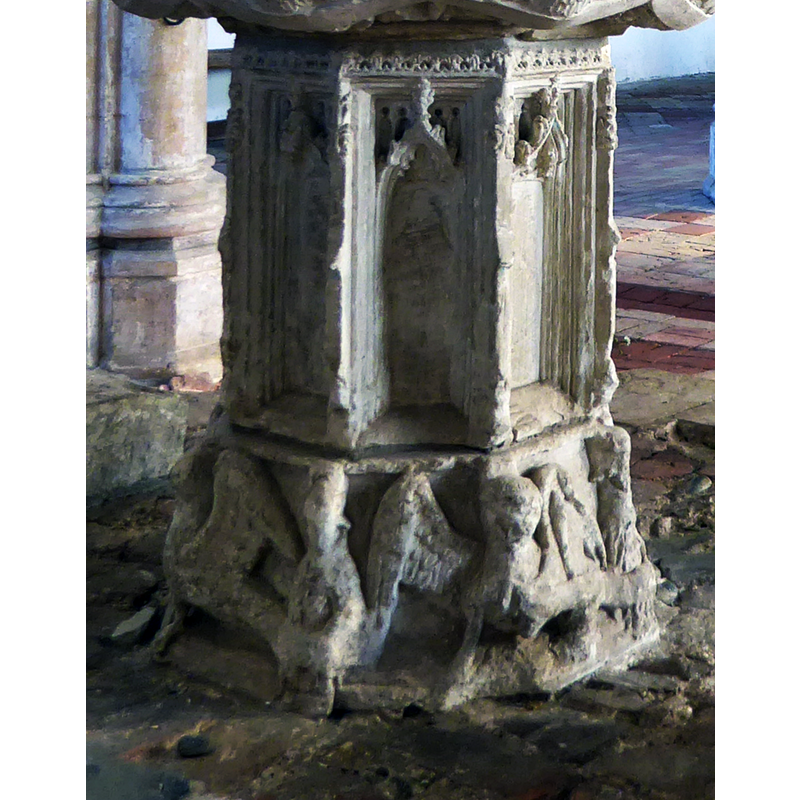
Scene Description: though very eroded, at least one, wings stretched, can be discerned on the lower end of the stem
Copyright Statement: Image copyright © Marathon, 2018
Image Source: edited detail of a digital photograph 20 October 2018 by Marathon [https://www.geograph.org.uk/photo/5955643] [accessed 12 April 2023]
Copyright Instructions: CC-BY-SA-2.5
design element - architectural - arcade - crocketed amd pinnacled
Scene Description: now damaged and missing the contents [statues?] in the original arches
Copyright Statement: Image copyright © Marathon, 2018
Image Source: edited detail of a digital photograph 20 October 2018 by Marathon [https://www.geograph.org.uk/photo/5955643] [accessed 12 April 2023]
Copyright Instructions: CC-BY-SA-2.5
INFORMATION
Font ID: 00736BLY
Object Type: Baptismal Font1
Font Date: 1449
Font Century and Period/Style: 15th century (mid), Perpendicular
Workshop/Group/Artisan: Seven-Sacraments font
Cognate Fonts: perhaps originally the font at Westhall
Church / Chapel Name: Parish Church of the Holy Trinity
Font Location in Church: Inside the church, in the W end of the nave
Church Patron Saint(s): The Holy Trinity
Church Notes: A great church described recently with passion and much interesting detail by Simon Knott [cf. www.suffolkchurches.co.uk/Blythburg.htm]
Church Address: Church Ln, Blythburgh, Halesworth IP19 9LP, United Kingdom -- Tel.: +44 1502 725424
Site Location: Suffolk, East Anglia, England, United Kingdom
Directions to Site: Located off (N) the A12 [aka London Rd.), on the S bank of the Nlyth river, 5 km W of Southwold and the coast
Ecclesiastic Region: Diocese of St Edmundsbury and Ipswich
Historical Region: Hundred of Blything [in Domesday]
Additional Comments: damaged font: all the carving of this, the oldest of the Seven-sacrament fonts, was obliterated, probably by Commonwealth iconoclast Dowsing. The gunshot ridden angels of this church, however, appears to have been the work of the locals during a plague of jackdaws in the church [cf. Simon Knott's WEB site www.suffolkchurches.co.uk for more info]
Font Notes:
Click to view
GET MORE FONT PICS ESPECIALLY THE LARGE ONE HERE https://commons.wikimedia.org/wiki/Category:Holy_Trinity_Church,_Blythburgh,_font
There is an entry for Blythburg [variant spelling] in the Domesday survey [https://opendomesday.org/place/TM4575/blythburgh/] [accessed 12 April 2023]; it reports "3 churches. 2.0 church lands" in it. The Mirror of Literature, Amusement and Instruction (no. 969, vol. xxxiv, 21 September 1839: 186) notes that this font "still shows some traces of colouring and gilding". Noted in Paley (1844) as a baptismal font that has retained vestiges of old paint. Suckling (1846-1848) writes: "The octagonal cost was raised at the cost of John Masin and Katherine his wife, who probably also vaulted the porch with stone, as its boss, or central ornament, bore the figure of Masin surrounded by a label thus inscribed. 'Orate pro aiabs Johis Masin et Katerine uxoris eius'" [abbreviation signs not reproduced here]. Noted in Parker (1885), after Rickman, as a fine octagonal and "of good composition". In Cautley (1949). Described and fully studied in Nichols (1994), who describes "relief sculpture obliterated, though shadows remain for penance and extreme unction"; Nichols cites Janet Becker as being able to discern the Eucharist panel "when the light is good" [quoted by Nichols after Becker's Blythburgh, 1935]. Nichols also relates the controversy regarding the inscription which supposedly named the donors of the font, Johne Masin and Katerine, his wife. She cites Becker's reading of the inscription [cf. Inscription] and mentions that both Cautley and Pevsner accepted the date as correct. Cox (1907) describes it as a font raised on three high octagonal stone steps with half-erased inscription probably stating that John and his wife Katherine donated the font. Hutton (1957) writes that the font was "damaged by both lightning and the Puritans." Tyrrell-Green (1928) states that "writers are mistaken [...] in including the font at Blythburg in the list of fonts depicting the Seven Sacraments" [cf. Nichols, supra]. Simon Knott [www.sufflokchurches.co.uk/Blythburgh.htm] notes: "this was one of the rare, beautiful seven sacrament fonts, similar in style to the one at Westhall; but, like those at neighbouring Wenhaston and Southwold, it has been completely stripped of imagery. Almost certainly, this was done in 1540, but there is a story that the font at Wenhaston was chiselled clean as part of the 19th century restoration."
There is an entry for Blythburg [variant spelling] in the Domesday survey [https://opendomesday.org/place/TM4575/blythburgh/] [accessed 12 April 2023]; it reports "3 churches. 2.0 church lands" in it. The Mirror of Literature, Amusement and Instruction (no. 969, vol. xxxiv, 21 September 1839: 186) notes that this font "still shows some traces of colouring and gilding". Noted in Paley (1844) as a baptismal font that has retained vestiges of old paint. Suckling (1846-1848) writes: "The octagonal cost was raised at the cost of John Masin and Katherine his wife, who probably also vaulted the porch with stone, as its boss, or central ornament, bore the figure of Masin surrounded by a label thus inscribed. 'Orate pro aiabs Johis Masin et Katerine uxoris eius'" [abbreviation signs not reproduced here]. Noted in Parker (1885), after Rickman, as a fine octagonal and "of good composition". In Cautley (1949). Described and fully studied in Nichols (1994), who describes "relief sculpture obliterated, though shadows remain for penance and extreme unction"; Nichols cites Janet Becker as being able to discern the Eucharist panel "when the light is good" [quoted by Nichols after Becker's Blythburgh, 1935]. Nichols also relates the controversy regarding the inscription which supposedly named the donors of the font, Johne Masin and Katerine, his wife. She cites Becker's reading of the inscription [cf. Inscription] and mentions that both Cautley and Pevsner accepted the date as correct. Cox (1907) describes it as a font raised on three high octagonal stone steps with half-erased inscription probably stating that John and his wife Katherine donated the font. Hutton (1957) writes that the font was "damaged by both lightning and the Puritans." Tyrrell-Green (1928) states that "writers are mistaken [...] in including the font at Blythburg in the list of fonts depicting the Seven Sacraments" [cf. Nichols, supra]. Simon Knott [www.sufflokchurches.co.uk/Blythburgh.htm] notes: "this was one of the rare, beautiful seven sacrament fonts, similar in style to the one at Westhall; but, like those at neighbouring Wenhaston and Southwold, it has been completely stripped of imagery. Almost certainly, this was done in 1540, but there is a story that the font at Wenhaston was chiselled clean as part of the 19th century restoration."
Credit and Acknowledgements: We are grateful to Simon Knott, of www.sufflokchurches.co.uk/Blythburgh.htm, for the information on and photographs of this font and church]
COORDINATES
UTM: 31U 404224 5797690
Latitude & Longitude (Decimal): 52.321169, 1.594761
Latitude & Longitude (DMS): 52° 19′ 16.21″ N, 1° 35′ 41.14″ E
MEDIUM AND MEASUREMENTS
Material: stone, type unknown
Font Shape: octagonal, mounted
Basin Interior Shape: round
Basin Exterior Shape: octagonal
INSCRIPTION
Inscription Language: Latin
Inscription Location: Steps under the font (plinths); but Suckling says on the bodd of the porch vault [cf. FontNotes]
Inscription Text: Suckling: "ORATE PRO A[n]I[m]AB[u]S JOH[ann]IS MASIN ET KATERINE UXORIS EIUS"
Cox & Harvey: "Orate pro aiabs Johne Masin et Katerine uxoris ejus…" [the rest illegible]
Becker (in Nichols): "ORATE PRO ANIMABUS JOHANNIS [Masin et Katerine] UXORIS EIUSQUI ISTUD FONTEM FECERUNT FIERI [...] NOBIS [...] QUOD [...] MCCCCXLIX"
Inscription Notes: [cf. FontNotes]
Inscription Source: Suckling (1846-1848: vol. 2: 153); Cox (1907: 178); Becker (1935) as quoted in Nichols (1994: 330)
LID INFORMATION
Date: modern
Material: wood
Apparatus: no
Notes: plain flat cover; modern
REFERENCES
- Anderson, M.D., The Imagery of British churches, London: John Murray, 1955, p. 200 fn3
- Bond, Francis, Fonts and Font Covers, London: Waterstone, 1985 c1908, p. 259
- Cautley, Henry Munro, Norfolk Churches, Ipswich: Norman Adlard & Co., 1949, p. 23
- Cautley, Henry Munro, Suffolk churches and their treasures, Woodbridge: The Boydell Press, 1982, p. 67, 68 and pl. 51
- Cox, John Charles, English Church Furniture, New York: E.P. Dutton & Co., 1907, p. 168, 178, 219, 220
- Hutton, Graham, English Parish Churches, London: Thames & Hudson, 1976, p. 52
- Knott, Simon, The Suffolk Churches Site, Simon Knott, 1999-. [standing permission to reproduce images received from Simon [February 2005]. URL: www.suffolkchurches.co.uk.
- Nichols, Ann Eljenholm, Seeable Signs: The Iconography of the Seven Sacraments 1350-1544, Woodbridge: The Boydell Press, 1994, p. 1, 3, 4, 5, 6, 71, 72, 76, 106, 107, 125, 330 and Pl. I
- Paley, Frederick Apthorp, Illustrations of Baptismal Fonts, London, UK: John van Voorst, 1844, p. 23
- Parker, John Henry, The Ecclesiastical and architectural topography of England [...] Suffolk, 1855, [unpaged]
- Suckling, Alfred, The History and Antiquities of the County of Suffolk, with genealogical and architectural notices of its several towns and villages, London: John Weale [...], 1846-1848, vol. 2: 152
- Tyrrell-Green, E., Baptismal Fonts Classified and Illustrated, London: Society for Promoting Christian Knowledge: The Macmillan Co., 1928, p. vi, 111