Quintanilla del Coco No. 2 / Coco et Quintaniella
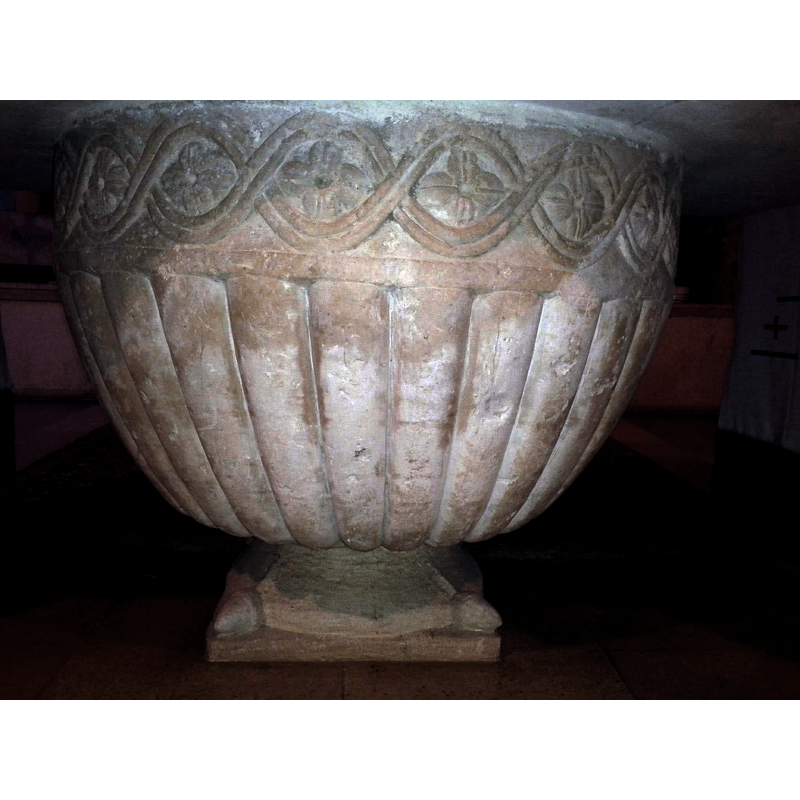
Image copyright © Pedro Lozano Huerta, 2020
Image and permission received from the author via Mikel Unanue (e-mail of 21 July 2020)
Results: 9 records
view of font
Scene Description: now serving as base of the altar stone top is a medieval baptismal font unearthed in the churchyard
Copyright Statement: Image copyright © Pedro Lozano Huerta, 2020
Image Source: digital photograph 14 July 2020 by Pedro Lozano Huerta
Copyright Instructions: Image and permission received from the author via Mikel Unanue (e-mail of 21 July 2020)
design element - motifs - braid - 2-strand - continuous circles - with insert
Scene Description: all around the side of the basin
Copyright Statement: Image copyright © Pedro Lozano Huerta, 2020
Image Source: digital photograph 14 July 2020 by Pedro Lozano Huerta
Copyright Instructions: Image and permission received from the author via Mikel Unanue (e-mail of 21 July 2020)
design element - motifs - floral - quatrefoiled
Scene Description: inscribed in the continuous circles formed by the braid
Copyright Statement: Image copyright © Pedro Lozano Huerta, 2020
Image Source: digital photograph 14 July 2020 by Pedro Lozano Huerta
Copyright Instructions: Image and permission received from the author via Mikel Unanue (e-mail of 21 July 2020)
design element - patterns - ribbed
Copyright Statement: Image copyright © Pedro Lozano Huerta, 2020
Image Source: digital photograph 14 July 2020 by Pedro Lozano Huerta
Copyright Instructions: Image and permission received from the author via Mikel Unanue (e-mail of 21 July 2020)
design element - motifs - flat moulding
Scene Description: all around dividing the basin side, marking the division with the underbowl
Copyright Statement: Image copyright © Pedro Lozano Huerta, 2020
Image Source: digital photograph 14 July 2020 by Pedro Lozano Huerta
Copyright Instructions: Image and permission received from the author via Mikel Unanue (e-mail of 21 July 2020)
view of font in context
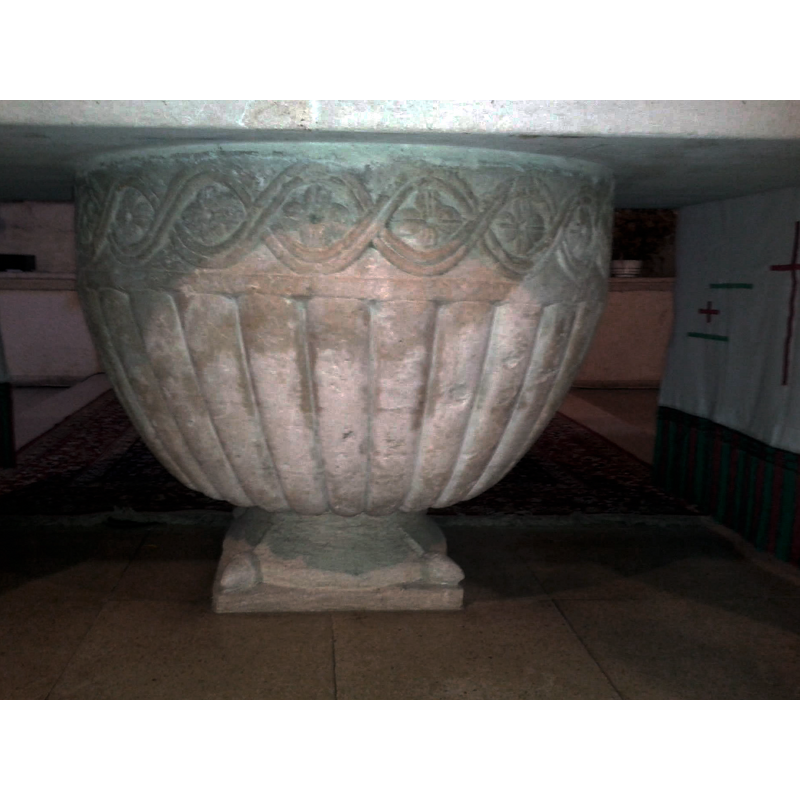
Scene Description: now serving as base of the altar stone top is a medieval baptismal font unearthed in the churchyard
Copyright Statement: Image copyright © Pedro Lozano Huerta, 2020
Image Source: digital photograph 14 July 2020 by Pedro Lozano Huerta
Copyright Instructions: Image and permission received from the author via Mikel Unanue (e-mail of 21 July 2020)
view of font in context
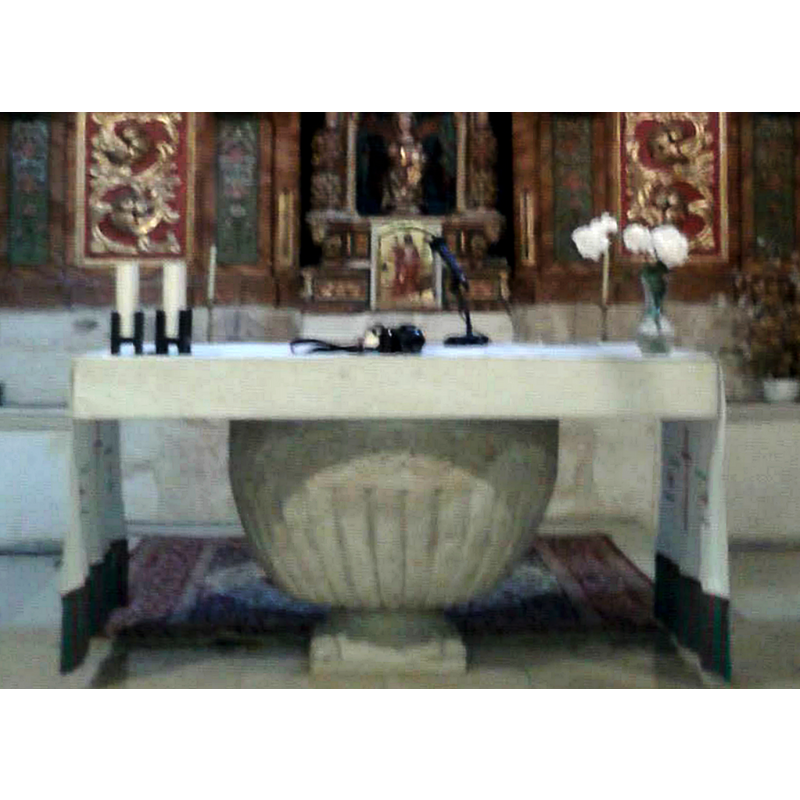
Scene Description: now serving as base of the altar stone top is a medieval baptismal font unearthed in the churchyard
Copyright Statement: Image copyright © Pedro Lozano Huerta, 2020
Image Source: digital photograph 14 July 2020 by Pedro Lozano Huerta
Copyright Instructions: Image and permission received from the author via Mikel Unanue (e-mail of 21 July 2020)
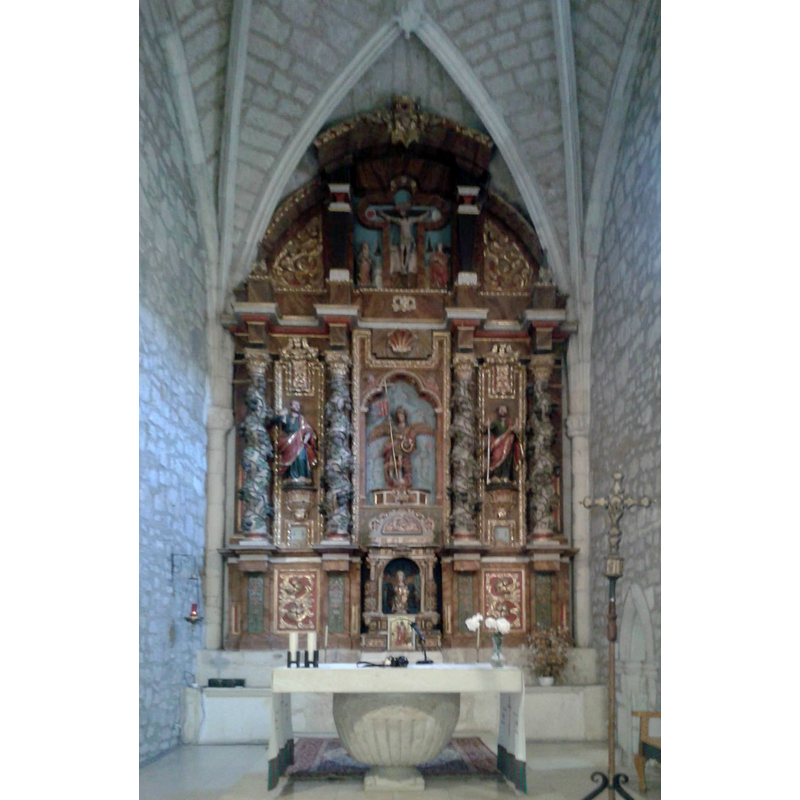
view of church interior - altar and retable
Copyright Statement: Image copyright © Pedro Lozano Huerta, 2020
Image Source: digital photograph 14 July 2020 by Pedro Lozano Huerta
Copyright Instructions: Image and permission received from the author via Mikel Unanue (e-mail of 21 July 2020)
design element - motifs - unidentified - 4
Scene Description: round and pointy; the one on the left here somewhat resembles an acorn
Copyright Statement: Image copyright © Pedro Lozano Huerta, 2020
Image Source: digital photograph 14 July 2020 by Pedro Lozano Huerta
Copyright Instructions: Image and permission received from the author via Mikel Unanue (e-mail of 21 July 2020)
INFORMATION
Font ID: 00660QUI
Object Type: Baptismal Font1
Font Date: ca. 1200?
Font Century and Period/Style: 12th - 13th century, Late Romanesque
Church / Chapel Name: Iglesia Parroquial de San Miguel Arcángel
Font Location in Church: Inside the church; the basin now serves as foot or base for the altar [unearthed in the cemetery in the 1960s]
Church Patron Saint(s): St. Michael
Church Address: Calle Plaza, 2, 09348 Quintanilla del Coco, Burgos, Spain
Site Location: Burgos, Castilla y León, Spain, Europe
Directions to Site: Located off (N) the BU-900, 8 km W of Silos, 26 km ESE of Lerma, 50-55 km SSE of Burgos capital
Ecclesiastic Region: Diócesis de Burgos
Historical Region: Comarca de Arlanza
Additional Comments: buried font - restored font / re-cycled font (serving now as base for the altar stone) / moved font (originally from an earlier church)
Font Notes:
Click to view
According to Bilbao (1996), this font, the basin of which serves now as base to the altar, was disinterred from the cemetery about thirty years since. Noted and illustrated in Valle Barreda (2009), with date ca. 1200. The entry for this village in the Enciclopedia del románico [https://www.romanicodigital.com/sites/default/files/pdfs/files/burgos_QUINTANILLA_DEL_COCO.pdf] [accessed 30 March 2023] notes that there were two separate hamlets here in the late-12th century, but the two had been merged into one by 1433: "El día 10 de junio del año 1187, Alfonso VIII da a Silos la villa de Congosto, situada inter Castrum Ceniza et Coco et Quintaniella, lo que indica que había dos núcleos de población independientes. En 1433, en un intercambio de pueblos realizado entre las abadías de Silos y Arlanza, aparece citado con su nombre actual lo que indica que Coco ya debía estar despoblado". The Enciclopedia del románico (ibid.) further notes that the present Gothic church replaced and was built with materials from an earlier in Coco dedicated to San Andres, as well as those from the earlier church in Quintanilla del Coco itself. This same source (ibid.) notes the two medieval fonts in this church now, the original one still being used as baptismal font, and a second one that serves now as base to the altar stone: "En el templo parroquial actual se conservan dos pilas bautismales románicas: una del propio templo y otra desenterrada hace algunos años en el cementerio. La primera (99 cm de diámetro × 86 cm de altura) decora su copa con una gruesa cenefa de zarcillos con frutos y hojas, además de los habituales gallones. La peana presenta garras en lo ángulos y dos tallos entrelazados que encierran cuatripétalas. La otra, que sirve actualmente de soporte a la mesa de altar, es gallonada y se remata con un entrela-zo que alberga cuatripétalas con el centro perforado a trépano." The entry for this village in Emiliano Nebreda Perdiguero [www.archiburgos.es/wp-content/uploads/amo-a-mi-pueblo.pdf] [accessed 30 April 2023] notes two Romanesque fonts in the present church as well: "La pila es románica con gallones y cenefa decorada […] Tiene otra pila románica también con gallones y cenefa decorada que sirve de pie de altar." This font, now used as base to the altar stone, consists of a large toughly hemispherical basin decorated with a two-strand braid of continuous crcles with quatrefoiled floral motifs inside, followed down by a flat moulding and a pattern of braod ribs on the underbowl; the tiny and squat lower base is round-to-square in shape, with unidentified motifs at the angles, one of which resembles an acorn. No cover present.
Credit and Acknowledgements: We are grateful to Pedro Lozano Huerta for his photographs of this church and font
COORDINATES
UTM: 30T 457092 4647518
Latitude & Longitude (Decimal): 41.978489, -3.517928
Latitude & Longitude (DMS): 41° 58′ 42.56″ N, 3° 31′ 4.54″ W
MEDIUM AND MEASUREMENTS
Material: stone, limestone?
Number of Pieces: two
Font Shape: hemispheric, mounted
Basin Interior Shape: round
Basin Exterior Shape: round
Diameter (includes rim): 98 cm [calculated]*
Basin Total Height: 54.5 cm*
Notes on Measurements: * ["Perímetro: 307,5; Altura: 54,5"] Bilbao (1996: 289)
REFERENCES
- Bilbao López, Garbiñe, Iconografía de las pilas bautismales del románico castellano: Burgos y Palencia, Burgos: Editorial La Olmeda, S.L., 1996, p. 68, 103-104, 289
- Valle Barreda, César del, Todo el románico de Burgos, Aguilar de Campoo: Fundación Santa María la Real, 2009, p. 514