Palgrave / Palegrava
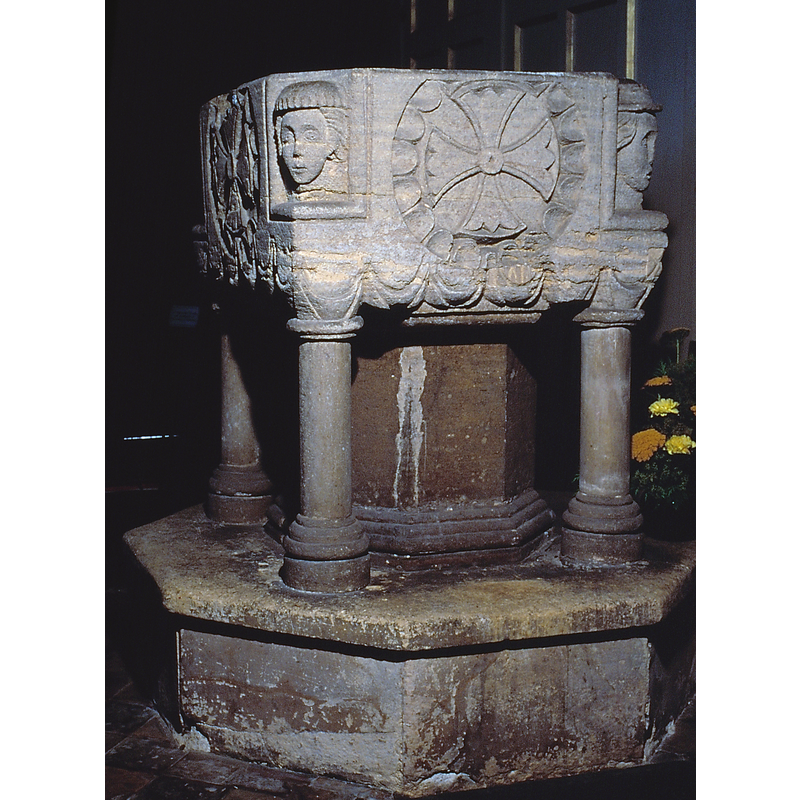
Image copyright © Baptisteria Sacra Index, 2023
CC-BY-NC-ND-4.0
Results: 12 records
view of font
Copyright Statement: Image copyright © Baptisteria Sacra Index, 2023
Image Source: digital image of a photograph taken 23 July 1998 by BSI
Copyright Instructions: CC-BY-NC-ND-4.0
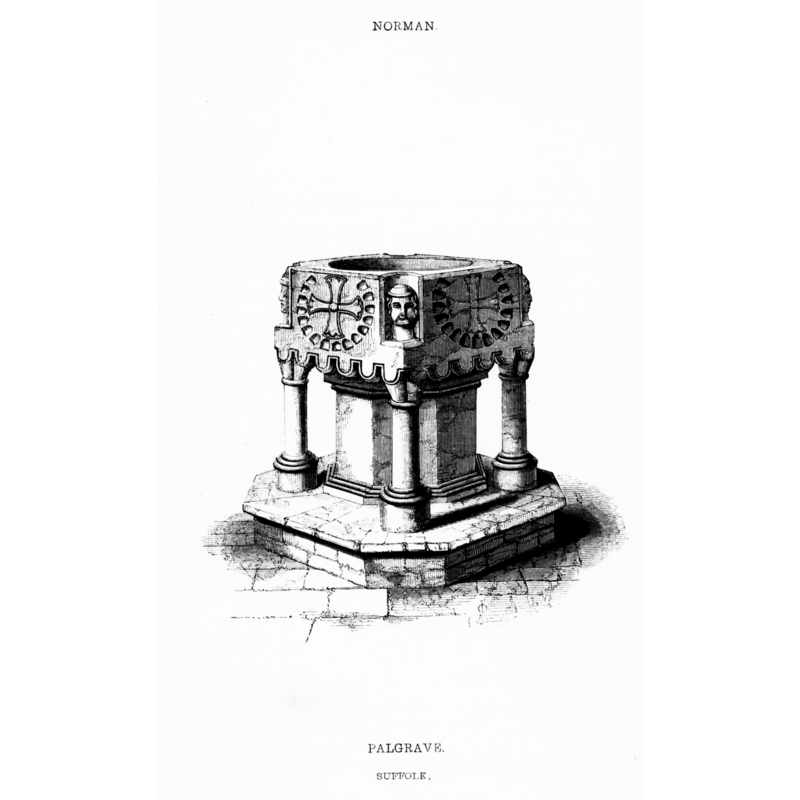
view of font
Copyright Statement: Image copyright © [in the public domain]
Image Source: digital image of an engraving in Paley (1844: unpaged)
Copyright Instructions: PD
design element - motifs - scallop
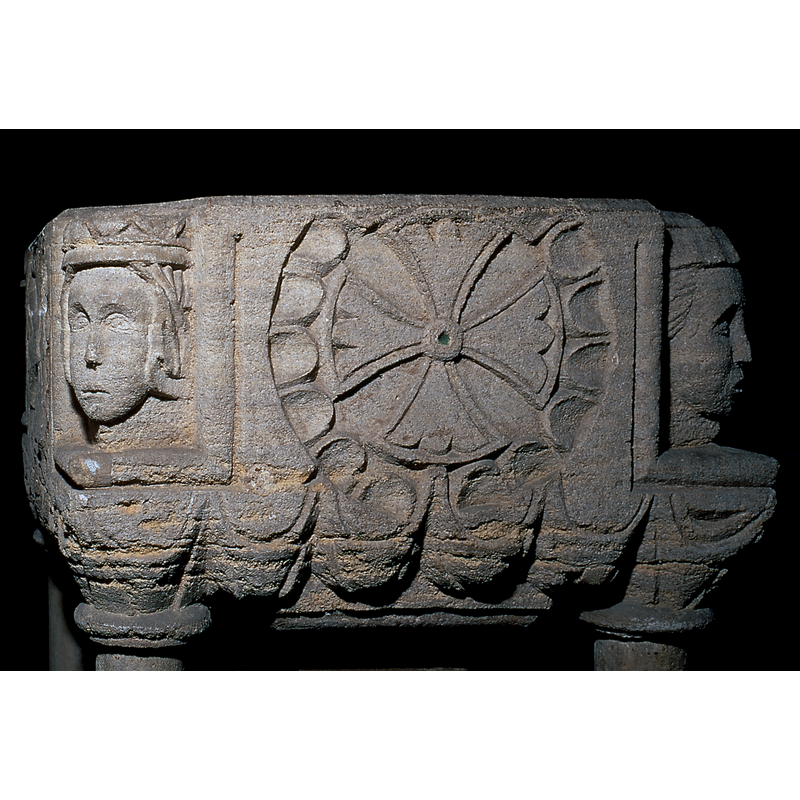
Scene Description: in the circles that contain the crosses
Copyright Statement: Image copyright © Baptisteria Sacra Index, 2023
Image Source: digital image of a photograph taken 23 July 1998 by BSI
Copyright Instructions: CC-BY-NC-ND-4.0
human figure - male - head - wearing crown
Scene Description: on the northwest angle of the basin
Copyright Statement: Image copyright © Baptisteria Sacra Index, 2023
Image Source: digital image of a photograph taken 23 July 1998 by BSI
Copyright Instructions: CC-BY-NC-ND-4.0
symbol - cross - Greek - treflée or fleuronnée - in a circle - 4
Scene Description: the circle is made of a scalloped pattern and the cross appears Maltese although the arm ends are treflée or fleuronnée
Copyright Statement: Image copyright © Baptisteria Sacra Index, 2023
Image Source: digital image of a photograph taken 23 July 1998 by BSI
Copyright Instructions: CC-BY-NC-ND-4.0
design element - patterns - scalloped
Scene Description: on the underbowl sides
Copyright Statement: Image copyright © Baptisteria Sacra Index, 2023
Image Source: digital image of a photograph taken 23 July 1998 by BSI
Copyright Instructions: CC-BY-NC-ND-4.0
human figure - male - head - wearing head-cover
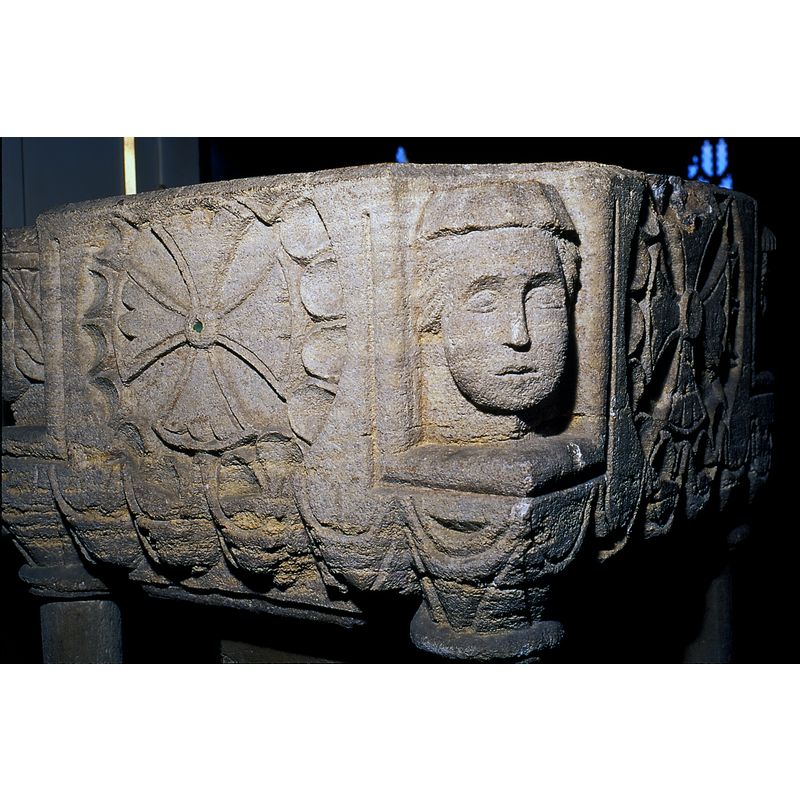
Scene Description: on the southwest angle of the basin
Copyright Statement: Image copyright © Baptisteria Sacra Index, 2023
Image Source: digital image of a photograph taken 23 July 1998 by BSI
Copyright Instructions: CC-BY-NC-ND-4.0
human figure - male - head - wearing head-cover
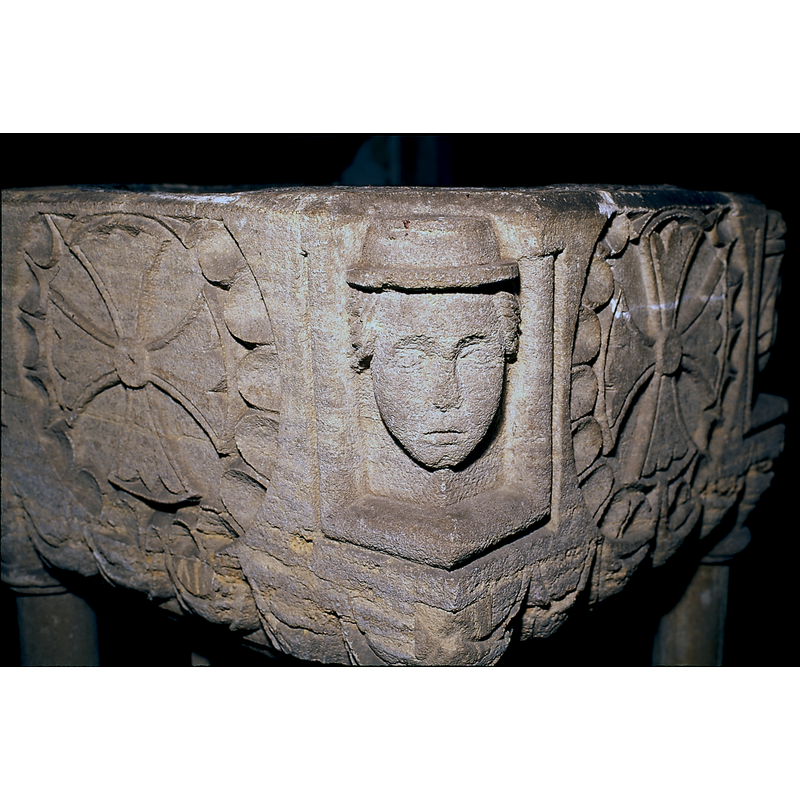
Scene Description: on the northeast angle of the basin
Copyright Statement: Image copyright © Baptisteria Sacra Index, 2023
Image Source: digital image of a photograph taken 23 July 1998 by BSI
Copyright Instructions: CC-BY-NC-ND-4.0
human figure - female - head - wearing headdress
Scene Description: seen here on the left [southeast] angle of the basin
Copyright Statement: Image copyright © Baptisteria Sacra Index, 2023
Image Source: digital image of a photograph taken 23 July 1998 by BSI
Copyright Instructions: CC-BY-NC-ND-4.0
view of church exterior - south façade
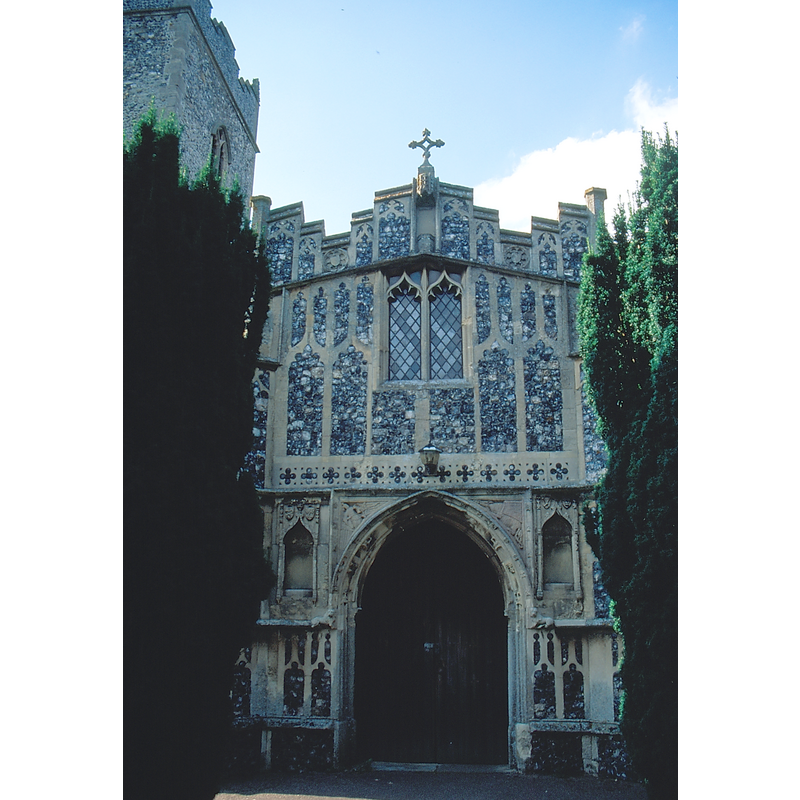
Copyright Statement: Image copyright © Baptisteria Sacra Index, 2023
Image Source: digital image of a photograph taken 23 July 1998 by BSI
Copyright Instructions: CC-BY-NC-ND-4.0
view of church exterior in context
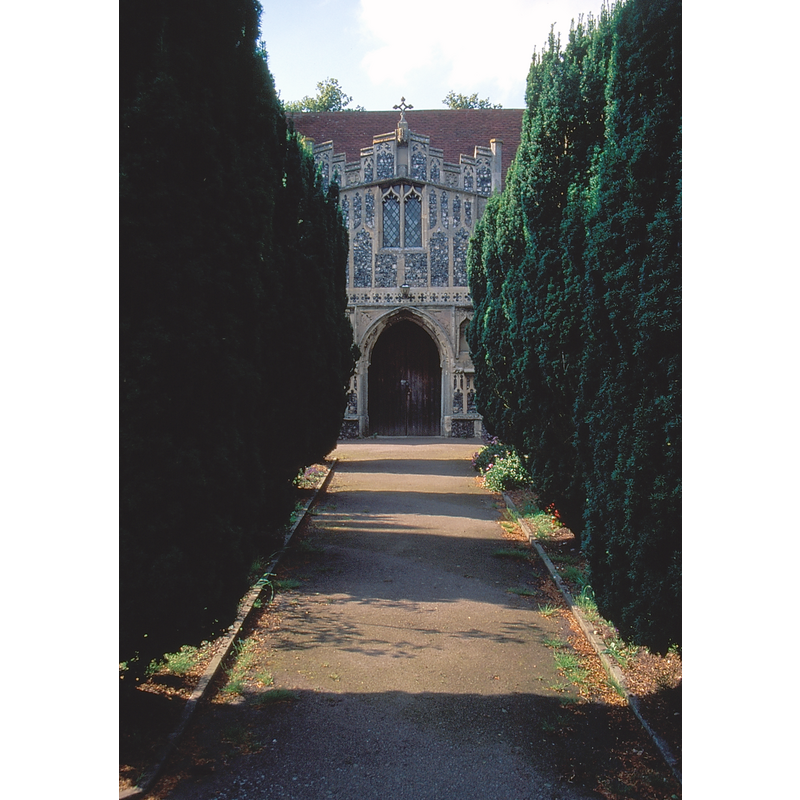
Copyright Statement: Image copyright © Baptisteria Sacra Index, 2023
Image Source: digital image of a photograph taken 23 July 1998 by BSI
Copyright Instructions: CC-BY-NC-ND-4.0
view of church exterior - south portal
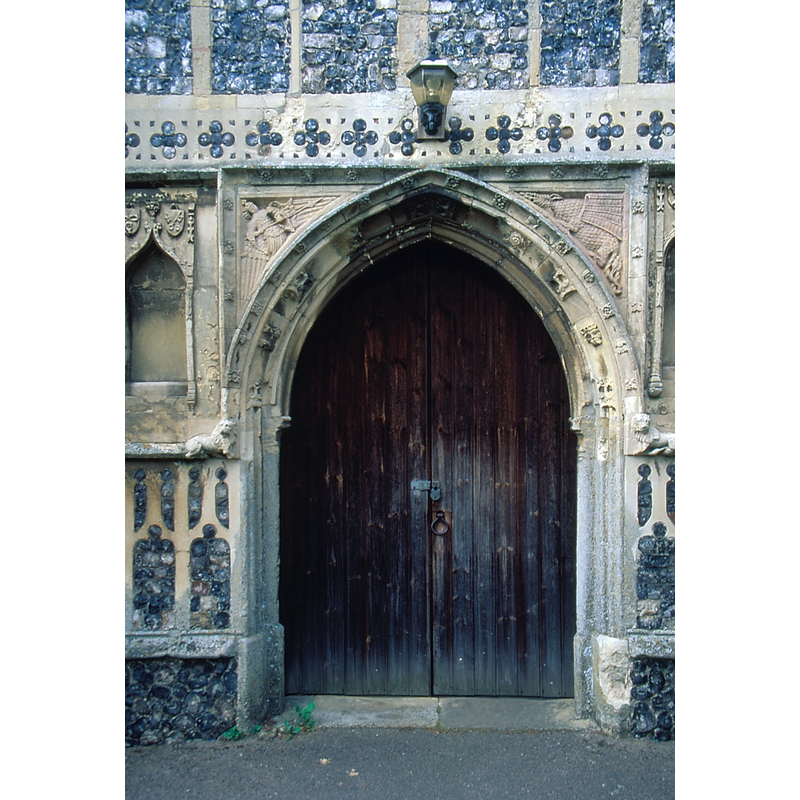
Copyright Statement: Image copyright © Baptisteria Sacra Index, 2023
Image Source: digital image of a photograph taken 23 July 1998 by BSI
Copyright Instructions: CC-BY-NC-ND-4.0
INFORMATION
Font ID: 00269PAL
Object Type: Baptismal Font1
Date Visited: 1998-07-23
Font Century and Period/Style: 12th century [basin only] -- 13th century, Medieval / composite
Church / Chapel Name: Parish Church of St. Peter
Font Location in Church: Inside the church, at the W end of central nave, to the W of the S entrance
Church Patron Saint(s): St. Peter
Church Address: Lion Rd, Palgrave, Diss IP22 1AL, United Kingdom -- Tel.: +44 1379 741949
Site Location: Suffolk, East Anglia, England, United Kingdom
Directions to Site: Located off (N) the A143 [aka Old Bury Rd.], in the municipality and 1 km S of Diss, about 40 kms N of Ipswich
Ecclesiastic Region: Diocese of St. Edmundsbury & Ipswich
Historical Region: Hundred of Hartismere
Additional Comments: composite font? / re-carved font? (the basin was re-carved and the base appears to be of a later date than the basin) -- disappeared font(s)? (the one(s) from the two Domesday-time churches here)
Font Notes:
Click to view
The entry for this Palgrave [variant spelling] [there is another Palgrave in Norfolk] in the Domesday survey [https://opendomesday.org/place/TM1178/palgrave/] [accessed 24 December 2017] reports "2 churches" and "0.25 church lands" in it. The font here is described and illustrated in Paley (1844) and Bond (1908). Parker (1855) describes it as "a very fine font" dated by its mouldings to the Transitional style. Listed in Cautley (1982) as a baptismal font of the 12th century, though he notes that "the detached angle shafts appear to be 13th century." The CRSBI (2017) entry for this church notes: "The only 12thc. sculpture is on the elaborately carved font [...] Paley dated the Palgrave fontc.1180. Bond (1908) dated the bowl to the close of the 12thc. and the supports toc.1300, at which period, he thought, the corner masks were also carved. He related the fonts of Palgrave and Preston (both Suffolk), and Hunstanton (Norfolk) to the celebrated NW Norfolk group, including Shernborne, Toftrees, Sculthorpe and S Wootton. A formal connection certainly exists, although the Palgrave group is less plastic in its carving and relies more on geometrical decoration. Pevsner calls the font late Norman, and a S-Western rather than an East Anglian type, presumably thinking of fonts of the Bodmin type. Mortlock follows Pevsner on this point, but Bond's Norfolk connection is more convincing to the present author" [Ron Baxter?]. On-site notes (July 1998): A composite font: the square basin is said to be late Norman, though the upper rim was shaved off at a later date, perhaps the time when the re-carving was done; the angles of the basin corners are trimmed at the upper two-thirds, and contain a human head in each, all wearing head covering (each a different type); under the heads scalloped capitals top the detached shafts; a larger octagonal pedestal at the centre; both pedestal and shafts are of a later date than the basin; the sides of the basin are ornamented with a large medallion on each side containing a Greek cross with fleurisé arms; the bottom of the basin also has a scalloped motif; the base is the usual columnar arrangement of one broad shaft in the centre and four -in this case, detached- slender colonnettes at the corners, and appears to be of a later date than the basin; the basin well is lined with lead and has a central drainage hole. There is evidence of an earlier lid on the remains of a hinge in the rim.
COORDINATES
UTM: 31U 370905 5802956
Latitude & Longitude (Decimal): 52.361659, 1.104125
Latitude & Longitude (DMS): 52° 21′ 41.97″ N, 1° 6′ 14.85″ E
MEDIUM AND MEASUREMENTS
Material: stone, limestone
Font Shape: square, mounted
Basin Interior Shape: round
Basin Exterior Shape: square
Drainage System: centre hole in basin
Drainage Notes: lead lining
Rim Thickness: 7 cm* (21 cm at the corners)
Diameter (inside rim): 63 cm* / 63.5 cm**
Basin Depth: 33 cm* / 355.56 cm**
Height of Basin Side: 43 cm*
Basin Total Height: 48 cm* / 45.72 cm**
Height of Base: 46 cm*
Font Height (less Plinth): 94 cm* / 96 cm**
Font Height (with Plinth): 127 cm* (with one-step plinth)
Trapezoidal Basin: 78 x 78 cm* / 78-79 x 78-79 cm**
Notes on Measurements: * BSI on-site / ** from ft/in in Paley (1844)
LID INFORMATION
Notes: evidence of an earlier lid on the remains of a hinge in the rim
REFERENCES
- Bond, Francis, Fonts and Font Covers, London: Waterstone, 1985 c1908, p. 46, 57, 95, 97, 151, 155, 191and ill. on p. 92
- Cautley, Henry Munro, Suffolk churches and their treasures, Woodbridge: The Boydell Press, 1982, p. 65
- Cox, John Charles, English Church Furniture, New York: E.P. Dutton & Co., 1907, p. 218, 220
- Enlart, Camille, Manuel d'archéologie française depuis les temps mérovingiens jusqu'à la Renaissance, Paris: Alphonse Picard & fils, 1902, p. 777 fn3
- James, M. R., Suffolk and Norfolk, London, Toronto: Dent & Sons, 1930, p. 80
- Paley, Frederick Apthorp, Illustrations of Baptismal Fonts, London, UK: John van Voorst, 1844, p. 15, 21 et al.
- Parker, John Henry, The Ecclesiastical and architectural topography of England [...] Suffolk, 1855, [unpaged]
- Tyrrell-Green, E., Baptismal Fonts Classified and Illustrated, London: Society for Promoting Christian Knowledge: The Macmillan Co., 1928, p. 72, 87