Wareham No. 1 / Warham
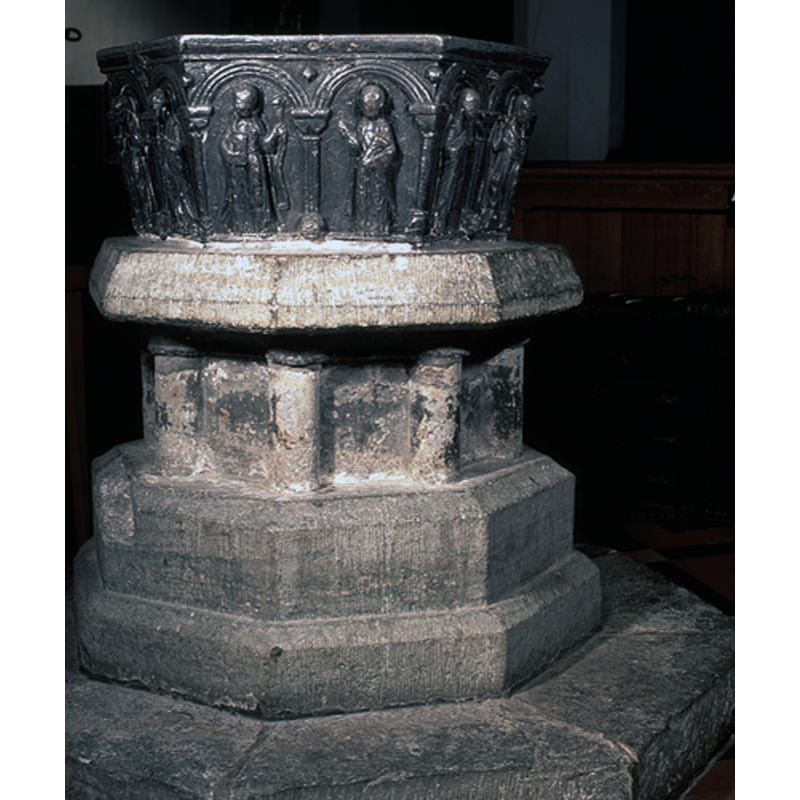
Image copyright © Baptisteria Sacra Index, 2023
CC-BY-NC-ND-4.0
Results: 13 records
B01: Apostle or saint - Apostles - unidenitfied - 12 - 1 per niche
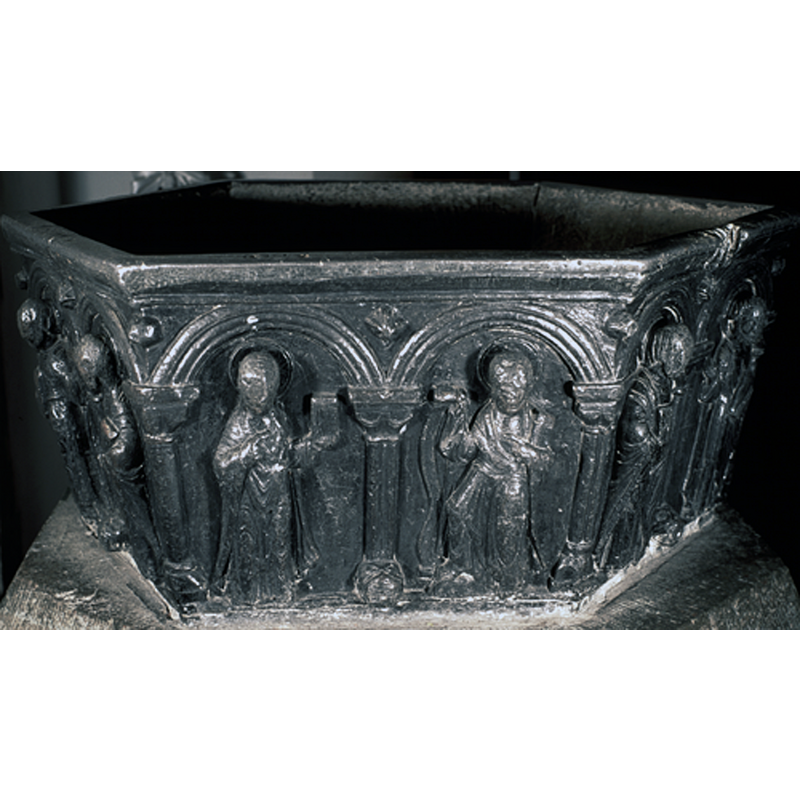
Scene Description: Arcade has two round arches per face of the hexagonal basin: 12 Apostles in total
Copyright Statement: Image copyright © Baptisteria Sacra Index, 2023
Image Source: BSI - Photographed July 2000
Copyright Instructions: CC-BY-NC-ND-4.0
B02: design element - architectural - arcade - round arches - 12
Scene Description: two on each side of the hexagonal basin; the arches are grooved; the columns have cushion capitals and bases
Copyright Statement: Image copyright © Baptisteria Sacra Index, 2023
Image Source: BSI - Photographed July 2000
Copyright Instructions: CC-BY-NC-ND-4.0
BBU01: design element - motifs - moulding
Scene Description: around the upper basin side
Copyright Statement: Image copyright © Baptisteria Sacra Index, 2023
Image Source: BSI - Photographed July 2000
Copyright Instructions: CC-BY-NC-ND-4.0
BS01: design element - motifs
Scene Description: they appear to be foliage, one on each spandrel of the arcade
Copyright Statement: Image copyright © Baptisteria Sacra Index, 2023
Image Source: BSI - Photographed July 2000
Copyright Instructions: CC-BY-NC-ND-4.0
view of font
Copyright Statement: Image copyright © Baptisteria Sacra Index, 2023
Image Source: BSI - Photographed July 2000
Copyright Instructions: CC-BY-NC-ND-4.0
view of font - upper view
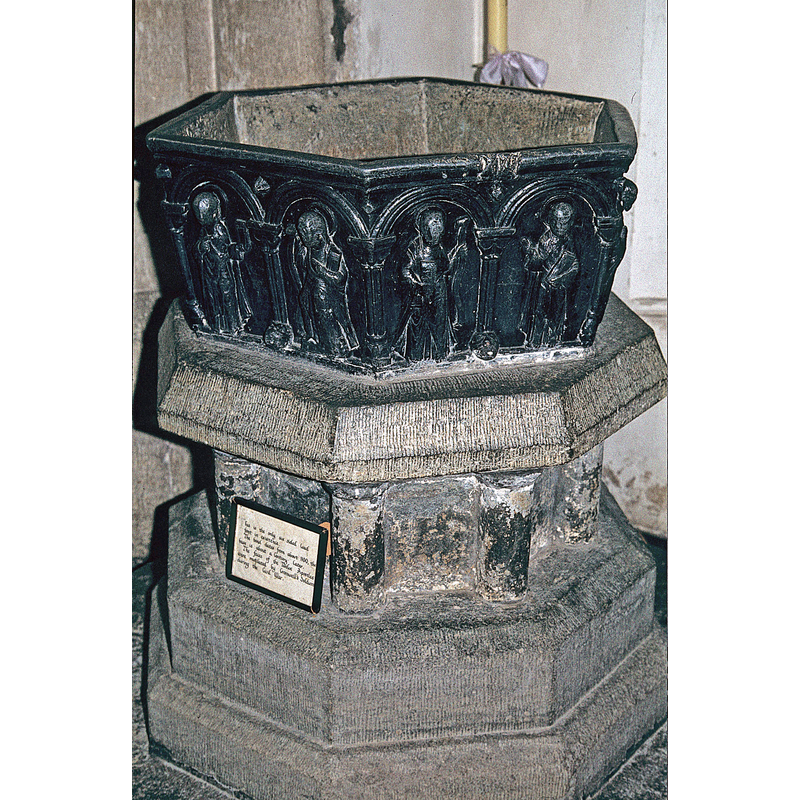
Copyright Statement: Image copyright © Timothy Marlow, 2015
Image Source: photograph taken 30 May 1981 by Timothy Marlow
Copyright Instructions: Image and permission received (letter of 26 October 2013)
view of font
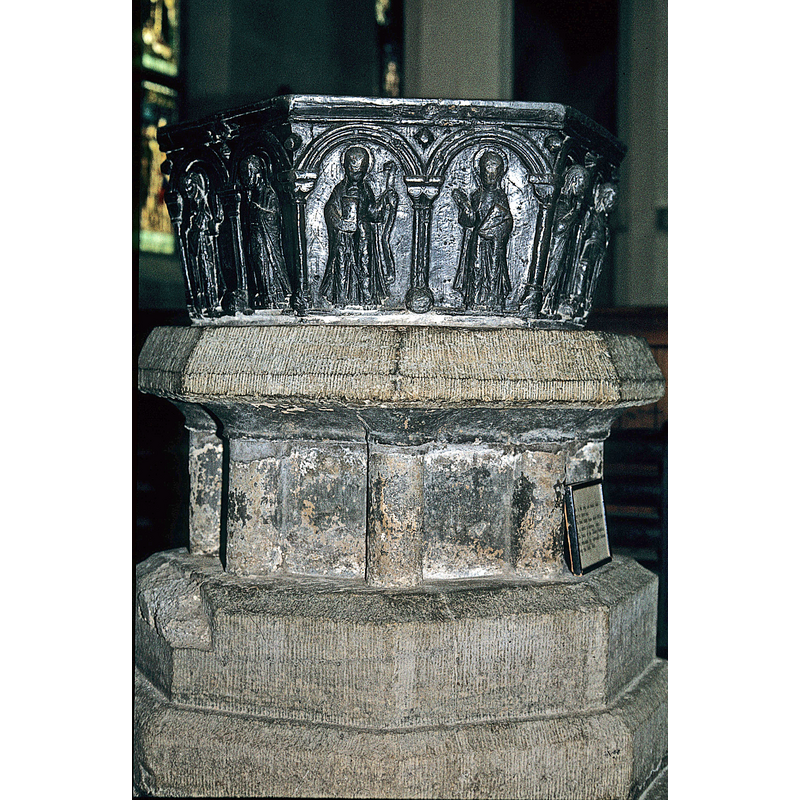
Copyright Statement: Image copyright © Timothy Marlow, 2015
Image Source: photograph taken 30 May 1981 by Timothy Marlow
Copyright Instructions: Image and permission received (letter of 26 October 2013)
view of font
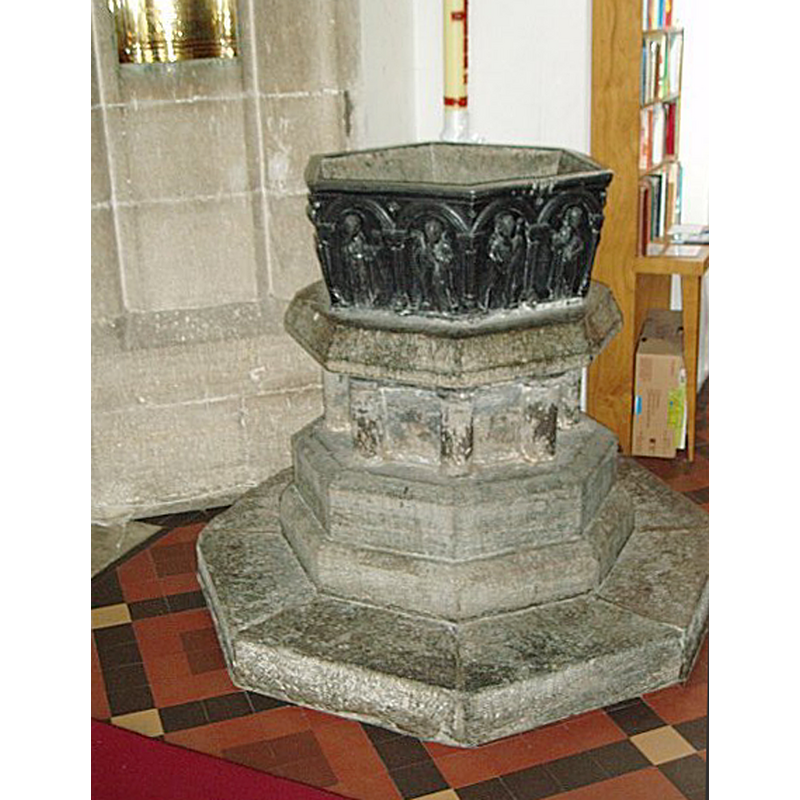
Copyright Statement: Image copyright © Peter Fairweather, 2005
Image Source: Digital photograph from Peter Fairweather [www.churchmousewebsite.co.uk]
Copyright Instructions: Standing permission
view of font
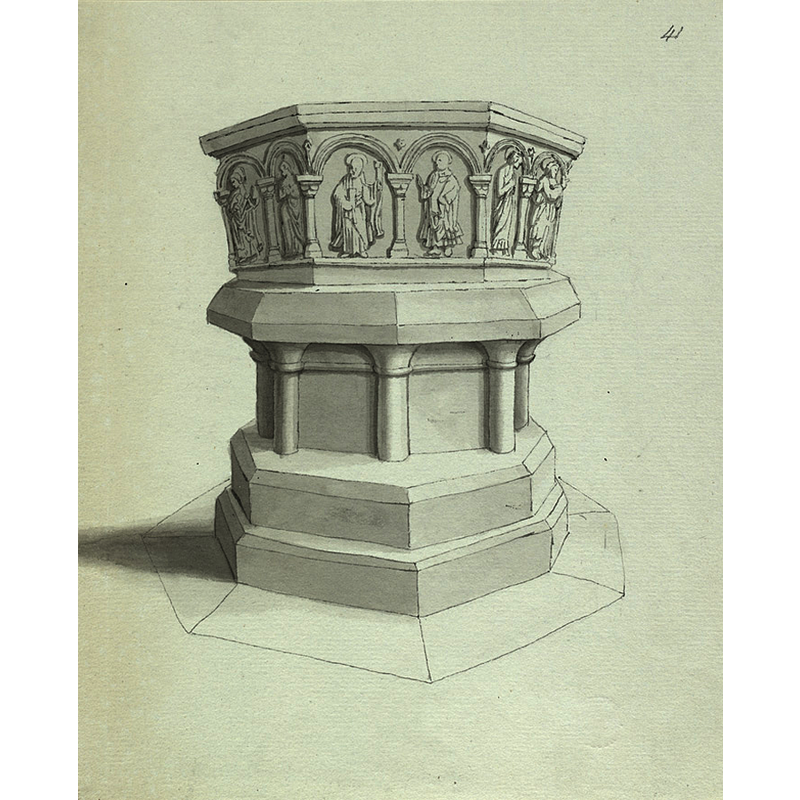
Copyright Statement: Image copyright © British Library Board, 2011
Image Source: July 1790 ink-wash-on-paper drawing by Samuel Hieronymus Grimm (1733-1794) in the British Library Online Gallery [www.bl.uk/onlinegallery/onlineex/topdrawings/f/005add000015538u00041000.html] [accessed 29 October 2011]
Copyright Instructions: No known copyright restriction – Fair Dealing
view of basin
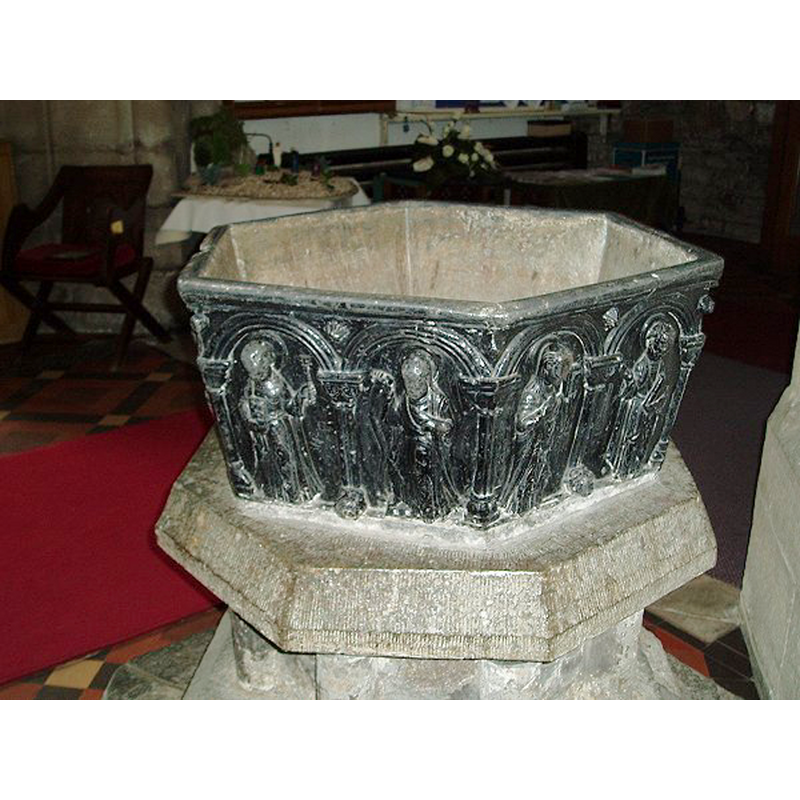
Copyright Statement: Image copyright © Peter Fairweather, 2005
Image Source: Digital photograph from Peter Fairweather [www.churchmousewebsite.co.uk]
Copyright Instructions: Standing permission
view of basin
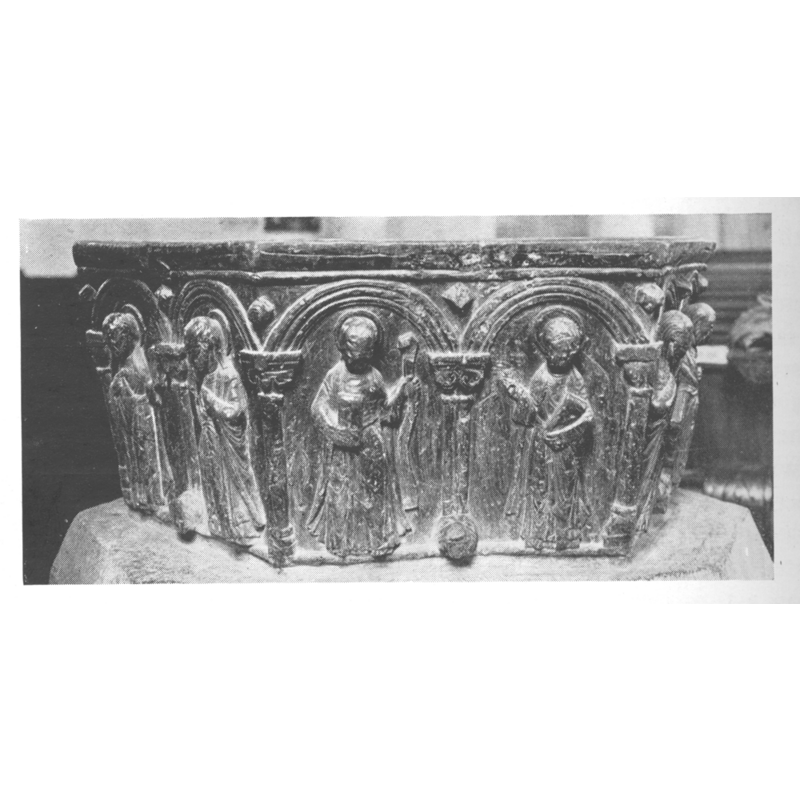
Copyright Statement: Image copyright © Crossley, 1941
Image Source: digital image of an illustration in Crossley (1941)
Copyright Instructions: PD
view of church exterior
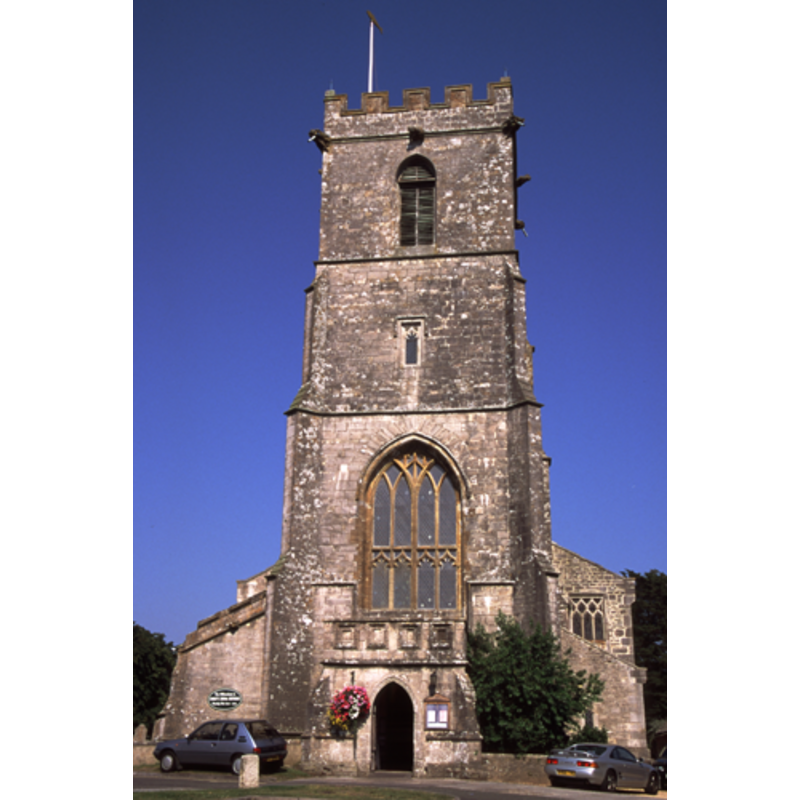
Copyright Statement: Image copyright © Baptisteria Sacra Index, 2023
Image Source: BSI - Photographed July 2000
Copyright Instructions: CC-BY-NC-ND-4.0
view of church exterior - churchyard, cemetery
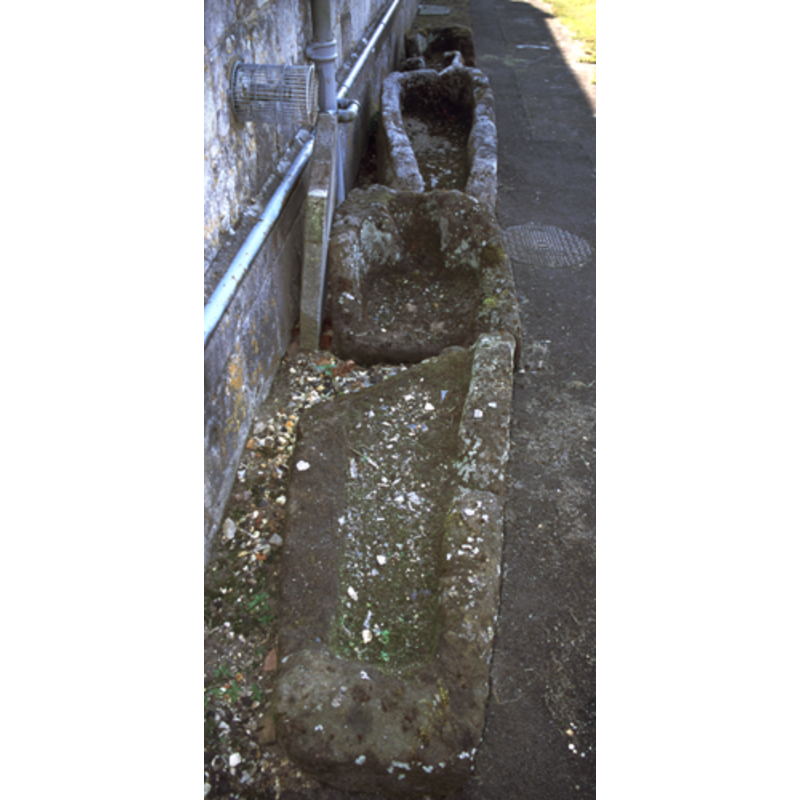
Copyright Statement: Image copyright © Baptisteria Sacra Index, 2023
Image Source: BSI - Photographed July 2000
Copyright Instructions: CC-BY-NC-ND-4.0
INFORMATION
Font ID: 00266WAR
Object Type: Baptismal Font1
Date Visited: 2000-07-21
Font Century and Period/Style: 11th century [Cox] / 13th century [Bond] [basin only], Medieval [composite font?]
Workshop/Group/Artisan: lead font
Church / Chapel Name: Priory Church of of Our Lady St. Mary Church
Font Location in Church: Inside the church, W end, N side?
Church Patron Saint(s): St. Mary the Virgin
Church Address: Church Street, Wareham, Dorset, BH204ND
Site Location: Dorset, South West, England, United Kingdom
Directions to Site: Located on the NW side of the "Isle of Purbeck" [it is really a peninsula], about 10 km WSW across from Poole
Ecclesiastic Region: Diocese of Salisbury
Historical Region: Hundred of Winfrith [Newburgh] [in Domesday]
Additional Comments: altered font? (the base is probably later and, why octagonal?) -- Was this the font of the Domesday-time church here?
Font Notes:
Click to view
There are two entries for Wareham [variant spelling] in the Domesday survey [http://domesdaymap.co.uk/place/SY9287/wareham/] [accessed 21 February 2015], one of which, in the hands of the Abbey of Saint Wandrille, mentions a church and church lands in it. There is a July 1790 ink-wash-on-paper drawing of this font by Samuel Hieronymus Grimm (1733-1794) in the British Library collections [Shelfmark: Additional MS 15538 - Item number: f.41]. This font is listed in Gough (1792), Paley (1844), Cox (1875) and Andre (1882) as an early lead font. Reported in the 3rd ed. of Hutchins (1973 c1861-1874): "a very ancient font, which seems to have been once much larger [...] a well-preserved example of cast-lead work, apparently of the twelfth century [...] It formerly had a cover, probably of the same material." During his visit to this church in October 1825, Glynne (1923) noted: "The font is an octagon ornamented with figures beneath semi-circular shafts; around the base are shafts." Described in the J G Harrod & Co's Postal & Commercial Directory of Dorset & Wiltshire of 1865, where it is dated 11th century and located near the west entrance. Lethaby (1893) notes: "The style seems central Norman not Transitional". Cox & Harvey (1907) describe it as a "11th-cent[ury] leaden font", adding that it is "the only example of a hexagonal leaden font; it has a double arcading on each face, with a figure under each arcade". Bond (1908) writes that the basin appears to be one piece [as opposed to many others that consist of welded and formed plates] and adds that "if the lead bowl at Wareham is of the same date of the pedestal, it also belongs to the thirteenth century"; Bond (ibid.) supports this dating saying that "no font with grooved shafts is likely to be earlier then the twelfth century." Long (1923) notes it as "the only instance of a lead font in Dorset" , and lists it with the Norman fonts of this county. Mee (1939) remarks that this is "a unique member of the very small family of lead fonts [...] unique because it has six sides". Described and illustrated in Zarnecki (1957) who dates it ca. 1150 and suggests an Italian influence in the design of the font. In Newman & Pevsner (1972). Noted in Rodwell (1009). On-site notes: the large octagonal stone base is made of Purbeck marble and consists of four volumes (but one piece): the upper is a flat console on which the font rests; the next volume has constructional columns at the angles; the third and fourth are octagonal "steps" gradually wider. The base has all the appearance of "belonging" with the basin, except for its shape: why octagonal? The whole rests on a wider plinth. [cf. Index entry for Wareham No. 2, St Mary's (Dorset) for another font listed in this church]
Credit and Acknowledgements: We are grateful to Peter Fairweather, of www.churchmousewebsite.co.uk, to Timothy Marlow, and to Gerald Duke, for the added information and images of this font. [cf. Index entry for Wareham No. 2, St Mary's (Dorset) for another font listed in this temple]
COORDINATES
UTM: 30U 563078 5615121
Latitude & Longitude (Decimal): 50.684495, -2.107101
Latitude & Longitude (DMS): 50° 41′ 4.18″ N, 2° 6′ 25.57″ W
MEDIUM AND MEASUREMENTS
Material: metal (basin) and stone (base), lead (basin) and limestone (Purbeck marble) (base)
Number of Pieces: two?
Font Shape: hexagonal, mounted
Basin Interior Shape: hexagonal
Basin Exterior Shape: hexagonal
Drainage System: centre hole in basin
Drainage Notes: no lining
Rim Thickness: 3 cm
Diameter (inside rim): 71 x 80 cm (min.&max. diagonals)
Diameter (includes rim): 77 x 86 cm (min.&max. diagonals)
Basin Depth: 35 cm
Height of Basin Side: 33 cm
Basin Total Height: 33 cm
Height of Base: 70 cm
Font Height (less Plinth): 103 cm
Font Height (with Plinth): 117 cm
Notes on Measurements: BSI on-site
LID INFORMATION
Material: wood, oak?
Apparatus: no
Notes: octagonal wooden lid
REFERENCES
- André, J. Lewis, "Leaden Fonts in Sussex", 32, Surrey Archaeological Collections, relating to the history and antiquities of the county, 1882
- Bloxam, Matthew Holbeche, The Principles of Gothic ecclesiastical architecture, with an explanation of technical terms […], London: W. Kent, 1859, p. 366
- Bond, Francis, Fonts and Font Covers, London: Waterstone, 1985 c1908, p. 77, 79, 149 and ill. on p. 84
- Clayton, Brian C., "English Church Fonts of Ornamental Lead Work", X, no. 57, Apollo: a Journal of the Arts, 1929, pp. 133-138; p. 133-138
- Cox, John Charles, 1875-1877
- Cox, John Charles, English Church Furniture, New York: E.P. Dutton & Co., 1907, p. 163, 197
- Crossley, Frederick Herbert, English Church Craftsmanship: an Introduction to the Work of the Mediaval Period and Some Account of Later Developments, London: B.T. Batsford, 1941, p. 16, 103 and fig. 190
- Davies, J.G., The Architectural Setting of Baptism, London: Barrie and Rockliff, 1962, p. 68
- Davis, T., Wareham, Gateway to Purbeck, Milborne Port: Dorset Publishing Co., 1984
- Druce, George Claridge, "Lead fonts in England, with some references to French examples", 39, Journal of the British Archaeological Association, 1934, pp. 289-329; p. 289-329
- Friar, Stephen, The Sutton Companion to Churches, Thrupp, Stroud (Gloucs.): Sutton Publishing, 2003, p. 203
- Glynne, Stephen Richard, "Notes on some Dorset churches", 44, 86-104, Proceedings of the Dorset Natural History and Antiquarian Field Club, 1923
- Gough, Richard, "Description of the old font in the Church of East Meon, Hampshire, 1789: with some observations on fonts", X, Archaeologia, 1792, pp. 183-209; p. 187
- Great Britain. Royal Commission on Historical Monuments (England), An inventory of historical monuments in the County of Dorset, London: H.M. Stationary Office, 1970, pt. 2: p. 304-312
- Holmes, Edric, Wanderings in Wessex: an Exploration of the Southern Realm from Itchen to Otter, London: Robert Scott Roxburghe House, [1922]
- Hope, M., "Dorset", Blue guide: Churches and chapels of southern England, London: Black, 1991, p. 201-202
- Hutchins, John, The History and Antiquities of the County of Dorset, Wakefield: E.P. Pub. Ltd., 1973, vol. I: 111
- Lethaby, William Richard, Leadwork, old and ornamental, and for the most part English [...] with illustrations, London; New York: Macmillan & co., 1893, p. 58, 62`
- Long, E.T., "Dorset church fonts", 44, Proceedings of the Dorset Natural History and Antiquarian Field Club, 1923, pp. 62-76; p. 67, 68, 75
- Mee, Arthur, The King's England. Dorset: Thomas Hardy's Country, London: Hodder & Stoughton, 1939, p. 274
- Paley, Frederick Apthorp, Illustrations of Baptismal Fonts, London, UK: John van Voorst, 1844, p. 24
- Pevsner, Nikolaus, Cambridgeshire, Harmonsworth: Penguin, 1970, p. 435-437
- Pevsner, Nikolaus, Dorset, Harmondsworth: Penguin, 1972, p. 19, 436
- Pitfield, F.P., 1985
- Sackett, Terry, Francis Frith's Dorset Churches, Salisbury, Wilts.: Frith Book Co., 2000, p. 82
- Stanier, Peter, Dorset's archaeology: archaeology in the landscape, 4000BC to AD1700, Tiverton: Dorset Books, 2004, p. 141
- Taylor, H.M., Anglo-Saxon Architecture, Cambridge: Cambridge University Press, 1965-1978, vol. II: p. 634-637 and plates 602-603
- Zarnecki, George, English Romanesque Lead Sculpture: Lead Fonts of the Twelfth Century, London: A. Tiranti, 1957, p. 5, 8-10, 13, 16, 19, 22, 0, 31 and figs. 18-22, 24-27