Kilpeck No. 2 / Chipeete
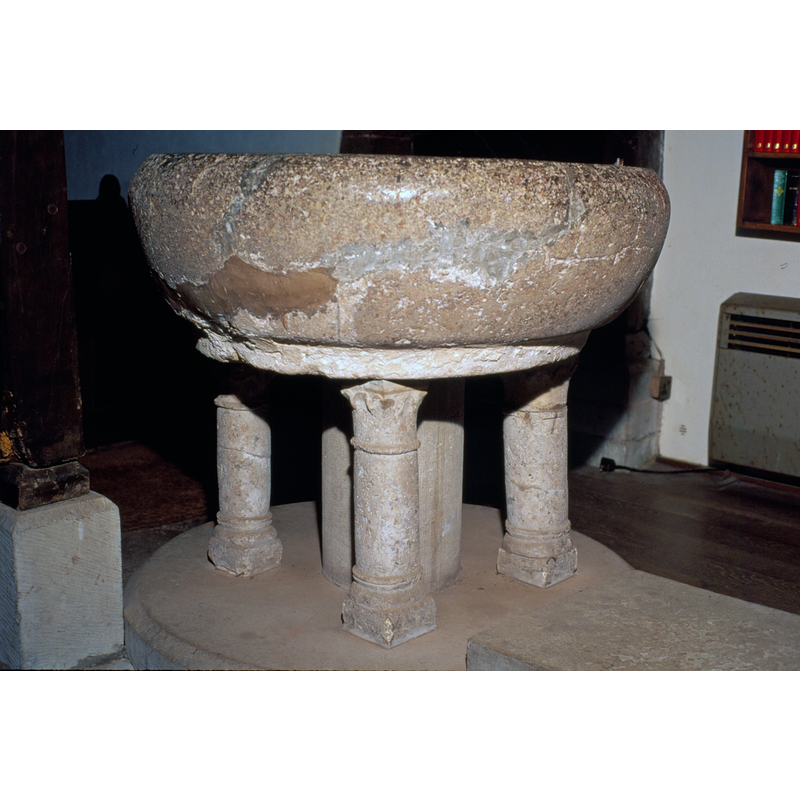
Image copyright © Baptisteria Sacra Index, 2023
CC-BY-NC-ND-4.0
Results: 6 records
view of font
Copyright Statement: Image copyright © Baptisteria Sacra Index, 2023
Image Source: digital image of a photograph taken 19 July 1998 by BSI
Copyright Instructions: CC-BY-NC-ND-4.0
view of font
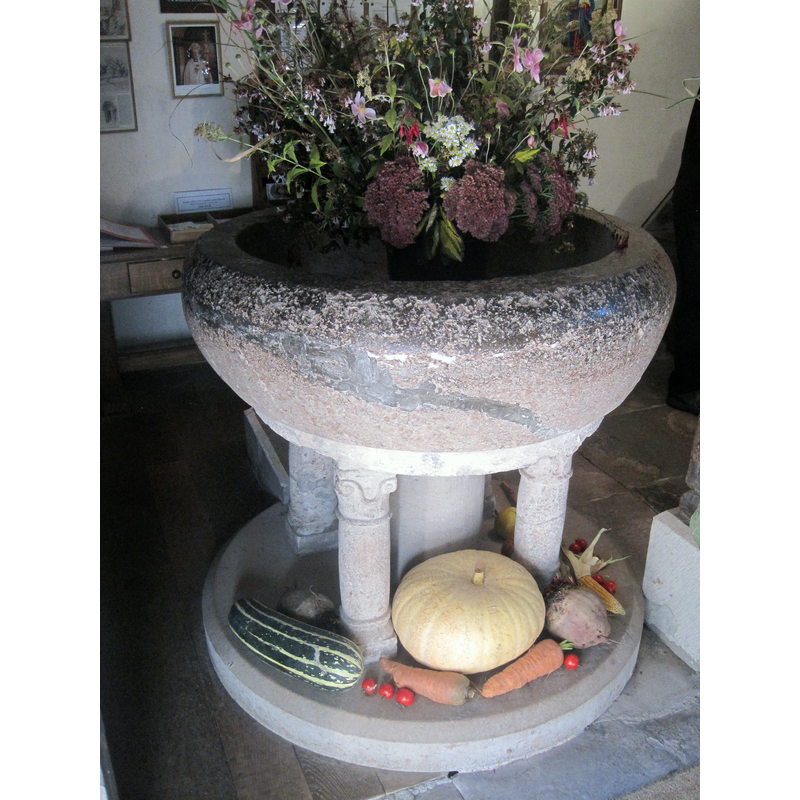
Scene Description: with harvest offerings
Copyright Statement: Image copyright © Joanna and Peter Blanchard, 2014
Image Source: digital photograph taken 4 October 2014 by Joanna and Peter Blanchard
Copyright Instructions: Image and permission received from the authors
view of font in context
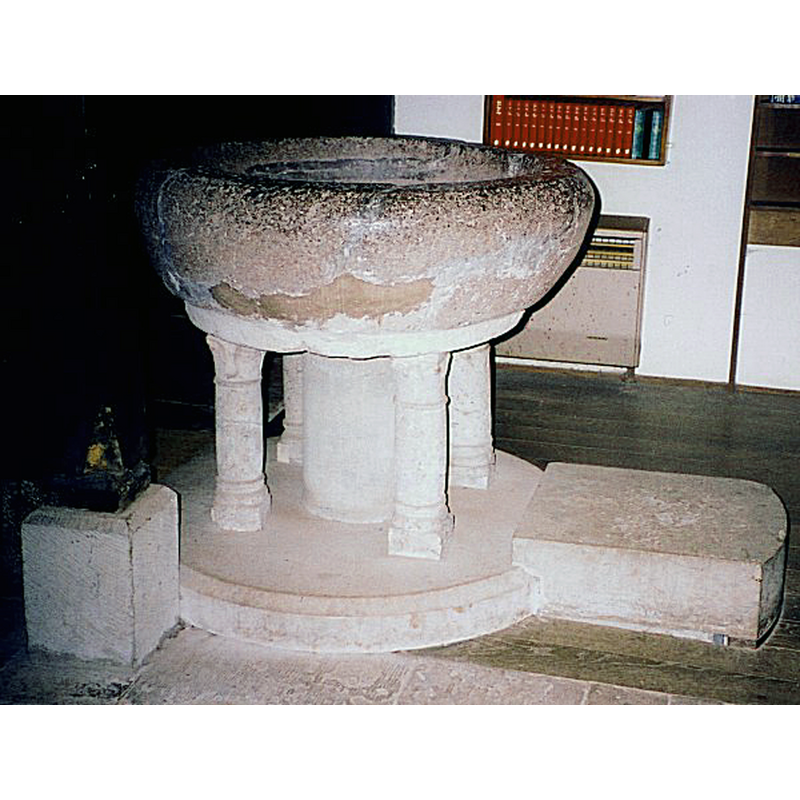
Copyright Statement: Image copyright © Peter Fairweather, 2004
Image Source: Peter Fairweather [www.churchmousewebsite.co.uk]
Copyright Instructions: Standing permission
view of font
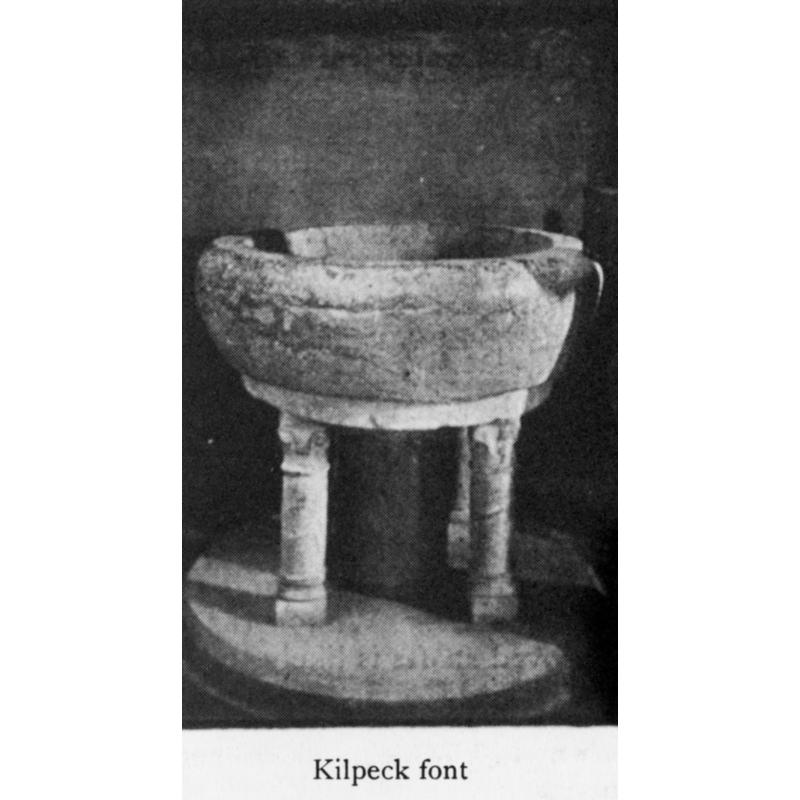
Copyright Statement: Image copyright © [in the public domain]
Image Source: digital image of an illustration in Bond (1908)
Copyright Instructions: PD
view of font
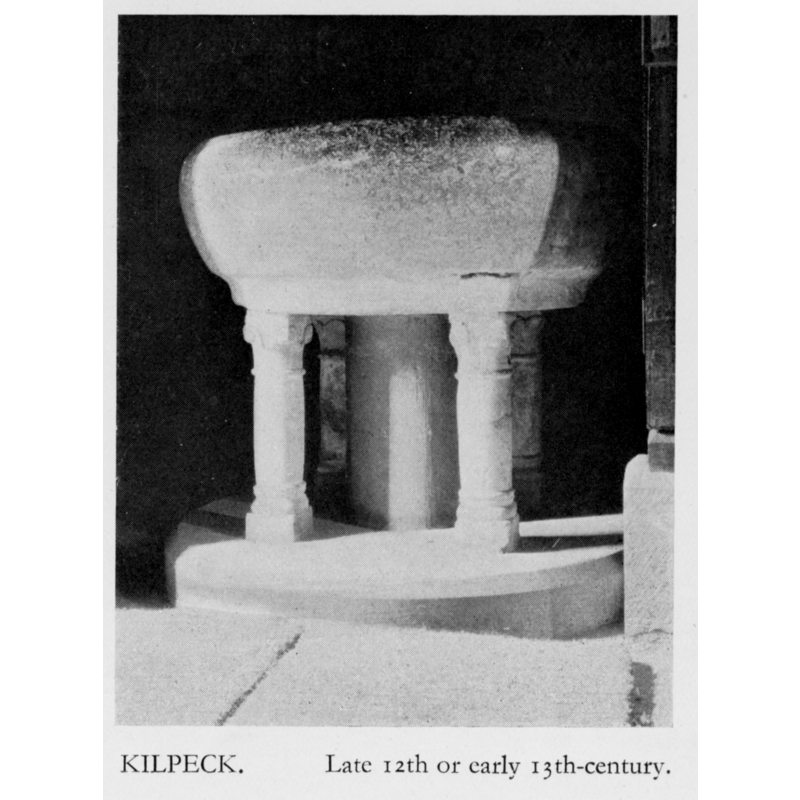
Copyright Statement: Image copyright © H.M.S.O., 1934
Image Source: Herefordshire (1931-1934, vol. I: p.l. 38)
Copyright Instructions: PD
view of church exterior - south view - detail
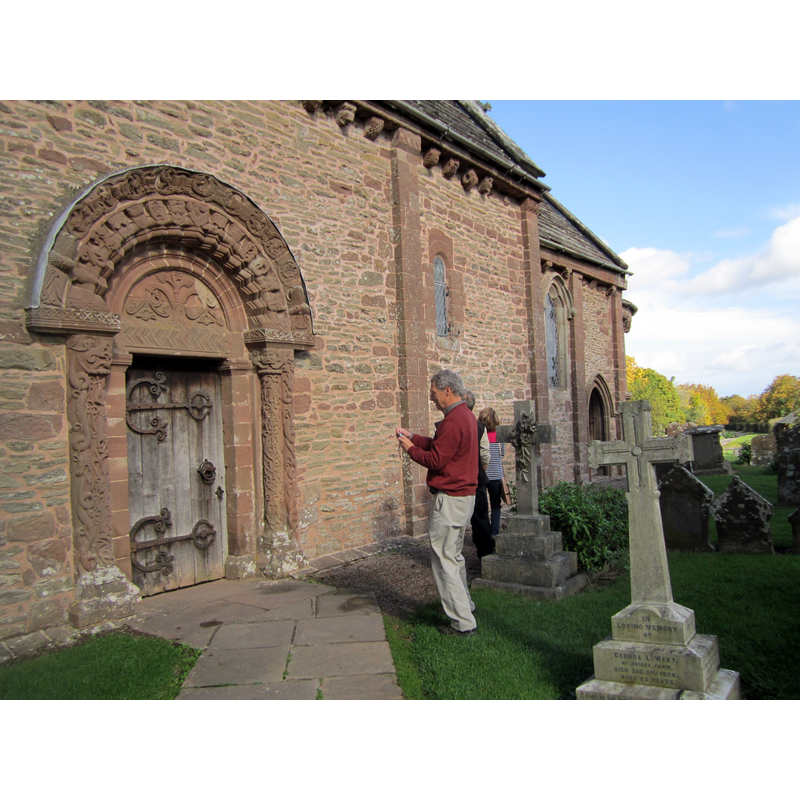
Copyright Statement: Image copyright © Joanna and Peter Blanchard, 2014
Image Source: digital photograph taken 4 October 2014 by Joanna and Peter Blanchard
Copyright Instructions: Image and permission received from the authors
INFORMATION
Font ID: 00252KIL
Object Type: Baptismal Font1
Date Visited: 1998-07-19
Font Century and Period/Style: 12th century (mid? / late?), Late Norman
Workshop/Group/Artisan: Herefordshire school?
Cognate Fonts: The fonts at Bredwardine and Madeley, according to Cox & Harvey (1907); Thurlby (22006) adds Llantilio Crossenny (Gwent / Monmouthshire) as a smaller version
Church / Chapel Name: Parish Church of St. Mary and St. David
Font Location in Church: Beneath the gallery. Font Stopper now on display in chuch
Church Patron Saint(s): St. Mary the Virgin & St. David
Church Address: Castle Park, Kilpeck, County of Herefordshire HR2 9DN
Site Location: Herefordshire, West Midlands, England, United Kingdom
Directions to Site: Located about 10-15 km SW of Hereford (S on the A465 to St Devereux, then E to Kilpeck)
Ecclesiastic Region: Diocese of Hereford
Historical Region: Hundred of Archenfield [in Domesday]
Additional Comments: altered font? (central shaft and plinth are modern)
Font Notes:
Click to view
There is an entry for Kilpeck [variant spelling] in the Domesday survey [http://opendomesday.org/place/SO4430/kilpeck/] [accessed 19 May 2015], but it mentions neither cleric nor church in it. Cox & Harvey (1907) quote the Gentleman's Magazine of 1833: "The font is a huge circular bason of granite, 4 feet in diameter, set on a cylindrical column 10 feet in circumference; the height of the whole is 3 feet". Described and illustrated in the RCHM Herefordshire (1931-1934) where it is dated late 12th or early 13th century. Jenkins (1999) writes that "it is so big it could be used as a bath"]; not believed to be the work of the Herefordshire School which made other fonts in the area. Halsey (1987) argues that, "despite its present ungainly appearance, it is a special font, one of a group of eight in Herefordshire made of a local reddish-brown, psammitic limestone, called 'Breccia' or 'Cornstone'" and that it is the work of the Herefordshire School [NB: the eight fonts are: Bishops Frome, Bosbury, Bredwardine, Kilpeck, Kingstone, Madley, Turnastone and Vowchurch]. Hutton (1957) describes it as "a Norman font of unusual design and workmanship." Described and illustrated in Bond (1908). Thurlby (2006) adds Llantilio Crossenny (Gwent / Monmouthshire) as a smaller version of this group. On-site notes: mounted on four side columns with one central pillar; this is a non-constructional type - pillars are not carved from the same stone as the bowl. Plain, no ornamentation. No lead lining. There is evidence of a lid once being attached to the rim: the metal staples are still in the rim. [We are grateful to Peter Fairweather, of Lincoln, for his image of this font]
Credit and Acknowledgements: We are grateful to Peter Fairweather, of Lincoln, for his image of this font.
COORDINATES
UTM: 30U 513107 5757752
Latitude & Longitude (Decimal): 51.9703, -2.8092
Latitude & Longitude (DMS): 51° 58′ 13.08″ N, 2° 48′ 33.12″ W
MEDIUM AND MEASUREMENTS
Material: stone, limestone (psammitic limestone)
Number of Pieces: six-seven
Font Shape: round, mounted
Basin Interior Shape: round
Basin Exterior Shape: round
Drainage System: centre hole in basin
Rim Thickness: 9-10 cm
Diameter (inside rim): 88 cm
Diameter (includes rim): 107 cm
Basin Depth: 25 cm
Height of Basin Side: 40 cm
Basin Total Height: 40 cm
Height of Base: 45 cm
Font Height (less Plinth): 95 cm
Font Height (with Plinth): 108 cm
Notes on Measurements: BSI on-site [cf. FontNotes for earlier measurements in the Gentleman's Magazine]
LID INFORMATION
Notes: NB: there is no font cover now but the rim of the basin shows evidence of old staples
REFERENCES
- Guide to the Parish of SS. Mary & David, Kilpeck, [Kilpeck, Hereford?]: [?], 1989, p. 3
- Bond, Francis, Fonts and Font Covers, London: Waterstone, 1985 c1908, p. 151, 153 and ill. on p. 150
- Clapham, Alfred William, English Romanesque Architecture after the Conquest, Oxford: Clarendon Press, 1934, p. 155
- Cox, John Charles, English Church Furniture, New York: E.P. Dutton & Co., 1907, p. 201
- Great Britain. Royal Commission on Historical Monuments (England), An Inventory of the Historical Monuments in Herefordshire, London: H.M. Stationary Office, 1931-1934, vol. I: p. xlii, 158 and pl. 38
- Halsey, Richard, "Eight Herefordshire marble fonts", Romanesque and Gothic: Essays for George Zarnecki, Woodbridge, Suffolk: Boydell, 1987, p. 107-109
- Hutton, Graham, English Parish Churches, London: Thames & Hudson, 1976, p. 37-38
- Jenkins, Simon, England's Thousand Best Churches, London and New York: Allen Lane, the Penguin Press, 1999 [2000 rev. printing], p. 270
- Thurlby, Malcolm, Romanesque architecture and sculpture in Wales, Little Logaston, Woonton, Almeley, Herts.: Logaston Press, 2006, p. 172
- Tyrrell-Green, E., Baptismal Fonts Classified and Illustrated, London: Society for Promoting Christian Knowledge: The Macmillan Co., 1928, p. 40