Walton / Waletone / Walton-on-the-Hill / Walton on the Hill nr. Liverpool
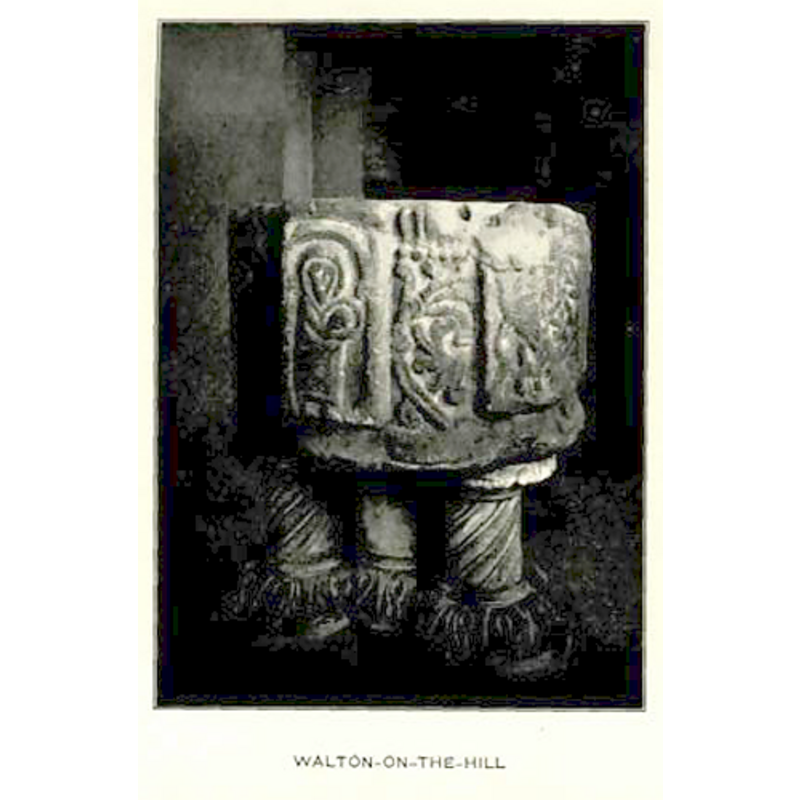
Image copyright © [in the public domain]
PD
Results: 11 records
B01: New Testament - Childhood and youth of Christ - Flight to Egypt - Mary riding an ass - Joseph carrying the Child
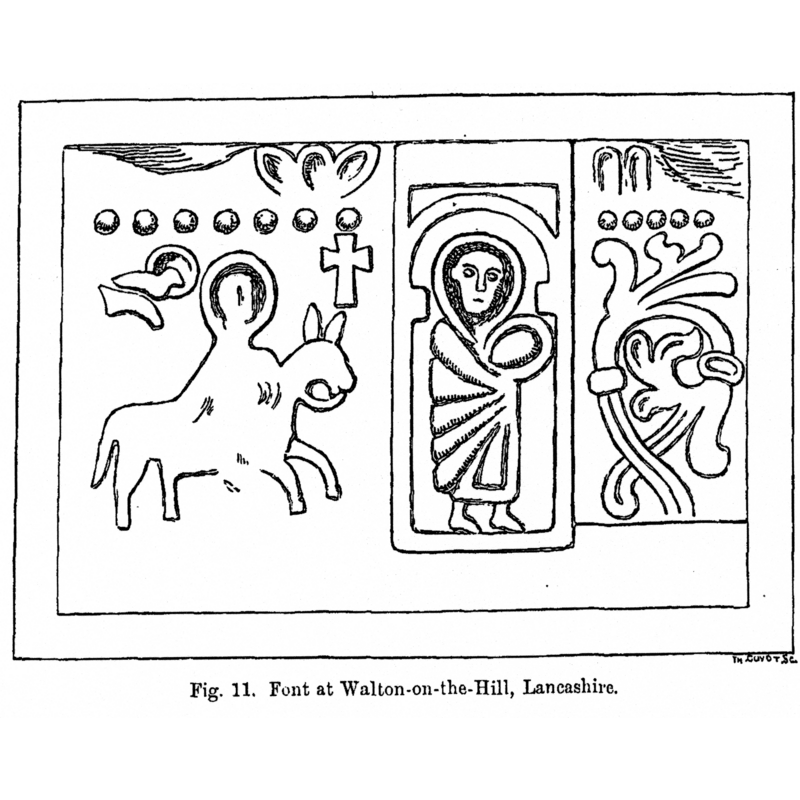
Scene Description: a cross over Mary's head
Copyright Statement: Image copyright © [in the public domain]
Image Source: illustration in Romilly Allen (1884)
Copyright Instructions: PD
B02: Old Testament - Genesis from the creation to the expulsion from paradise, and later years of Adam and Eve - Temptation and Fall: Adam and Eve in paradise (after the Fall) (Genesis 3:8-21)

Scene Description: a/p description in Bond

B03: New Testament - Virgin Mary - Madonna with Christ-child
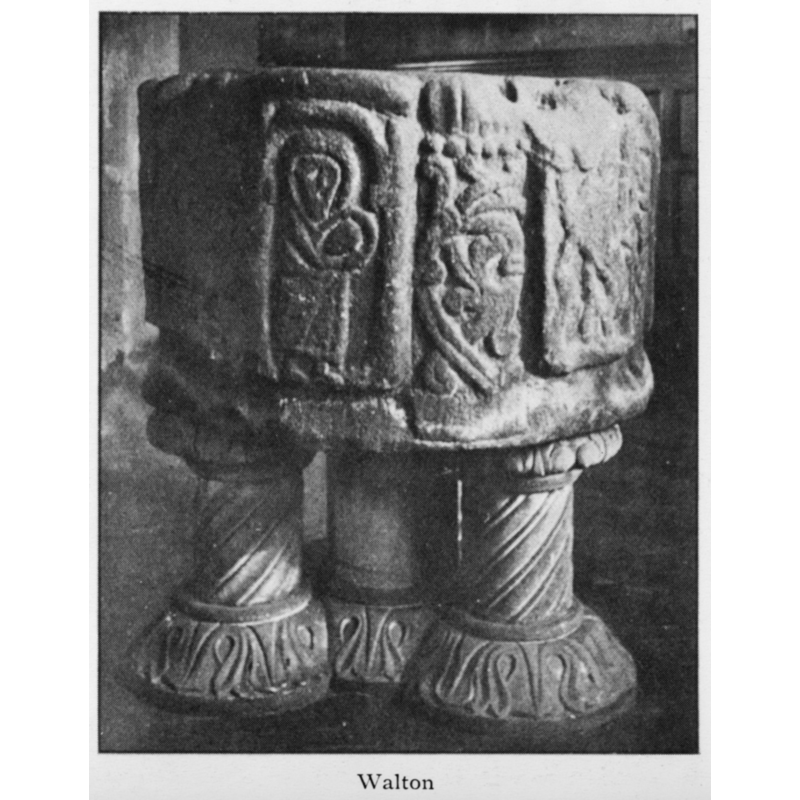
Scene Description: standing under an arch
Copyright Statement: Image copyright © [in the public domain]
Image Source: B&W photograph in Bond (1908: 164)
Copyright Instructions: PD
B04: design element - architectural - arch
Scene Description: at least one, with Mary (?) inside it
Copyright Statement: Image copyright © [in the public domain]
Image Source: B&W photograph in Bond (1908: 164)
Copyright Instructions: PD
B05: symbol - tree - Tree of life?
Scene Description: to the right of Mary (her left)
Copyright Statement: Image copyright © [in the public domain]
Image Source: B&W photograph in Bond (1908: 164)
Copyright Instructions: PD
LB01: design element - motifs - foliage
Scene Description: on the capitals and bases of the columns
Copyright Statement: Image copyright © [in the public domain]
Image Source: B&W photograph in Bond (1908: 164)
Copyright Instructions: PD
LB02: design element - patterns - fluted - diagonal
Scene Description: on the outer columns of the base
Copyright Statement: Image copyright © [in the public domain]
Image Source: B&W photograph in Bond (1908: 164)
Copyright Instructions: PD
view of font
Copyright Statement: Image copyright © [in the public domain]
Image Source: illustration in Ellis (1902)
Copyright Instructions: PD
view of church exterior - southeast view
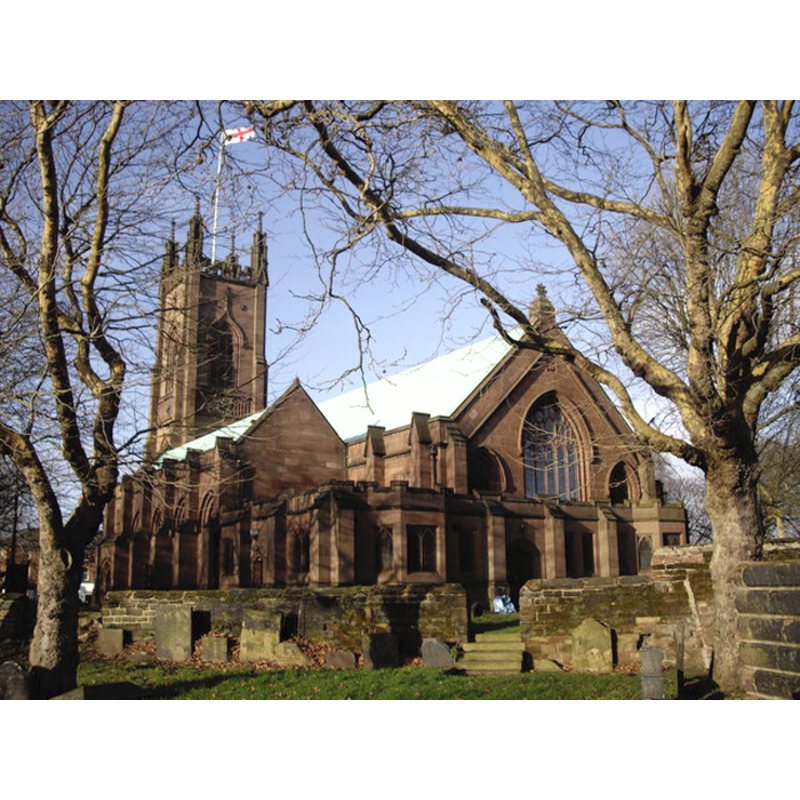
Scene Description: the present church
Copyright Statement: Image copyright © John Lord, 2011
Image Source: digital photograph taken 28 December 2011 by John Lord [www.geograph.org.uk/photo/2745730] [accessed 10 May 2013]
Copyright Instructions: CC-BY-SA-2.0
view of iconographic program - detail
Copyright Statement: Image copyright © [in the public domain]
Image Source: illustration in Romilly Allen (1884)
Copyright Instructions: PD
view of font in context

Scene Description: the font probably ca. 1970
Copyright Statement: Image copyright © Dave Wood, 2010
Image Source: photograph taken by Dave Wood, in 'Liverpool images' [http://www.liverpoolpictorial.co.uk] [accessed 6 October 2010]
Copyright Instructions: PERMISSION NOT AVAILABLE -- IMAGE NOT FOR PUBLIC USE
INFORMATION
Font ID: 00101WAL
Object Type: Baptismal Font1
Font Century and Period/Style: 12th century [basin only] [re-cut], Medieval [composite]
Cognate Fonts: This font shares some general design and iconographic details with the one in nearby Kirkby
Church / Chapel Name: Parish Church of St. Mary the Virgin [aka Our Lady's]
Font Location in Church: Inside the church
Church Patron Saint(s): St. Mary the Virgin
Church Notes: The church of St. Mary was the original parish church of Liverpool
Church Address: County Road and Church Lane, Walton-on-the-Hill, Liverpool L4 5PW
Site Location: Merseyside, North West, England, United Kingdom
Directions to Site: Walton-on-the-Hill is now within Liverpool -- St Mary's is on Country Rd
Ecclesiastic Region: Diocese of Liverpool
Historical Region: formerly in Lancashire -- Hundred of West Derby
Additional Comments: Used as a mounting stone [joss-stone, horse stone] in a nearby inn -- broken into pieces in 1941 and restored thereafter MUST USE
Font Notes:
Click to view
There is an entry for this Walton [variant spelling] in the Domesday survey [http://domesdaymap.co.uk/place/SJ3695/walton-on-the-hill/] [accessed 23 July 2014], but it mentions neither church nor cleric in it. Butterworth (1841) notes: "the ancient font is interesting". W.J. Roberts' letter to Sylvanus Urban, editor of the Gentleman's Magazine (issue of October 1845: 370) mentions a visit to the Parish of Walton-on-the-Hill, in the county of Lancaster, where a church had existed "in the time of Edward the Confessor"; of that building, adds Roberts, "in the burial grounds there are the vestiges of a font, which, no doubt, from its form and appearance, belonged to that early era. About ninety years ago [i.e., ca. 1755] it was thrown out of the church, and was superseded by a more uncanonical one"; the landlord of the tavern adjoining the churchyard "eyeing the desecrated font, without any qualms of conscience, appropriated it to the service of his Bacchanalian chapel, placing it by the door to serve as a stepping-stone to enable his customers to mount their horses; where it lay in the year 1817 [...]; subsequently it was removed to the spot it now occupies. Its form is circular, about three feet diameter. On its circumference there are six projecting panels, which, with the divisions formed by them, are covered with sculptured figures in high relief, very much mutilated by being exposed to the weather and the more destructive violence of man, rendering it impossible to decipher their once intelligible character. The remains in one compartment appear to be a representation of 'Christ's entrance into Jerusalem." Much of that information is reproduced in Ellis (1902), who identifies "The Temptation" and "an unconventional representation of flight into Egypt:, adding that it is "an interesting specimen of early Norman workmanship, and dates probably from the time of Edward the Confessor", dating which Ellis credits The Gentleman's Magazine text of 1845 [cf. supra]. Noted in the Victoria County History (Lancaster, vol. 3, 1907), as "a relic of the ancient church, now restored to use after many years of desecration, having been turned out of the church in 1754, and used as a mounting stone by the door of a neighbouring inn. It has a circular bowl on which are six arched panels containing figure sculpture, the intervening spaces having floral patterns. The figure-subjects are damaged and indistinct, but one shows the Temptation of Adam and Eve --as on the font at Kirkby-- and another has been interpreted as the Flight to Egypt." Romilly Allen (1884) points out that the Virgin is represented with a nimbus on this font. Described and illustrated in Bond (1908) as an archaic stone basin probably of the early 12th century, ornamented with motifs and figural scenes; it probably rested on the ground or on a simple plinth, but at some point since it was mounted on a set of grooved shafts of later date. "At Walton, near Liverpool, is represented the Flight into Egypt; the Blessed Virgin rides on an ass, over her head is a cross; St. Joseph carries the Babe" (ibid.) "At Walton, near Liverpool, is another archaic font, on which are shewn Adam and Eve, and an angel with a sword expelling them from Paradise" (ibid.); the font includes also a representation of the Virgin and Child. Studied with an illustration in Rommilly Allen (1884). The basin appears rougly cylindrical and the carving archaic and rather crude; the shafts of the base, including the one in the centre, have ugly capitals and bases decorated with foliage motifs; the outer ones have torsade pattern on the columns, but the column at the centre is plain. Noted in Pevsner (1969): "Font. Originally Norman, but cruelly hacked about. The top moulding is now an impossible coarse egg-and-dart, and below are the Flight into Egypt, St John the Baptist, and Adam and Eve." Pollard & Pevsner (2006) add: "Broken into pieces in 1941 and restored by E. Carter Preston." [NB: not to be mistaken with another "Walton on the Hill", located in Surrey, just south of London, that has a lead font entry in this Index]
COORDINATES
UTM: 30U 502120 5921891
Latitude & Longitude (Decimal): 53.446038, -2.968076
Latitude & Longitude (DMS): 53° 26′ 45.74″ N, 2° 58′ 5.08″ W
MEDIUM AND MEASUREMENTS
Material: stone, type unknown
Font Shape: cylindrical, mounted
Basin Interior Shape: round
Basin Exterior Shape: round
Rim Thickness: 17.5 cm [calculated]
Diameter (inside rim): 55 cm**
Diameter (includes rim): 90 cm [approx.]*
Basin Depth: 30 cm**
Basin Total Height: 52.5 cm**
Notes on Measurements: *[Roberts (1845: 370) has: "about three feet diameter"] -- ** [Ellis (1902: 61)]
REFERENCES
- Victoria County History [online], University of London, 1993-. URL: https://www.british-history.ac.uk.
- Allen, J. Romilly, "Notes on Early Christian Symbolism", N.S., VI, Proceedings of the Society of Antiquaries of Scotland, 1884, pp. 380-464; p. 410, 415fn4, 420fn4 and pl. 11
- Bond, Francis, Fonts and Font Covers, London: Waterstone, 1985 c1908, p. 45, 149, 158, 171, 173 and ill. on p. 164
- Butterworth, Edwin, A statistical sketch of the County Palatine of Lancaster, Manchester: Longman & Co.; Banks & Co., 1841, p. 133
- Cox, John Charles, English Church Furniture, New York: E.P. Dutton & Co., 1907, p. 204-205
- Pevsner, Nikolaus, Lancashire, Harmondsworth: Penguin Books, 1969, vol. 1: 251
- Pollard, Richard, Lancashire: Liverpool and the South-West, New Haven, London: Yale University Press, 2006, p. 488
- Roberts, W.J., "Ancient fonts at Walton-on-the-Hill and Kirkby, Lancashire", New Series XXIV, October 1845, The Gentleman's Magazine: or, Trader's monthly intelligencer, 1845, pp. 370-371; p. 370-371